

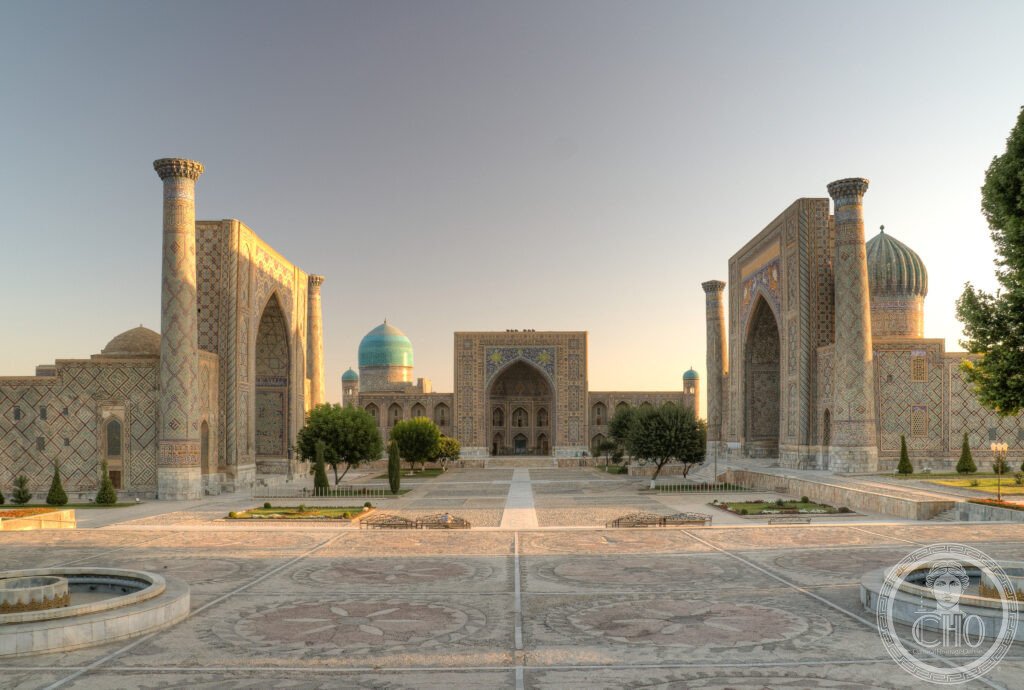
The most visually magnificent city on the Silk Road and the capital of Timur’s 14th-century empire. Samarkand presents in a single city the entire visual vocabulary of Timurid Islamic architecture at its peak: the Registan (the finest public square in the Islamic world), the Gur-e-Amir mausoleum where Timur himself lies under a jade slab, the Shah-i-Zinda funerary avenue with the most refined tile-work in Central Asia, and the observatory from which Ulugh Beg produced the most accurate star catalogue of the pre-telescopic era.
At a glance
Samarkand. Crossroads of Cultures (UNESCO WHS 2001; the inscribed zone covers the historic monuments of Samarkand; population of the city of Samarkand approximately 550,000 (the second-largest city in Uzbekistan)) is located in the Zeravshan River valley of central Uzbekistan at approximately 720 m altitude. It is one of the oldest continuously inhabited cities in the world, the site of the ancient Sogdian city of Maracanda, mentioned in the accounts of Alexander the Great’s Central Asian campaign of 329 BCE: Alexander captured Maracanda, Samarkand, in 329 BCE and wintered there, and the city was the easternmost point of the Macedonian empire. Later it became the most important junction of the central Silk Road, the route that joined China, India, Persia and the Mediterranean, and its wealth came both from the transit trade and from what it made itself — silk, ceramics, metalwork and above all paper. Samarkand paper was the finest in the medieval Islamic world, and the technique arrived from China in 751 CE at the Battle of Talas, when Arab forces captured Chinese soldiers who knew how to make it: that battle is considered the moment papermaking passed from China to the Islamic world. The zenith came under the Timurids. Timur, Tamerlane, 1336–1405, conquered from Persia to Delhi and from the Volga to the Mediterranean, and made Samarkand the capital and showpiece of his empire; the art, science and architecture of his reign and of his successors, Ulugh Beg his grandson above all, make up the Timurid Renaissance, one of the most creative periods in Islamic civilisation.
Key facts
- The Registan: the most spectacular public square in the Islamic world. The Registan — Persian for the “Sandy Place” — is the main public square of Samarkand and was the commercial and administrative heart of the city under both the Timurid and the Shaybanid dynasties. Three madrasas close it. The Ulugh Beg Madrasa of 1420 is the earliest, built by Timur’s grandson Ulugh Beg, who was at once governor of Samarkand and the greatest astronomer of the 15th century. Its entrance portal carries the most refined Timurid geometric tilework, with star-polygon patterns in the spandrels and, around the arch, a Quranic inscription from Surah Al-Tawbah: “The mosques of Allah are maintained by those who believe in Allah and the Last Day and establish prayer”. The courtyard inside measures 50 × 50 m, with four iwans — vaulted halls opening onto it — and 50 student cells around the sides. The Sher-Dor Madrasa of 1636, commissioned by the Shaybanid governor Yalangush Bahadur, is the “Having Lions” madrasa, and its entrance mosaic is the most controversial thing on the square: in the tympana above the arch, lions — or tigers, Uzbek art historians debate which — chase a deer, or a gazelle, beneath a rising sun with a human face. The face on the sun is a Zoroastrian motif, and the Islamic prohibition on depicting animals and humans makes these panels theologically unusual on a madrasa. The Tilya-Kori Madrasa of 1660 is the “Gilded” one, with the most opulent interior: the dome of its main mosque is covered in gold leaf, applied over the entire surface of a complex honeycomb muqarnas ceiling, the most extreme gilded interior in Central Asian Islamic architecture, and the effect is of a sun indoors.
- The Gur-e-Amir: Timur’s mausoleum and the most important dynastic tomb in Central Asia. The Gur-e-Amir — Persian: Гури Мир, “Tomb of the Ruler” — was built in 1404 for Timur’s grandson Muhammad Sultan, who had died in 1403; Timur himself was buried here in 1405, after dying on campaign. Its blue-ribbed drum dome became the prototype of every Timurid domed mausoleum and, through them, of the Mughal ones, the Taj Mahal included: the Mughal emperors were direct descendants of Timur and built in the same tradition, so the resemblance — the high drum carrying the onion dome, the ribbing, the octagonal base — is ancestry and not coincidence. Timur’s real sarcophagus, in the underground crypt, is a plain marble slab; the spectacular dark green jade one in the hall above is a symbolic cenotaph, a marker set over the grave to show visitors and pilgrims where it lies. That jade block is approximately 1.88 m long and 0.5 m wide, the largest single piece in the world when it was carved in 1404, brought from East Turkestan, today’s Xinjiang in China. The Sovetnikov’s curse says that opening Timur’s tomb would release a catastrophe: the Soviet archaeologist Mikhail Gerasimov opened it on 22 June 1941, the day Germany invaded the Soviet Union.
- Shah-i-Zinda: the most spiritually powerful funerary street in Central Asia. Shah-i-Zinda (Шоҳи Зинда) means “The Living King”, after the tomb of Kusam ibn Abbas, a cousin of the Prophet Muhammad who brought Islam to Samarkand in the 7th century and is believed to have been martyred here without dying: the living king who went down alive into a well to escape his enemies. The avenue is a processional street approximately 200 m long, lined on both sides with the mausoleums of the Timurid royal family and high officials, 11 of them surviving from the medieval period, mostly 14th–15th century. The tile-work is the finest in Central Asia, in a palette of deep cobalt blue, turquoise, white and black more refined even than the Registan’s, and some panels are mosaic faience, individual tiles hand-cut and assembled into complex patterns. The best interior of the whole avenue is the Tomb of Shadi Mulk Agha, Timur’s niece, about 1372. The approach climbs a flight of 36 steps, and tradition holds that counting them going up and coming down is a test of spiritual readiness: if the two counts agree, the pilgrimage has been accepted.
- Heritage: UNESCO World Heritage Site, Samarkand. Crossroads of Cultures, inscribed 2001.
- GPS: 39.6547° N, 66.9750° E.
History
Sogdian Maracanda (the Silk Road trading city visited by Alexander the Great in 329 BCE). Persian Achaemenid, Greek Seleucid, and Parthian periods. The Arab conquest (712 CE; the Umayyad general Qutayba ibn Muslim captured the city; the conversion to Islam; the papermaking transfer from China (751 CE; the Battle of Talas)). The Samanid and Qarakhanid periods (9th–12th century; Samarkand as a major intellectual centre of the Islamic world). The Mongol destruction (1220; Genghis Khan destroyed the city completely; only the mosques were spared; the city was rebuilt over the following decades). The Timurid period (1370–1500; the zenith; the Registan, Gur-e-Amir, Bibi-Khanym, Shah-i-Zinda, and Ulugh Beg Observatory all built in this period; the Timurid Renaissance). The Shaybanid period (16th–17th century; the Uzbek dynasty; the construction of the Sher-Dor and Tilya-Kori madrasas). The Russian conquest (1868; the Russian Empire incorporated Samarkand into the Governorate-General of Turkestan). Soviet period (1920–1991; the brief capital of the Uzbek SSR (1924–1930) before the capital moved to Tashkent). Uzbek independence 1991. UNESCO WHS 2001. Samarkand was designated the Cultural Capital of the Islamic World in 2007.
What you see
The Registan is the heart of any visit: allow 2–3h. In the evening the sound-and-light show projects images onto the three madrasa facades, one of the finest architectural illuminations in Central Asia, and each courtyard repays going in — the Ulugh Beg is the most refined, the Tilya-Kori interior the most opulent. The Gur-e-Amir is a 20 min walk away and needs 45–60 min, with the underground crypt open and a guide to the difference between the symbolic cenotaph and the grave below it. Shah-i-Zinda lies 15 min from the Registan and deserves 1–2h: the tiles are the point, and the count of the steps; it is the quietest and most spiritual site in Samarkand, best early in the morning before the crowds. The Bibi-Khanym Mosque was the largest in the Islamic world when it was built and is now partly restored, extraordinary in scale even in ruin, with a main entrance portal arch of 35 m — the largest built anywhere in the Islamic world to that date. North of the city, on the hill, stands the Ulugh Beg Observatory, with the Fakhri sextant: a large stone quadrant set in a deep trench cut into the hillside, used to measure the altitude of celestial objects with extraordinary precision, and a museum above it.
Practical information
- Getting there: Samarkand International Airport (SKD; 12 km from the city centre; Uzbekistan Airways, Air Arabia, and flydubai serve Samarkand from Dubai, Abu Dhabi, Moscow, Istanbul, and other hubs; direct connections from some European cities via Istanbul (Turkish Airlines + partner); the Tashkent–Samarkand high-speed train (the Afrosiyob train (named after the ancient Sogdian city adjacent to Samarkand); approximately 2h 10 min from Tashkent to Samarkand; the fastest and most comfortable intercity train in Central Asia; approximately 20 USD in second class; 6–8 trains daily; the most pleasant way to travel between the two cities; Tashkent has more international connections and is the main entry point for Uzbekistan)). Uzbekistan e-visa (most nationalities obtain visa online before arrival; the e-visa system is modern and well-functioning; approximately USD 20–30; processed within 3–7 days).
- Bukhara. The most intact historic city in Uzbekistan: 270 km west of Samarkand (3h by train; the Afrosiyob; 3 daily connections). Bukhara, UNESCO WHS 1993, is the most complete surviving Islamic city in Central Asia: if Samarkand is the most spectacular, Bukhara is the most authentic. The old city holds the Lyabi Hauz complex and the 16th-century trading domes, Toqi Sarrofon and Toqi Telpak Furushon. The Ark Citadel, the fortress of the Emirs, was in use from the 5th century to 1920 and is the most important political building in the history of Central Asia. The Kalon Minaret of the 12th century is the second tallest in Central Asia at 47 m, and in the 18th–19th century it served as a place of execution, criminals being thrown from the top. It is the only major building in Bukhara that Genghis Khan did not destroy in 1220: he saw it, paused and ordered it spared, and later sources say he bowed in awe of the tower, which was read as a sign that it should be saved. With the Kalon Mosque and the Mir-i-Arab Madrasa it forms the Po-i-Kalyon, the most important architectural ensemble in the city.
- Khiva and the Khwarezm oasis: 650 km north-west of Samarkand (8h by overnight train; or fly Samarkand→Urgench). Khiva (Itchan Kala) is UNESCO WHS 1990 and the only completely intact walled Islamic city in Central Asia. The Ichan Kala, the inner walled city, is entirely car-free and the most atmospherically preserved Islamic city in Uzbekistan: it has the feeling of a medieval city more completely than anywhere else in the country. The Kalta Minor Minaret — the fat blue minaret — was begun in 1851 and never completed. It was supposed to be the tallest minaret in the Islamic world (c.70 m), but the khan who commissioned it died in 1855 before completion. The current height is 29 m and the base diameter is 14.2 m, making it one of the widest minarets in the world relative to its height; the blue and turquoise majolica tile surface is the most photographed element of Khiva.
Getting there
Samarkand Airport (12 km) or high-speed train from Tashkent (2h10min). e-visa required (USD 20–30 online). GPS: 39.6547, 66.9750.
Nearby
- Afrasiyab and the ancient Sogdian city. Adjacent to the modern Samarkand (walk from the Registan; 20 min). The archaeological site of Maracanda and the museum of the Sogdian ambassadorial paintings. Afrasiyab (the site of ancient Maracanda; the city that Alexander the Great captured in 329 BCE; the city destroyed by Genghis Khan in 1220; now a broad plateau of eroded archaeological mounds; the Afrasiyab Museum (the most important find: the Sogdian ambassadorial paintings (6th–7th century CE frescoes discovered in 1965 in a buried audience hall; the paintings depict an ambassadorial reception in the court of a Sogdian king; the ambassador figures in the painting can be identified by their costumes as coming from India, Korea, China, and the Byzantine Empire — the most remarkable visual document of Silk Road diplomacy surviving from antiquity))).
- Shakrisabz (Shakhrisabz). 85 km south of Samarkand (1h 30 min by road through the Takhtakaraca Pass; a spectacular mountain drive). The birthplace of Timur and the finest Timurid palace ruins in Central Asia. Shakrisabz (UNESCO WHS 2000; the birthplace (c.1336) of Timur; the Ak-Saray Palace (“White Palace”; built by Timur as his summer palace 1380–1404; the most ambitious building project of the Timurid period; at its completion, the entrance portal was 65 m high — the largest portal in the history of Islamic architecture; only the two flanking towers and the lower portions of the portal walls survive; the tiles (the complex geometric patterns in cobalt blue and turquoise on the surviving sections; a fraction of what was once here))).
- Tashkent. 350 km north-east of Samarkand (2h 10 min by high-speed train; the Afrosiyob). The capital of Uzbekistan and the largest city in Central Asia. Tashkent has a population of approximately 3 million and is the main entry point for Uzbekistan. Its Soviet-era showpiece architecture includes the Metro stations, which are among the most elaborately decorated Soviet-era metro stations in the former USSR, with chandeliers, mosaics, marble, and painted ceilings. The Khast Imam is the religious heart of Tashkent: the Teleshayakh Mosque is the largest mosque in Central Asia (capacity 7,000), and the Khast Imam Library holds the Uthman Quran, one of the oldest surviving Quran manuscripts in the world, dated approximately 650 CE. The Quran is attributed to the Caliph Uthman, the third Caliph of Islam; it was brought to Samarkand by Timur as booty from his campaigns, looted by the Russians in 1869 and returned to Tashkent in 1924. It is the oldest surviving Islamic manuscript in Central Asia.
Sources
- Wikipedia, Samarkand. Registan. Gur-e-Amir. Shah-i-Zinda. Ulugh Beg, accessed June 2026.
- UNESCO, Samarkand. Crossroads of Cultures, WHS reference 603rev, inscribed 2001.
- Christopher Marlowe, Tamburlaine the Great, 1587 (the primary European literary treatment of Timur’s character and ambitions).
Find it on the map
See this place and what’s around it →📷 Become a Cultural Heritage Online photographer
Share your photos of places: they stay published under your name as the author. The more they're seen, the more you get noticed — and soon a contest will reward the most appreciated photos.
Log in or sign up free to add a photo