

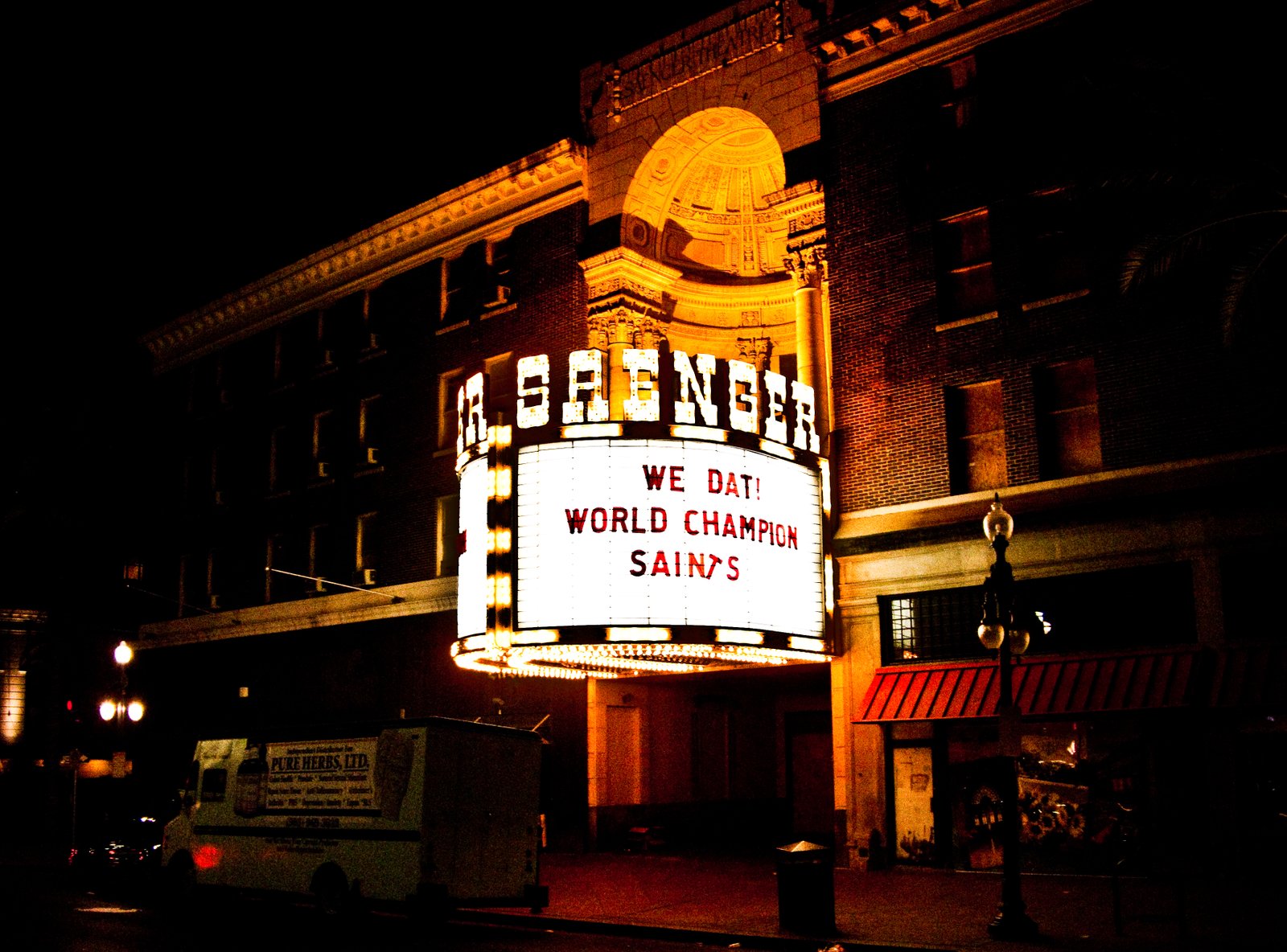

Opened in February 1927 on Canal Street, the Saenger Theatre is among the most opulent surviving picture palaces in the American South — an atmospheric interior designed as an Italian courtyard under a starlit dome, with Art Deco detailing throughout that survived Katrina to reopen in 2013.
At a glance
Designed by New Orleans architect Emile Weil and opened on 4 February 1927 at 1111 Canal Street, the Saenger Theatre was built for the Saenger Theatres circuit, founded by brothers Julian and Abe Saenger. Weil’s design drew on Spanish Mission and Moorish Revival sources for the exterior and elaborated them inside into a full-scale atmospheric theatre — a design genre popularised by John Eberson in the 1920s, in which the auditorium simulated an open-air Italian courtyard under a domed sky, with moving cloud projections and twinkling electric stars overhead. Weil modelled the interior on an Italian Baroque courtyard — warm plaster walls, projecting balconettes, and the starred dome overhead. The theatre is one of the most complete surviving examples of this style in the South. After flood damage from Hurricane Katrina in 2005 forced a temporary closure, a 53-million-dollar restoration reopened the theatre in 2013 with original decorative elements conserved.
Key facts
- Opened: 4 February 1927
- Architect: Emile Weil
- Style: Moorish/Spanish Revival exterior; Atmospheric theatre interior
- Address: 1111 Canal Street, New Orleans, LA 70112
- Capacity: approx. 2,700 seats (post-2013 restoration)
- Named for: Julian and Abe Saenger, founders of the Saenger Theatres chain
- Signature feature: Atmospheric domed ceiling with electric stars and cloud projections
History
Emile Weil (1878–1945) was among the most prolific theatre architects in Louisiana, responsible for several downtown New Orleans cinemas and entertainment venues in the 1920s and 1930s. For the Saenger he applied the atmospheric theatre concept developed by John Eberson: rather than a conventional proscenium box, the auditorium would simulate a Mediterranean courtyard open to the night sky, its dome projecting moving cloud effects and lit by hundreds of electric stars. The effect — warm stone walls, projecting balconies dressed with artificial plants, Moorish arches — was designed to transport audiences out of the city and into an outdoor Italian garden.
The Saenger was among the grandest picture palaces in the Gulf South at its opening, seating thousands in an interior that cost far more per seat than a functional cinema required. Its success reflected the early Hollywood era’s belief that the theatrical environment was as important as the film itself — the building sold the experience of going out as much as the programme on screen.
After Hurricane Katrina flooded the ground floor and lower levels in August 2005, the Saenger closed for nearly a decade. A major restoration, completed in 2013, conserved the original plaster ornament, restored the domed ceiling mechanism, and updated the theatre’s technical systems to modern standards. The reopening in October 2013 — the first large-scale entertainment venue to reopen in the Canal Street corridor after the storm — was widely regarded as a signal moment in New Orleans’ cultural recovery.
What you see
On Canal Street the Saenger presents a buff-brick facade with Moorish-arched windows and a projecting marquee that has been a Canal Street landmark since 1927. The ornamental vocabulary — horseshoe arches, geometric tile panels, decorative cornices — references Spanish Mission and Moorish sources while incorporating the flat, stylised ornament that was entering the mainstream as Art Deco in the mid-1920s. The facade’s verticality, the precision of its geometric panels, and the neon marquee’s graphic boldness all draw it toward the Deco register rather than strict historicist revival.
Inside, the auditorium’s atmospheric effect is the building’s architectural core. The ceiling dome has been painted and lit to simulate a night sky; the side walls are dressed as a Mediterranean courtyard with projecting balconettes, artificial climbing plants, and niched figures. The combination of warm plaster surfaces, dim lighting, and the slow drift of projected clouds overhead creates an environment whose theatrical ambition has few parallels in surviving American cinema architecture. The restoration of 2013 brought this effect back to its original vividness.
Practical information
- Access: Open for performances and occasional public tours; check schedule at saengernola.com
- Best time: Evening performance for the full atmospheric interior effect
- Time needed: 30 minutes exterior and lobby; 2+ hours for a performance
- GPS: 29.9558° N, 90.0728° W
- Nearest transit: Streetcar Canal Street line; bus network on Canal Street
Getting there
The Saenger Theatre stands at 1111 Canal Street, at the intersection with Rampart Street — the upper Canal Street boundary of the French Quarter. The Canal Street streetcar line stops at Rampart. Louis Armstrong New Orleans International Airport connects to the city centre by taxi or shuttle in 30–45 minutes; the Union Passenger Terminal on Loyola Avenue is a 10-minute walk from the theatre.
Nearby
- Joy Theater (1947) — restored mid-century theatre at 1200 Canal Street, adjacent to the Saenger
- New Orleans Union Passenger Terminal (1954) — Streamline Moderne Amtrak terminal on Loyola Avenue, 10 minutes’ walk
- French Quarter — Jackson Square, St. Louis Cathedral, and the French Market begin one block south
Sources
- Stanonis, Anthony J. Creating the Big Easy: New Orleans and the Emergence of Modern Tourism, 1918–1945. University of Georgia Press, 2006
- Wunsch, James L. “The Fabulous Palace: The Saenger Theatre.” Louisiana Cultural Vistas, Spring 2014
- Historic New Orleans Collection, architectural records — hnoc.org
- Preservation Resource Center of New Orleans — prcno.org
- Wikidata, Saenger Theatre entry Q7398302 — wikidata.org
Find it on the map
See this place and what’s around it →📷 Become a Cultural Heritage Online photographer
Share your photos of places: they stay published under your name as the author. The more they're seen, the more you get noticed — and soon a contest will reward the most appreciated photos.
Log in or sign up free to add a photoIs this page about you?
This page is read by travellers and heritage enthusiasts who find it on Google. Tell us how you are connected to this place and we will take it from there.