
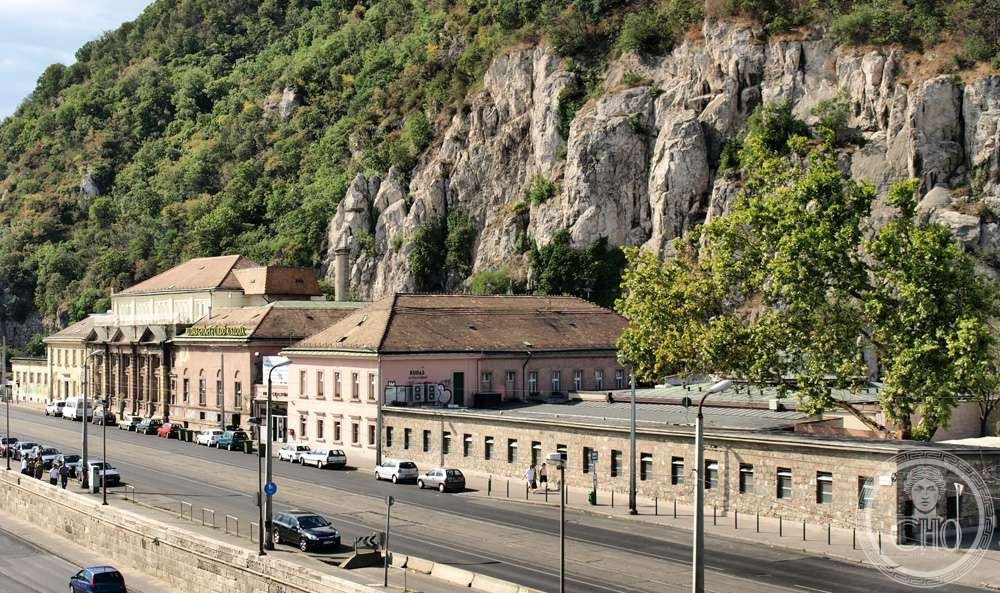
A working Ottoman bath from the 1570s at the foot of Gellért Hill — its octagonal pool still lit by shafts of coloured light falling through a 450-year-old dome.
At a glance
The Rudas Baths sit on the Buda bank of the Danube, below Gellért Hill. Built during the Ottoman occupation of Hungary, they are among the best-preserved Turkish baths in Budapest — a genuine sixteenth-century hammam still fed by the thermal springs that made the city a spa capital.
History
The baths were built in 1571–1572, during Ottoman rule, on the orders of Sokollu Mustafa Pasha, governor (beylerbey) of Buda from 1566 to 1578. As a nephew of the grand vizier Sokollu Mehmed Pasha, he built to an imperial standard, and the Rudas echoes the monumental Ottoman baths of Istanbul.
The heart of the complex has survived every later addition. Its central hall is an octagonal thermal pool about ten metres across, covered by a dome of the same span carried on eight stone pillars — the classic geometry of the Ottoman hammam. The waters, rich in sulphate, calcium, magnesium and fluoride, were valued then as now for treating joint and circulatory complaints.
What you see
Under the dome, small circular openings pierce the masonry, dropping discs of coloured daylight onto the steam and the octagonal pool below. Eight stone columns ring the water, holding the whole weight of the cupola.
Around this Ottoman core, later Turkish and modern wings add steam rooms, a drinking-hall of medicinal springs and a rooftop pool over the river.
Cultural significance
The Rudas is a rare survival: a monument of the Ottoman century in Central Europe that never became a ruin, because it never stopped being used. To bathe under its dome is to use a building for exactly the purpose it was raised for in the 1570s — a continuity almost nothing else in Budapest can claim.
Key facts
- Built: 1571–1572, under Sokollu Mustafa Pasha, Ottoman governor of Buda
- Type: Ottoman hammam — octagonal pool (~10 m) under a domed roof on eight pillars
- Location: Buda bank of the Danube, below Gellért Hill
- Waters: thermal springs rich in sulphate, calcium, magnesium and fluoride
- Status: one of the best-preserved Turkish baths in Budapest, still in use
Practical information & getting there
The baths are on Döbrentei tér, at the Buda end of the Elisabeth Bridge. Trams 19 and 41 stop nearby. Some sessions are single-sex and some mixed — check the day’s schedule before visiting, and bring or hire a towel and sandals.
Sources & resources
- Budapest Baths — Rudas Baths: budapest-baths.com/rudas-baths/about
- Baths Budapest — Rudas Bath: bathsbudapest.com/rudas-bath
- Spotting History — Rudas Baths, Budapest
- Rudas Baths — Ottoman Turkish Bath Guide (machupicchu.org)
Find it on the map
See this place and what’s around it →📷 Become a Cultural Heritage Online photographer
Share your photos of places: they stay published under your name as the author. The more they're seen, the more you get noticed — and soon a contest will reward the most appreciated photos.
Log in or sign up free to add a photoIs this page about you?
This page is read by travellers and heritage enthusiasts who find it on Google. Tell us how you are connected to this place and we will take it from there.