

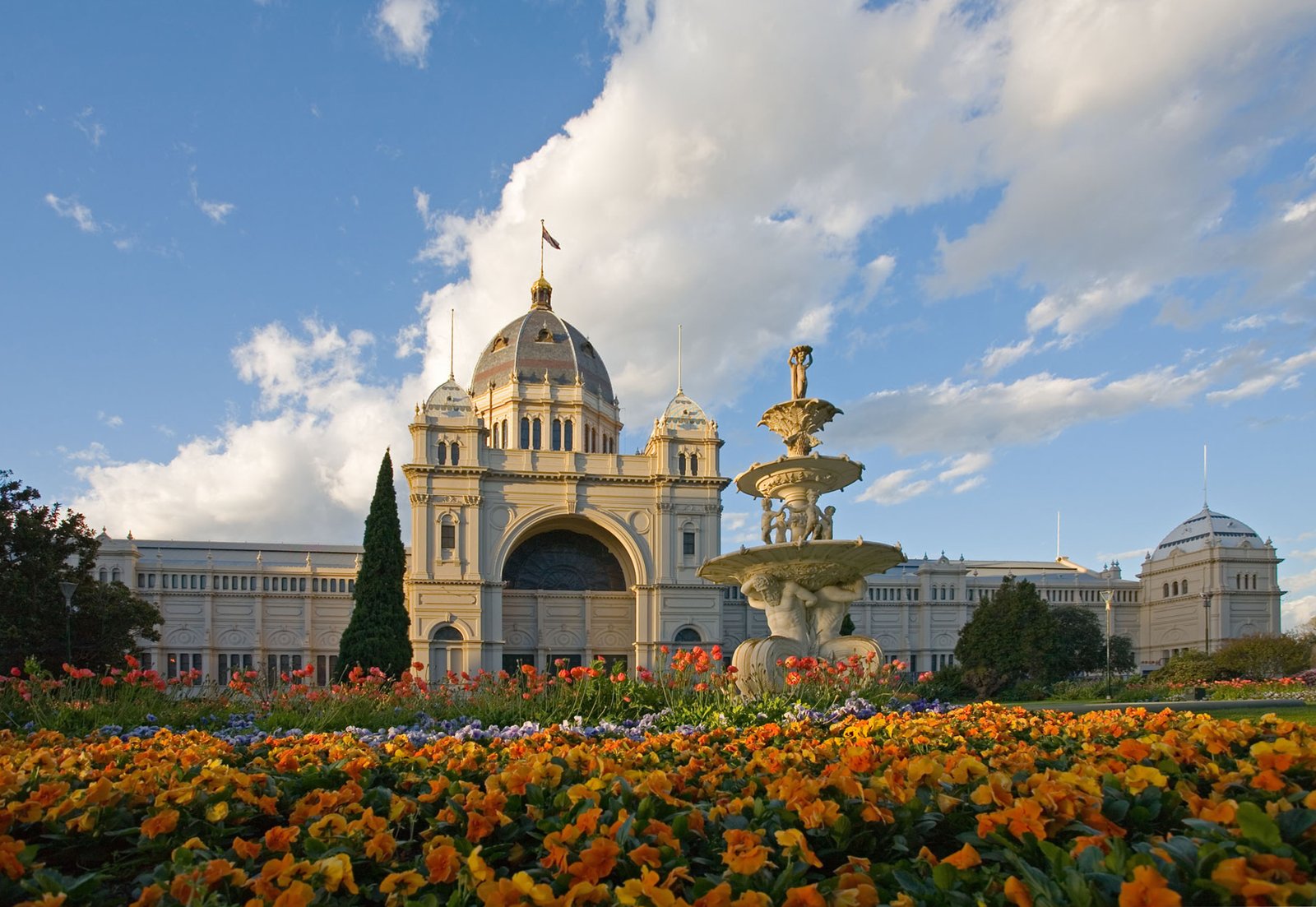
Melbourne’s magnificent High Victorian exhibition palace — the only surviving World Exhibition building still standing in its original location on Earth — where the Commonwealth of Australia was born on 9 May 1901 and where 145 years of continuous use prove that great architecture endures.
At a glance
The Royal Exhibition Building in Carlton Gardens, Melbourne, is a masterpiece of High Victorian architecture designed by Joseph Reed and completed in 1880 for the Melbourne International Exhibition. Its defining feature is a grand central dome (50 m high) inspired by Brunelleschi’s Florence Cathedral dome, flanked by Italianate arcades, transepts, and flanking wings in a cruciform plan. When completed, it was the largest structure in Australia.
The building was inscribed as a UNESCO World Heritage Site in 2004 — the first property in Victoria to receive the designation — in recognition of its global significance as the sole surviving example of the great Victorian-era World Exhibition halls, most of which (including London’s Crystal Palace and Paris’s Palais de l’Industrie) were demolished. The surrounding Carlton Gardens are intact Victorian formal public gardens with fountains, a lake, tree-lined promenades, and heritage plantings.
Key facts
- Built: 1879–1880 (main hall); expanded 1888 for Centennial Exhibition
- Architect: Joseph Reed (Melbourne, 1823–1890)
- Style: High Victorian — Italianate dome + Byzantine/Romanesque arcades
- Dome height: 50 metres; inspired by Brunelleschi’s Florence Cathedral
- UNESCO inscription: 2004 (criteria ii, iv)
- Historic event: First Australian Commonwealth Parliament, 9 May 1901
- Still in use: exhibitions, fairs, Melbourne International Flower & Garden Show
- Material: Brick, iron, steel, and timber
History
In the second half of the 19th century, international exhibitions were the internet of the Victorian age — vast showcases of industrial progress, scientific achievement, and national prestige. Melbourne, then one of the wealthiest cities on Earth thanks to the 1850s gold rush, commissioned architect Joseph Reed to build a permanent exhibition palace for the 1880 Melbourne International Exhibition. Reed created a building of extraordinary ambition: a cruciform plan with a soaring dome modelled on Brunelleschi’s Florence Cathedral, Italianate arcades, and classical flanking wings.
The 1888 Centennial International Exhibition — celebrating 100 years of European settlement in Australia — attracted 2 million visitors and required expansion of the building. By then Melbourne’s exhibition complex was among the grandest in the world.
The building’s most historic moment came on 9 May 1901, when the Duke of Cornwall and York (later King George V) opened the first sitting of the Federal Parliament of the new Commonwealth of Australia in the main hall. This single event makes the Royal Exhibition Building arguably the most constitutionally significant building in Australian history — the literal birthplace of the Australian federation.
Paradoxically, while the building survived intact, nearly every comparable World Exhibition hall in the world was demolished: London’s Crystal Palace burned in 1936, Paris’s Palais de l’Industrie was razed in 1900, Vienna’s Rotunda in 1937. Melbourne’s building endured through luck, civic pride, and continuous repurposing, and today stands as the last of its kind.
What you see
The building’s exterior presents a compelling Italianate composition: a central dome with a lantern at the apex, flanked by two lower transept domes and four corner turrets, all clad in terracotta tiles. The main facade features an arcaded loggia with round arches, polychrome brickwork in red and cream, and ornamental ironwork. The great hall interior is equally impressive — soaring iron-and-timber barrel vaults, clerestory windows flooding the space with light, and ornate painted decorations restored to their 1880 appearance.
The Carlton Gardens surround the building on all sides with Victorian-era formal landscaping: a ceremonial fountain to the north, an ornamental lake, radiating tree-lined avenues of elms and planes, and symmetrical garden beds. The museum building to the south (Museum Victoria / Melbourne Museum, opened 2000) was carefully sited to preserve sightlines to the historic structure.
Practical information
- Address: 9 Nicholson Street, Carlton, Melbourne VIC 3053, Australia
- Hours: Carlton Gardens open daily; building access via guided tours or events only
- Guided tours: Available through Museums Victoria; check museum.vic.gov.au for schedule
- Admission: Gardens free; building interior via tour (fee applies)
- Best time to visit: Melbourne International Flower & Garden Show (March) for access to full interior
Getting there
The Royal Exhibition Building is centrally located in Carlton, immediately north of Melbourne CBD. Tram lines 86 and 96 stop at Nicholson Street; the building is a 15-minute walk from Melbourne Central Station. Paid parking is available in Carlton Gardens on weekends.
Nearby
- Melbourne Museum — adjacent, world-class natural and cultural history (same precinct)
- IMAX Melbourne — on-site within the museum building
- Lygon Street — Melbourne’s historic Little Italy, 5-minute walk west
- Old Melbourne Gaol — historic convict prison, 10-minute walk south
- Queen Victoria Market — historic open-air market, 15-minute walk southwest
Sources
- UNESCO World Heritage List: Royal Exhibition Building and Carlton Gardens, inscribed 2004
- Museums Victoria: Royal Exhibition Building
- Wikipedia: Royal Exhibition Building
- Heritage Council Victoria: Statement of Significance, 2003
Find it on the map
See this place and what’s around it →📷 Become a Cultural Heritage Online photographer
Share your photos of places: they stay published under your name as the author. The more they're seen, the more you get noticed — and soon a contest will reward the most appreciated photos.
Log in or sign up free to add a photoIs this page about you?
This page is read by travellers and heritage enthusiasts who find it on Google. Tell us how you are connected to this place and we will take it from there.