
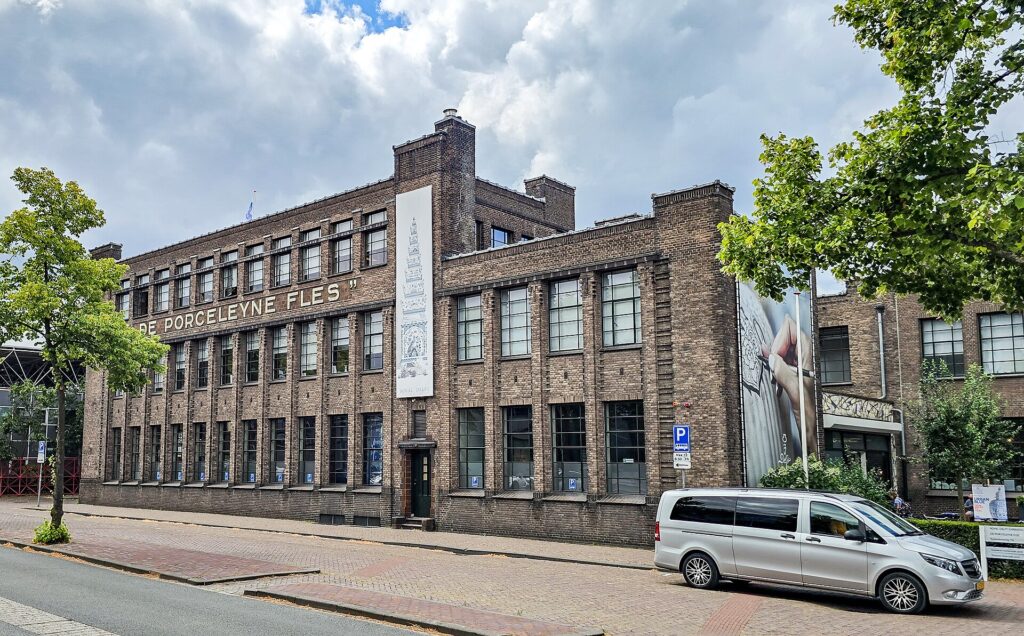
The only surviving Delftware factory from the seventeenth century, De Porceleyne Fles has produced its signature blue-and-white pottery without interruption since 1653. Visitors watch master painters at work in the same rooms where Dutch craftsmen once answered demand from the VOC trade era.
At a glance
De Porceleyne Fles — The Royal Delft — stands as the last active pottery from the golden age of Delftware. Founded in 1653 on the Rotterdamsche Dijk in Delft, the factory survived the collapse of the Delftware industry in the nineteenth century through a combination of craft revival and savvy branding. Today it operates as both a working manufactory and a public museum, offering visitors a continuous thread from seventeenth-century tin-glazed earthenware to contemporary hand-painted collectibles. The royal prefix dates from formal recognition by the House of Orange, a warrant the factory still holds and displays with pride throughout its showrooms.
History
Delftware emerged in the early seventeenth century when Dutch potters began imitating the blue-and-white porcelain arriving from China via the Dutch East India Company (VOC). Unable to replicate true hard-paste porcelain, they developed a tin-glazed earthenware that captured the aesthetic at a fraction of the cost. By 1700, Delft had over thirty active potteries; De Porceleyne Fles was one of the most prominent. The industry collapsed in the late 1700s as cheaper Chinese and European porcelain flooded the market. Most factories closed. De Porceleyne Fles survived through the nineteenth century largely because of its 1876 revival under Joost Thooft, who recruited skilled painters and reintroduced meticulous hand-decoration — a move that repositioned Delftware as artistic craft rather than utilitarian pottery. The factory received a royal warrant from the Dutch royal family and has maintained it ever since.
What you see
The museum building is set across the original factory premises, preserving kilns and workshop spaces alongside display galleries. The historic production hall is the centrepiece: visitors observe painters applying cobalt-oxide pigment freehand directly onto unfired clay — a skill that takes years to master and produces the characteristic rich blue after firing. The ground floor holds a chronological exhibition of Delftware from the seventeenth century onward, including rare pieces from the VOC period and examples of the distinctive polychrome palette introduced in the late 1600s. Upstairs, a gallery of royal-warrant pieces and special-edition commissions charts the factory’s relationship with Dutch monarchs across four centuries.
Cultural significance
Delft Blue is one of the most recognised design identities in European decorative arts. The distinctive cobalt palette on white tin glaze shaped Dutch visual culture for three centuries and remains an active symbol of Dutch national identity — present on KLM’s miniature house bottles, royal gifts, and diplomatic presentations worldwide. De Porceleyne Fles is not merely a museum: it is the living carrier of that tradition. The factory’s continued hand-production means that objects made here today are direct descendants — technically and aesthetically — of pieces made in the 1680s. For heritage tourism, this continuity of craft is increasingly rare and increasingly valued. In 2012 Delftware was inscribed on the Dutch national inventory of intangible cultural heritage.
Key facts
- Founded 1653; the only surviving original Delftware factory
- Royal warrant from the Dutch House of Orange
- All pieces painted by hand using traditional cobalt-oxide technique
- Holdings include rare 17th-century VOC-era Delftware
- Delftware inscribed on Dutch intangible cultural heritage register (2012)
- Working manufactory open to visitors: painters observed in real time
- Location: Rotterdamsche Dijk 196, Delft
Practical information
The museum is open Tuesday through Sunday, 10:00–17:00, with extended hours during Dutch school holidays. Admission covers both the museum galleries and access to the working studio where you can observe the painting process. The factory shop sells pieces at all price points, from small hand-painted tiles to large commissioned platters. Guided tours in English run twice daily and include a demonstration by a senior painter. Photography is permitted throughout, including in the working studio. The site is fully accessible by wheelchair, with a lift between floors.
Getting there
Royal Delft is a 15-minute walk from Delft Central Station, or a short cycle along the Schie canal. By tram from The Hague, take line 1 toward Delft and alight at TU Delft, then walk south along the Rotterdamsche Dijk (10 minutes). By car, the factory sits just outside central Delft on the road toward Rotterdam; paid parking is available on-street. Delft itself is 15 minutes by intercity train from Rotterdam Centraal and 10 minutes from The Hague.
Sources & resources
- Royal Delft official site: royaldelft.com
- Rijksmuseum Amsterdam: collection records for VOC-era Delftware
- Dutch Intangible Cultural Heritage register (2012 entry for Delftware)
- Montias, J.M., Artists and Artisans in Delft (Princeton University Press, 1982)
Find it on the map
See this place and what’s around it →📷 Become a Cultural Heritage Online photographer
Share your photos of places: they stay published under your name as the author. The more they're seen, the more you get noticed — and soon a contest will reward the most appreciated photos.
Log in or sign up free to add a photoIs this page about you?
This page is read by travellers and heritage enthusiasts who find it on Google. Tell us how you are connected to this place and we will take it from there.