

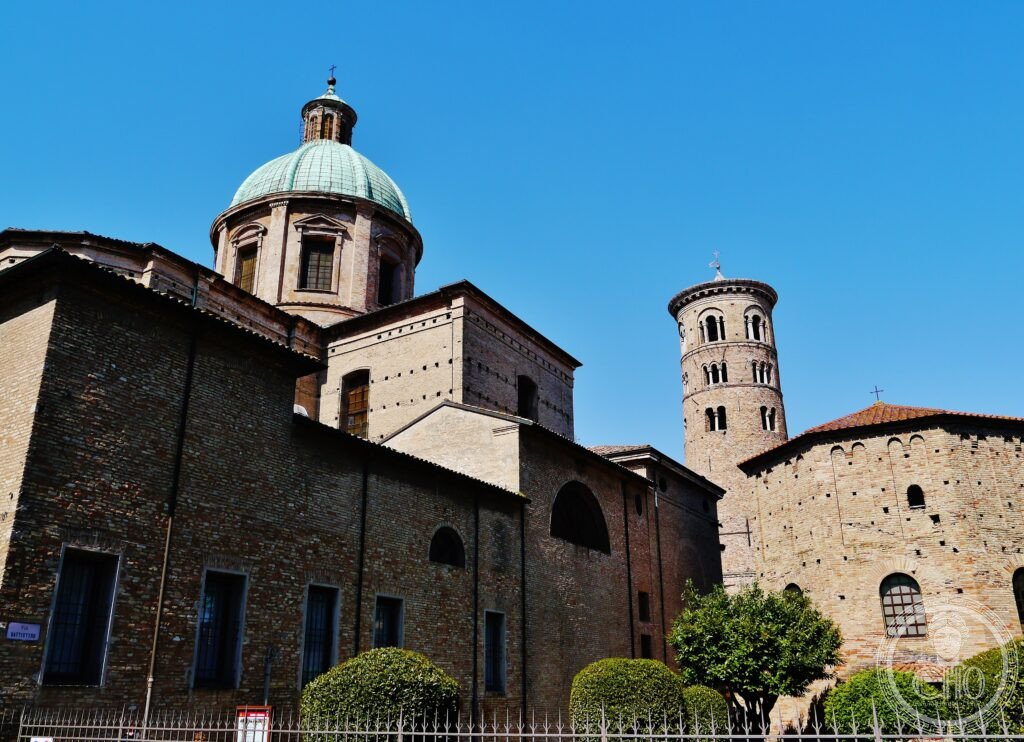
Ravenna holds the largest surviving group of Early Christian mosaics anywhere, spread across eight monuments raised between the fifth and sixth centuries. Their gold and lapis surfaces, still largely intact, record an empire in transition from Rome to Byzantium and include the only complete portrait of an imperial court to survive from that age.
At a glance
Ravenna’s Early Christian and Byzantine monuments were inscribed on the UNESCO World Heritage List in 1996 under reference 788. The listing covers eight buildings raised across roughly a century and a half, from the Mausoleo di Galla Placidia to the Basilica di Sant’Apollinare in Classe, all decorated with mosaic work of exceptional quality and completeness.
The city also holds the tomb of Dante Alighieri, who died in Ravenna in 1321 and has remained buried there ever since, a separate but closely associated point of interest for visitors following the mosaic circuit.
Key facts
- Mausoleo di Galla Placidia: built around 430 CE for Galla Placidia, daughter of the emperor Theodosius I; the oldest and best preserved of the eight monuments.
- Battistero Neoniano: an octagonal baptistery of around 450 CE, raised over an earlier Roman bath, with a dome mosaic showing the Baptism of Christ.
- Basilica di Sant’Apollinare Nuovo: built in 504 CE by Theoderic the Great as an Arian church, converted to Orthodox Catholic use in 561 CE.
- Basilica di San Vitale: consecrated in 547 CE, an octagonal palatine chapel holding the apse mosaics of Justinian I and the Empress Theodora.
- Mausoleo di Teodorico: built in 520 CE, the only above-ground pre-Romanesque mausoleum in Italy, capped by a single monolithic stone dome.
- Basilica di Sant’Apollinare in Classe: consecrated in 549 CE, standing on the site of Ravenna’s former Roman naval base.
History
Ravenna’s central period runs from 402 to 751 CE. The emperor Honorius transferred the Western Roman court there from Milan in 402, after the Visigoths under Alaric had crossed the Alps and besieged Milan the previous year. Ravenna offered better protection: the surrounding marshes of the Po delta could be flooded to block a land approach, while the nearby naval base at Porto di Classis kept open sea communication with Constantinople. The city went on to serve as the Ostrogoth capital from 493 to 526, and then as the seat of the Byzantine Exarchate of Ravenna until 751.
Dante Alighieri spent the final years of his life in Ravenna as a guest of Guido Novello da Polenta, completing the Paradiso there before his death in September 1321, reportedly from malaria contracted on a diplomatic mission to Venice. He was buried in the city, and Ravenna has kept his remains despite repeated requests from Florence for their return.
The ensemble of eight monuments was inscribed on the UNESCO World Heritage List in 1996, reference 788.
What you see
Inside the Mausoleo di Galla Placidia, a small cross-shaped brick building, the ceiling is covered with gold stars set against a deep blue lapis lazuli ground, and a lunette shows Christ as a young shepherd without a beard, an early departure from the later convention of a bearded Christ. The Battistero Neoniano, built over an earlier Roman bath, holds a dome mosaic of the Baptism of Christ surrounded by the twelve Apostles, among the earliest surviving Christian dome mosaics anywhere.
In the Basilica di San Vitale, an octagonal chapel with a surrounding ambulatory, the apse carries two facing panels: one showing the Emperor Justinian I with Bishop Maximian, his guard and clergy, the other showing the Empress Theodora with her ladies and attendants. Together they form the only intact portrait of an imperial court to survive from Early Christian art. The Basilica di Sant’Apollinare Nuovo lines its long nave with two processions of martyrs and virgins moving toward the altar, dozens of large mosaic figures in total. Outside the centre, the Mausoleo di Teodorico is capped by a single block of stone weighing many tonnes, quarried at a distance and moved to Ravenna by sea, and the Basilica di Sant’Apollinare in Classe stands a short way south on the site of the city’s former naval harbour.
Practical information
- Combined access: several of the monuments, including San Vitale, the Mausoleo di Galla Placidia, the Battistero Neoniano, Sant’Apollinare Nuovo and the Cappella Arcivescovile, can usually be visited on a single combined ticket; check the current arrangement and cost through the official Ravenna monuments channel.
- Sant’Apollinare in Classe: ticketed separately from the main circuit, reachable by local bus from the city centre.
- Tomba di Dante: open to visitors in the city centre; confirm current access on the official site.
- Suggested order: the Mausoleo di Galla Placidia rewards an early visit, when the light through its small windows brings out the blue of the ceiling mosaic most clearly.
Getting there
The monuments sit within and just outside central Ravenna, in Emilia-Romagna. The Basilica di Sant’Apollinare in Classe lies a short bus ride south of the centre; the other seven sites are within easy walking distance of one another in the city itself.
Nearby
- Basilica di Sant’Apollinare in Classe — about 5 km south of the centre, on the site of the former Roman naval base of Classis.
- Battistero degli Ariani — within the historic centre, built around 500 CE.
- Cappella Arcivescovile — within the historic centre, built around 500 CE.
- Tomba di Dante — in central Ravenna, the burial place of Dante Alighieri.
Sources
- UNESCO
- Procopius, “Secret History”
- Vegetius, “Epitoma rei militaris”
Find it on the map
See this place and what’s around it →📷 Become a Cultural Heritage Online photographer
Share your photos of places: they stay published under your name as the author. The more they're seen, the more you get noticed — and soon a contest will reward the most appreciated photos.
Log in or sign up free to add a photoIs this page about you?
This page is read by travellers and heritage enthusiasts who find it on Google. Tell us how you are connected to this place and we will take it from there.