
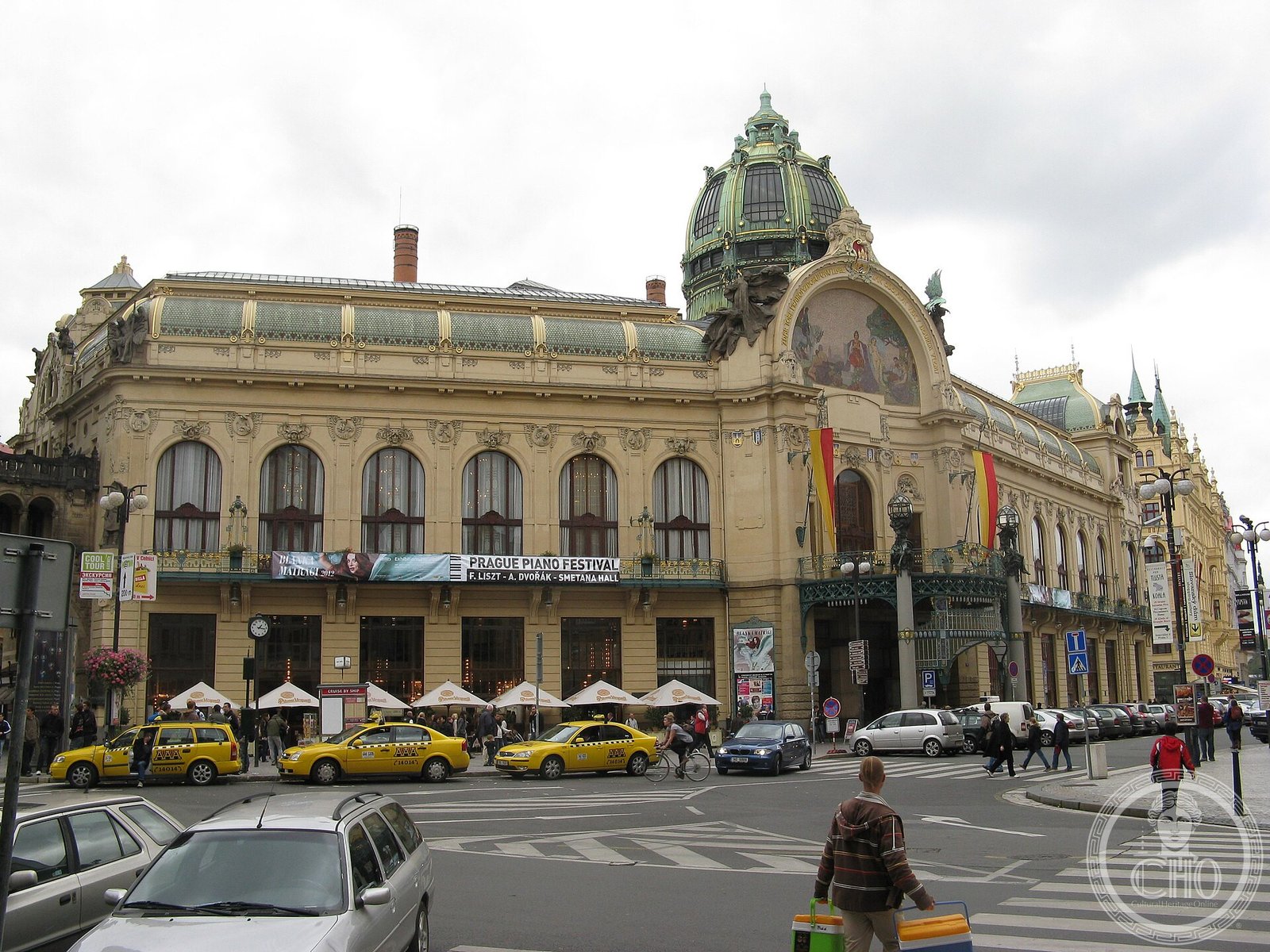
Prague’s Art Nouveau — locally called secese — found its fullest public expression in the Municipal House (1912), its most famous artist in Alphonse Mucha, and its most enduring monument in a city whose UNESCO historic centre had barely changed since the fourteenth century.
At a glance
Alphonse Mucha spent his most celebrated years in Paris — his poster cycle for Sarah Bernhardt, beginning with Gismonda in 1895, made him internationally famous overnight — but his deepest artistic ambition remained rooted in his Czech homeland. After returning to Prague permanently in 1910, Mucha devoted two decades to the Slav Epic: twenty monumental canvases charting the history of the Slavic peoples, completed in 1928 and now displayed at the Veletržní palác gallery. Prague preserves his memory in the intimate Mucha Museum on Panská Street, and his hand can be read in the mosaic and interior painting of the Municipal House, the city’s most complete Art Nouveau building.
Key facts
- Country: Czech Republic
- Key period: 1895–1928 (Czech Secese / Art Nouveau)
- Key figure: Alphonse Mucha (1860–1939) — graphic artist, poster designer, painter of the Slav Epic
- Essential sites: Mucha Museum (Panská 7), Municipal House / Obecní dům, Vyšehrad Cemetery (Mucha’s burial), Veletržní palác (Slav Epic)
- UNESCO heritage: Historic Centre of Prague (World Heritage Site since 1992)
- Annual anniversaries: Mucha birth 24 July, Mucha death 14 July
History
Alphonse Mucha was born in Ivančice, Moravia, on 24 July 1860. He studied in Munich and Vienna before arriving in Paris in 1887, where early struggles ended abruptly on 26 December 1894 when he was handed the commission for Gismonda — a theatre poster for Sarah Bernhardt — with less than two weeks to produce it. The result, with its elongated Byzantine figure and golden halo, launched the “Style Mucha” that became the dominant idiom of French Art Nouveau decoration.
Between 1895 and 1910 Mucha produced his most famous poster series — Jane Avril, the Seasons, the Precious Stones — while simultaneously designing jewellery for Georges Fouquet and exhibition pavilions for the 1900 Paris Exposition Universelle. He returned to Bohemia in 1910, and in 1912 contributed painted decorations to the Mayor’s Hall in Prague’s newly completed Municipal House.
The Municipal House (Obecní dům) itself was built on the site of the former Royal Court, demolished in 1902. Architects Osvald Polívka and Antonín Balšánek designed it between 1905 and 1912; every significant Czech Art Nouveau artist contributed to its interiors, including Alfons Mucha, Max Švabinský, Jan Preisler and Ladislav Šaloun. Its Smetana Hall became Prague’s premier concert venue and the site where Czechoslovakia’s independence was declared on 28 October 1918.
What you see
The Municipal House facade (náměstí Republiky 5) is a compendium of Czech Art Nouveau at its most confident: a mosaic tympanum by Karel Špilar showing Homage to Prague, flanked by winged allegorical figures and topped by a copper dome. The interiors — accessible on guided tours — include the Mayor’s Hall with Mucha’s ceiling allegories, the French Restaurant in gold and burgundy, and the Smetana Hall concert room under its glass-and-iron roof. The American Bar in the basement, barely altered since 1912, is still the best single room in Prague for Art Nouveau atmosphere at café prices.
The Mucha Museum (Panská 7) is small — occupying the Baroque Kaunický palác — but the collection is authoritative: original posters, photographs, pastels and personal objects. The museum also shows the documentary film The Mucha Effect, a useful introduction to his technique. Vyšehrad Cemetery, 3 km south by metro, is Mucha’s burial place and also holds the graves of Dvořák, Smetana and other Czech cultural figures.
Practical information
- Municipal House tours: daily guided tours 10:00–18:00; book at obecnidum.cz
- Mucha Museum: open daily 10:00–18:00; admission approx. CZK 260
- Prague Card: covers Mucha Museum and public transport; 2- or 3-day options
- Currency: Czech koruna (CZK); cards widely accepted
- Time needed: half-day for Municipal House + Mucha Museum; add 1h for Vyšehrad
Getting there
Václav Havel Airport Prague (PRG) is 17 km from the centre; bus 119 connects to Nádraží Veleslavín (Metro A, 30 min total to Old Town). The Municipal House is a 3-minute walk from náměstí Republiky station (Metro B, yellow line). Prague is also served by direct trains from Vienna (4h) and Berlin (4h30).
Related in CHO
- Anniversary: Alphonse Mucha birth — 24 July 1860
- Anniversary: Alphonse Mucha death — 14 July 1939
- National Museum of Prague (existing CHO card)
- Astronomical Clock in Prague (existing CHO card)
- Vienna — Capital of the Vienna Secession
Sources
Find it on the map
See this place and what’s around it →Events here — now on & upcoming
- Death Anniversary: František Xaver Brixi — October 14, 177114 Oct 2027See the event →
📷 Become a Cultural Heritage Online photographer
Share your photos of places: they stay published under your name as the author. The more they're seen, the more you get noticed — and soon a contest will reward the most appreciated photos.
Log in or sign up free to add a photo