
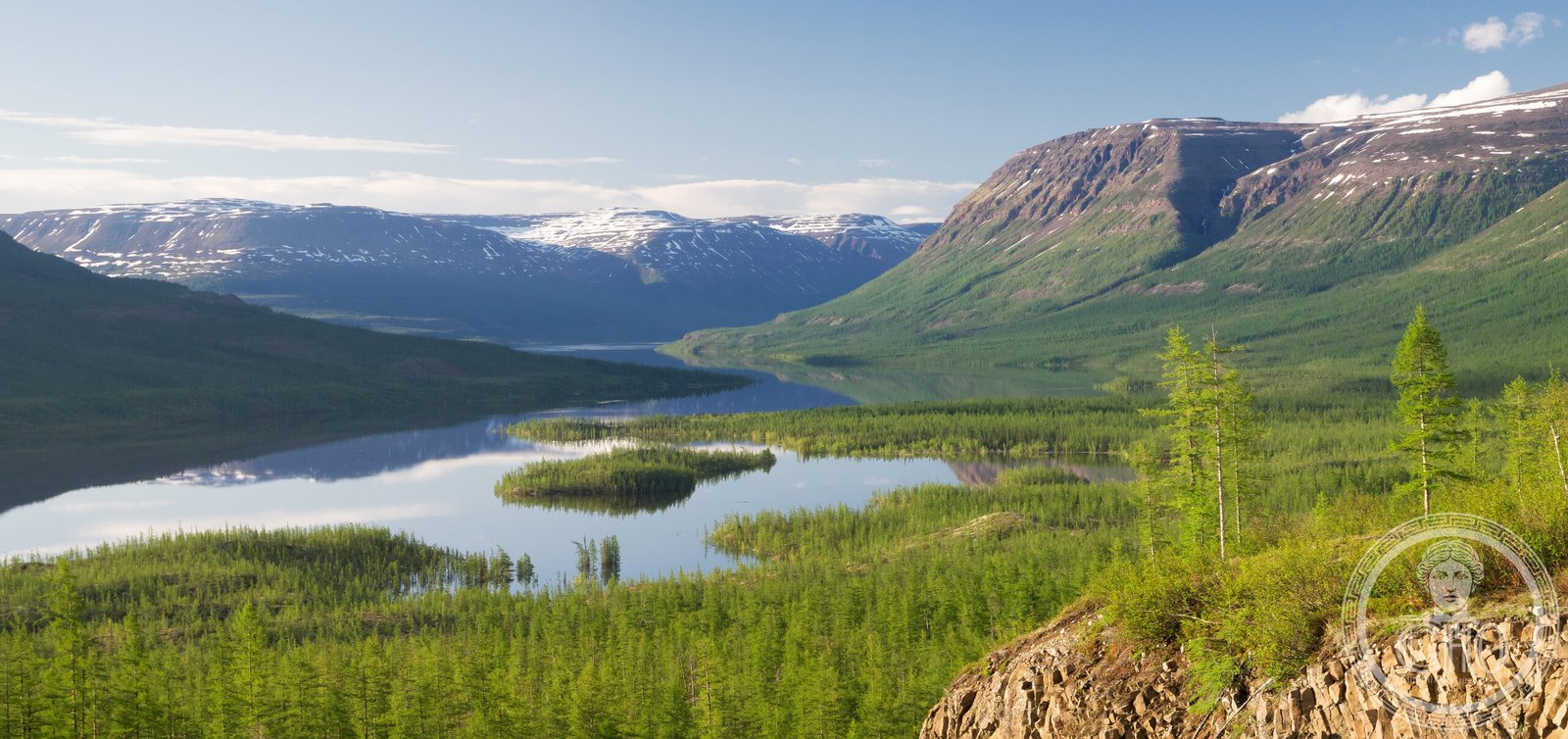
Siberia’s Hidden Basalt Plateau
The Putorana Plateau is one of the most remote and least visited landscapes on Earth, an isolated massif of ancient flood basalts rising abruptly from the West Siberian Plain in central Russia, north of the Arctic Circle. Covering over 250,000 km², the plateau was formed during one of the most catastrophic volcanic events in Earth’s history — the Siberian Traps eruptions of 252 million years ago, which released enough lava to cover the entire Earth’s surface to a depth of 6 metres and triggered the end-Permian mass extinction. UNESCO inscribed the Putorana Plateau State Nature Reserve in 2010.
Trap Basalt Geology: A Stepped Landscape
The word “putorana” derives from the Evenki language, meaning roughly “place of lakes with steep rocky banks” — an apt description of a landscape defined by the layered structure of trap basalts. Erosion has cut the horizontal lava flows into a characteristic stepped topography (trap = Swedish for “stairs”), creating sheer canyon walls, hanging valleys, and hundreds of lakes arranged in chains along tectonic fault lines. The largest lake, Khantayskoye, is over 200 km long.
Russia’s Highest Waterfalls
The dissection of the basalt plateau by rivers and glaciers has produced an exceptional concentration of waterfalls. Talnikovy Waterfall, at approximately 600 metres, is considered the highest waterfall in Russia and among the highest in Asia. Dozens of other falls, many unnamed, cascade from hanging valleys at the plateau edge into the deep canyon lakes below. During spring snowmelt, the plateau rim becomes a continuous curtain of falling water — one of the great spectacles of the Siberian wilderness.
The Wild Reindeer Migration: Largest on Earth
The Putorana Plateau hosts the Taimyr wild reindeer herd — the largest wild reindeer (caribou) migration on Earth, with estimates of over 600,000 animals making seasonal movements between their winter grazing grounds on the West Siberian lowlands and summer calving grounds on the Taimyr Peninsula. The route passes directly through the Putorana Reserve, making this one of the most significant terrestrial wildlife spectacles on the planet, comparable in scale to the Serengeti wildebeest migration.
Arctic Ecosystems: From Taiga to Tundra
The plateau encompasses the full transition from boreal forest (taiga) at lower elevations to alpine tundra and arctic desert at the highest points above 1,700 metres. This ecological gradient, virtually undisturbed by human activity, supports exceptional biodiversity including wolverine, snow sheep (Ovis nivicola), Arctic fox, wolf, brown bear, and rare Siberian crane (Grus leucogeranus). The intact nature of the ecosystem — with all trophic levels present — is a major reason for UNESCO inscription.
Isolation and Indigenous Peoples
The plateau’s remoteness has preserved both its natural character and traces of the indigenous Evenki and Dolgan peoples who seasonally inhabited its margins, following the reindeer herds and fishing the exceptionally clear lake systems. Traditional knowledge of the plateau’s geography, wildlife patterns, and seasonal rhythms accumulated over millennia represents an intangible cultural layer alongside the natural heritage. The region remains one of the least densely populated territories on Earth, with the nearest town, Norilsk, lying to the northwest.
Scientific Significance: The Siberian Traps Connection
The Putorana Plateau is the erosional remnant of the Siberian Traps — the largest continental flood basalt province in geological history. Study of the plateau’s rocks has been critical to understanding the end-Permian extinction event (the “Great Dying” of 252 million years ago, when 90–96% of marine species and 70% of terrestrial species disappeared). The volcanic aerosols and CO₂ released by the Siberian Traps eruptions are now considered the primary driver of this catastrophe, making Putorana a key site for understanding deep-time climate change.
Access and Conservation
The Putorana State Nature Reserve is one of Russia’s strictest protected areas, with access limited to scientific expeditions and a small number of guided visitors per year. The gateway is Norilsk — an industrial city accessible by air only, built on the site of one of the Soviet Union’s largest forced labour camps. From Norilsk, helicopter is the only practical way to reach the plateau interior. This extreme inaccessibility has been the plateau’s most effective protection, keeping it among the world’s last truly pristine wilderness areas.
Find it on the map
See this place and what’s around it →📷 Become a Cultural Heritage Online photographer
Share your photos of places: they stay published under your name as the author. The more they're seen, the more you get noticed — and soon a contest will reward the most appreciated photos.
Log in or sign up free to add a photo