
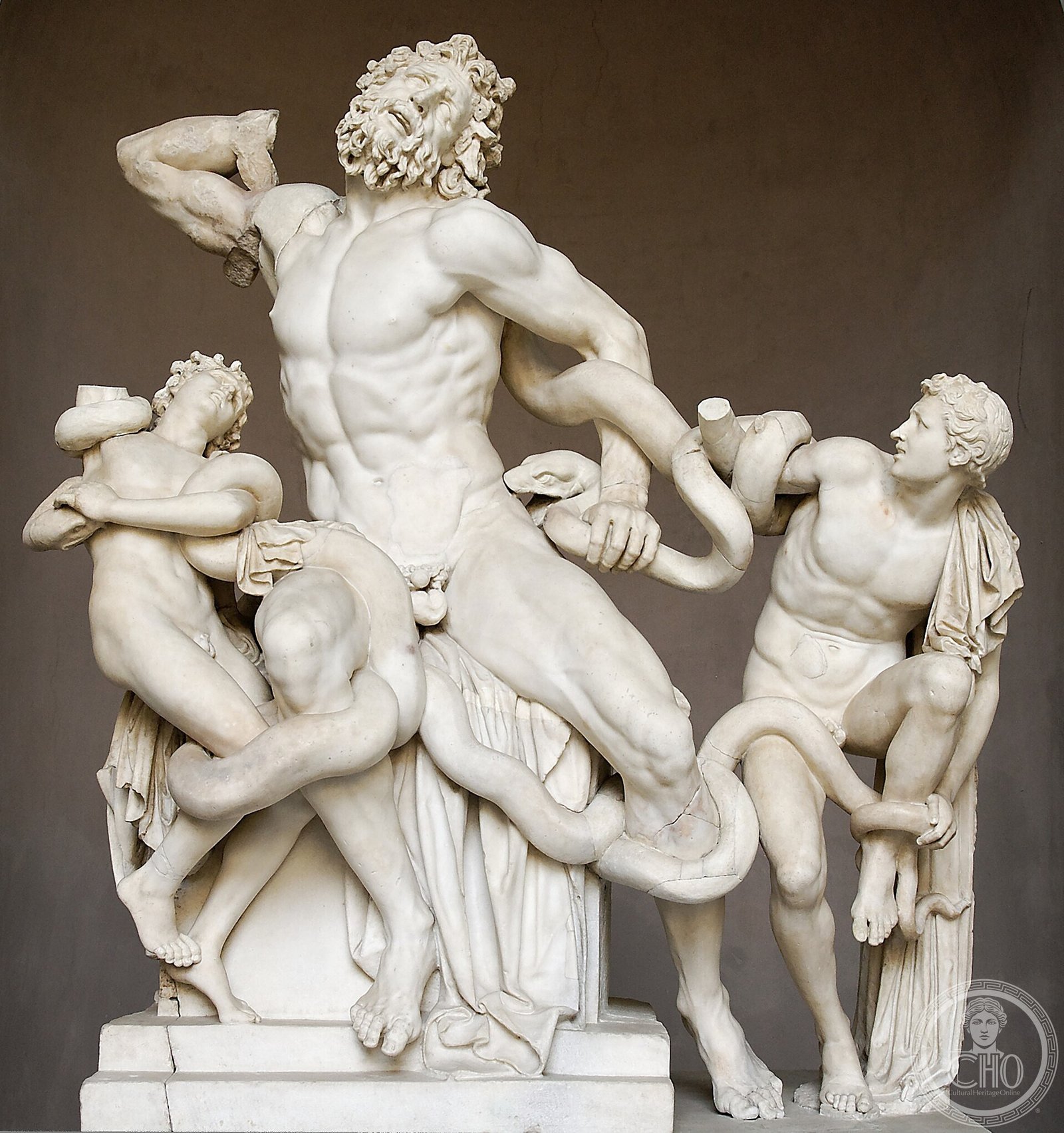
One of the Vatican Museums’ finest collections, the Pio Clementino houses masterpieces of Greek and Roman sculpture within the walls of Vatican City, including the celebrated Apollo of the Belvedere and the Laocoon group.
At a glance
The Pio Clementino Museum occupies twelve rooms within the Vatican Museums complex. Its galleries showcase outstanding examples of Greek and Roman sculpture, anchored by two of antiquity’s most revered works and framed by architectural interventions spanning three centuries.
History
Pope Clement XIV established the museum in 1771 following the acquisition of the Mattei and Fusconi collections. His successor, Pius VI, significantly expanded the institution and commissioned the architect Giuseppe Simonetti to design a monumental entrance. The Atrium of the Quattro Cancelli and the celebrated Simonetti staircase provided the museum with a suitably grand approach, leading visitors through an entrance hall known as the Greek cross room.
The Laocoon group, discovered on Rome’s Esquiline Hill in 1506, was acquired by Julius II and placed within Vatican walls—an acquisition that immediately captured the imagination of Michelangelo. The Apollo of the Belvedere, brought to the Vatican by the same pope, became a touchstone of neoclassical aesthetic theory.
What you see
The museum’s spatial progression guides visitors through carefully curated galleries. Beyond the Square Vestibule and the room displaying a splendid marble cup lies the Apoxyomenos Cabinet, named after a Roman copy of Lysippos’ Greek bronze (circa 320 BC). The figure captures an athlete wiping perspiration with a strigil, his gaze averted, body poised in the moment of post-victory repose.
The Octagonal Courtyard, reshaped by Clement XIV in 1772, commands the collection’s center. Here stands the Apollo of the Belvedere, a 2nd-century AD Roman copy attributed to the Greek sculptor Leochares (330–320 BC). The Laocoon group occupies a position of equal prominence—a 1st-century Roman marble copy of a 2nd-century BC Greek bronze by Hagesandros, Athanadoros, and Polydoros. The composition depicts the Trojan priest and his sons ensnared by serpents, their struggle conveying divine punishment for Laocoon’s warning about the wooden horse. Antonio Canova’s neoclassical Perseus with the head of Medusa between two Boxers (1800–1801) represents the museum’s later accretions.
From the Apoxyomenos Cabinet, visitors glimpse the Scala del Bramante, commissioned by Julius II in 1512 as a helical ramp within a square tower, designed to connect the Palazzetto di Innocenzo VIII with the city below and accessible to mounted riders.
Cultural significance
The Apollo of the Belvedere and the Laocoon group defined neoclassical ideals of formal perfection and emotional intensity. Both works shaped European artistic theory from the Renaissance through the nineteenth century. The museum’s architecture reflects papal ambitions to create spaces worthy of antiquity’s greatest works, integrating them into structures that command intellectual and spiritual reverence.
Key facts
- Address: Musei Vaticani, 00120, Stato del Vaticano
- Coordinates: 41.90516765840127, 12.455068230628967
- Founded: 1771 (Clement XIV)
- Galleries: 12 rooms
- Phone: 06 69883332
- Official website: http://www.museivaticani.va/content/museivaticani/it/collezioni/musei/museo-pio-clementino.html
Practical information
The museum is open as part of Vatican Museums admission. Booking in advance is recommended for groups and individuals. Hours and current admission prices are available on the official Vatican Museums website.
Getting there
The museum is located within Vatican City and accessed through the Vatican Museums entrance on Viale Vaticano in Rome. Public transport connections include Metro line A (Cipro-Musei Vaticani station) and multiple bus routes serving the area.
Sources & resources
Find it on the map
See this place and what’s around it →📷 Become a Cultural Heritage Online photographer
Share your photos of places: they stay published under your name as the author. The more they're seen, the more you get noticed — and soon a contest will reward the most appreciated photos.
Log in or sign up free to add a photoIs this page about you?
This page is read by travellers and heritage enthusiasts who find it on Google. Tell us how you are connected to this place and we will take it from there.