
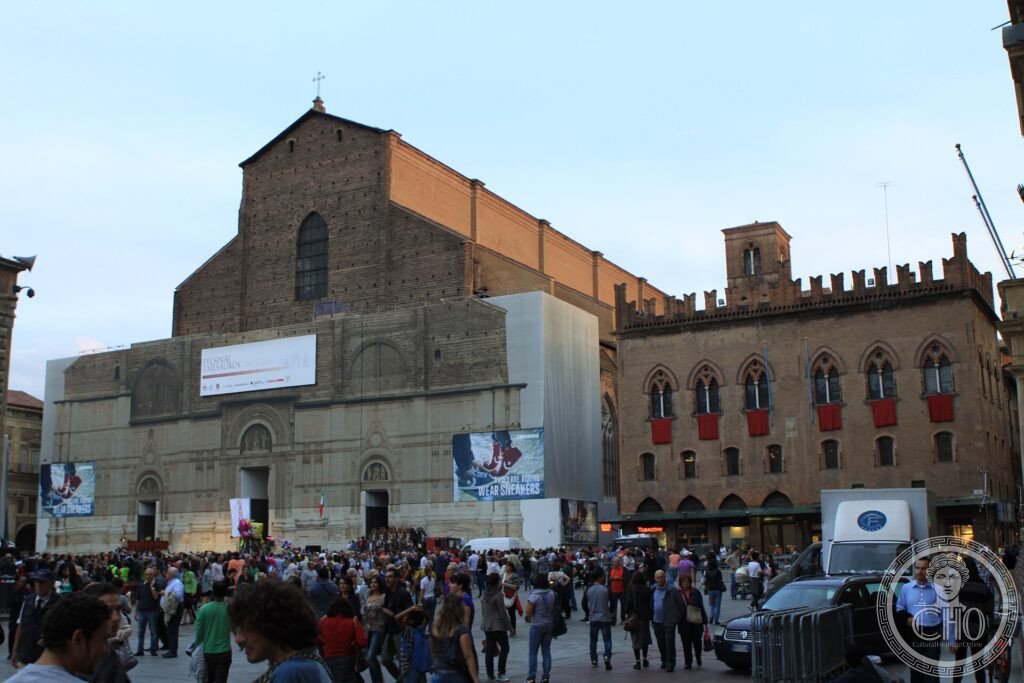
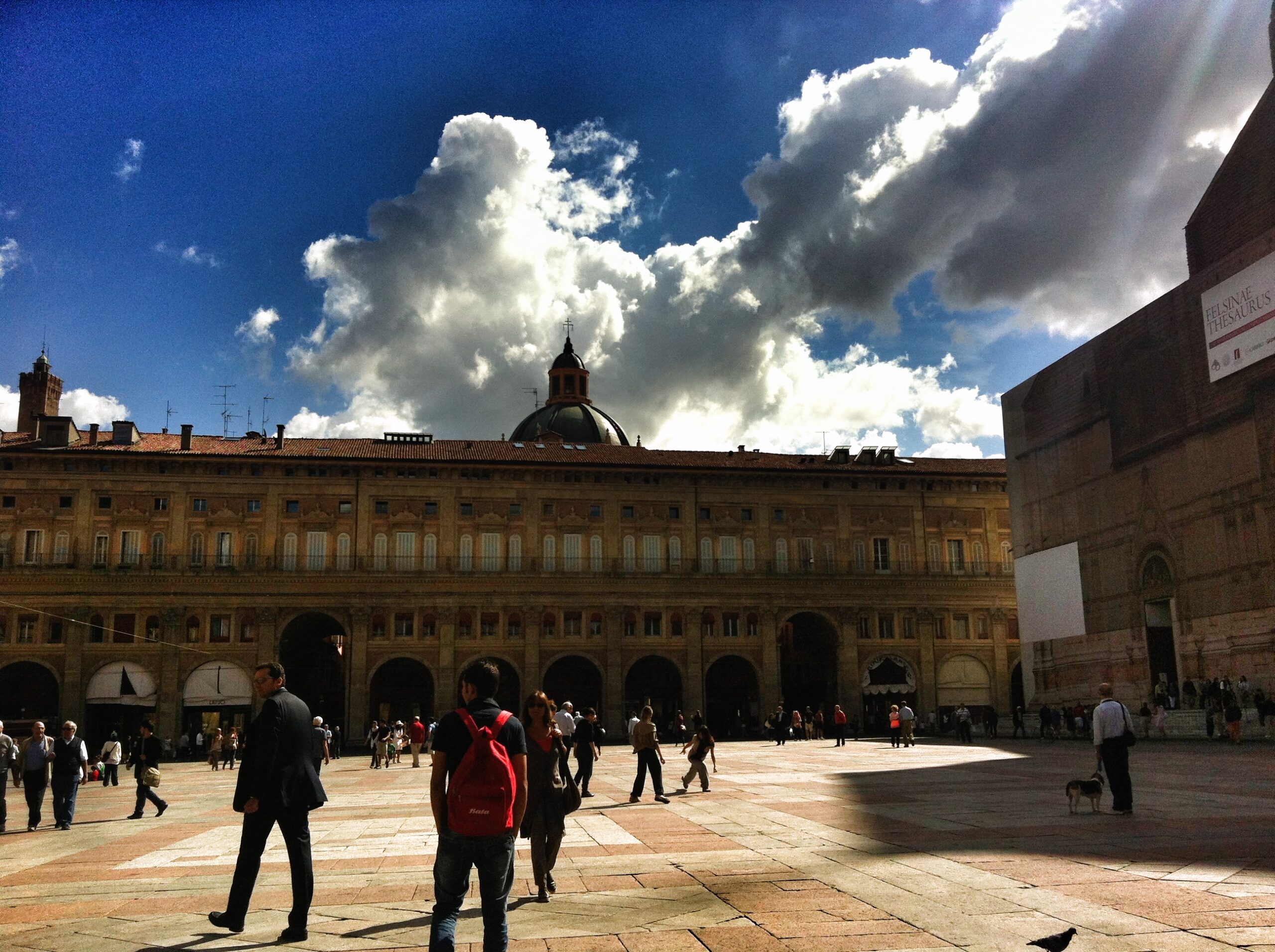
Piazza Maggiore in Bologna — ringed on all four sides by continuous porticoes, fronted by the unfinished Gothic facade of the Basilica di San Petronio, flanked by the medieval towers of Palazzo d’Accursio and the loggia of Palazzo dei Notai — is the most complete surviving example of the 13th-century Italian civic square tradition, a space where the porticoes are not merely a pedestrian amenity but the structural expression of medieval Bologna’s mercantile identity: the city that built the world’s first university (1088) and invented the portable covered market.
At a glance
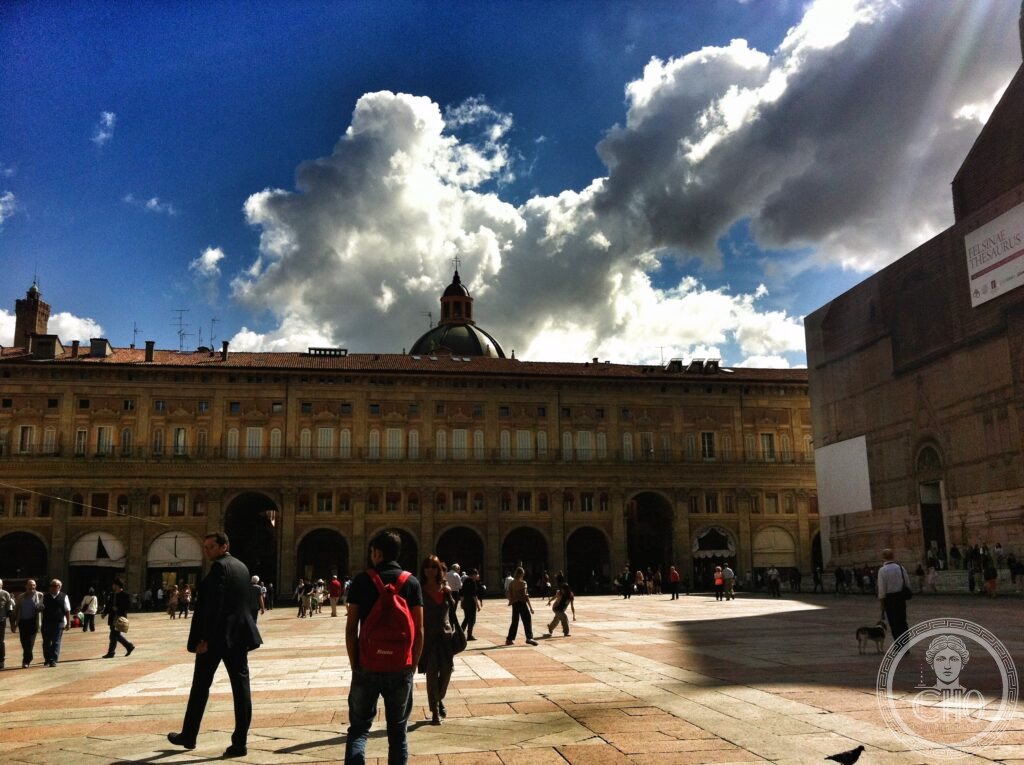
Piazza Maggiore (Bologna; UNESCO 2021, ref. 1650) and its adjacent Piazza Nettuno form the civic heart of Bologna: a connected pair of squares, approximately 100 × 60 m in total, bounded on all sides by medieval and Renaissance buildings all featuring ground-floor porticoes. The piazza emerged in its current form during the 13th century (the Commune of Bologna consolidated land holdings from 1200 to create a single large civic space to replace the earlier dispersed market) and has served as the centre of civic and commercial life continuously since then. The major buildings surrounding it — Palazzo d’Accursio (Palazzo Comunale, 1245), Palazzo dei Notai (1381), Palazzo dei Banchi (begun 1412), Basilica di San Petronio (begun 1390), and Palazzo Re Enzo (1246) — all contribute their ground-floor porticoed arcades to create a continuous covered perimeter around the entire square.
Key facts
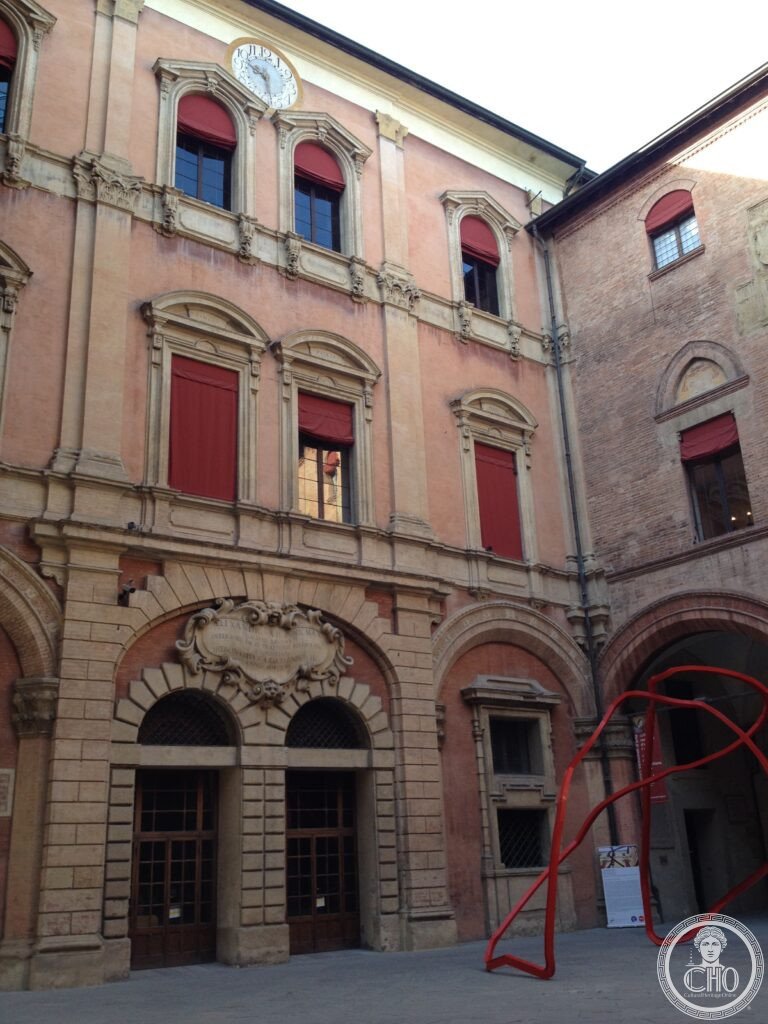
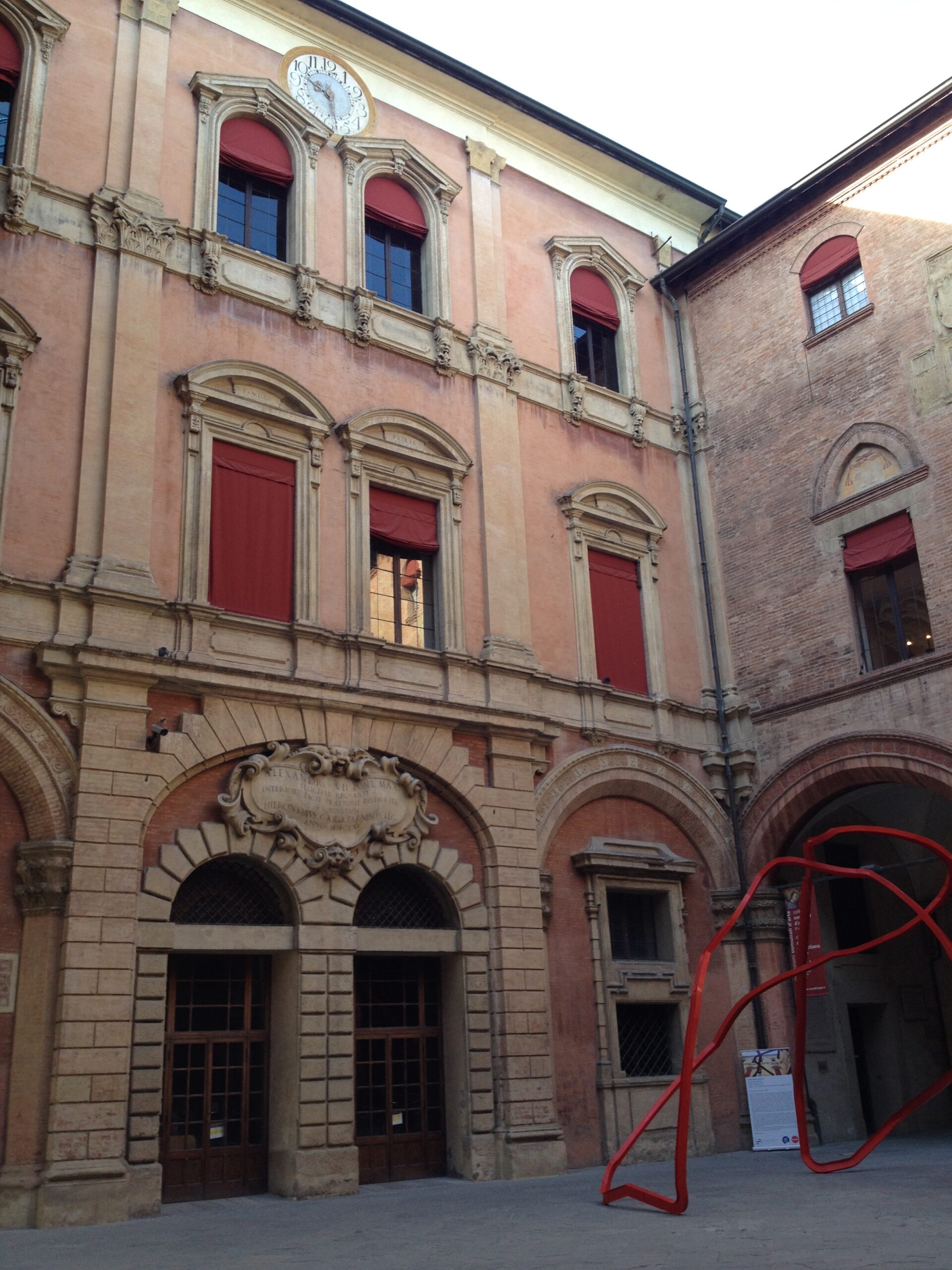
- Palazzo d’Accursio (Palazzo Comunale, 1245-XV sec.): The town hall of Bologna, built on the site of the medieval house of the jurist Accursius (d. 1263) — the most important jurist of the Glossators school, who compiled the Glossa Ordinaria (the standard commentary on Roman law used throughout medieval Europe); the palazzo was enlarged repeatedly from the 13th to the 15th century and now contains the civic collections (Collezioni Comunali d’Arte) on the first floor and the offices of the municipality on the upper floors; the facade has a large crenellated tower (Torre dell’Orologio) with the 1451 astronomical clock by Giovanni Dondi dell’Orologio (a later copy — original mechanisms survive in the Museo della Musica).
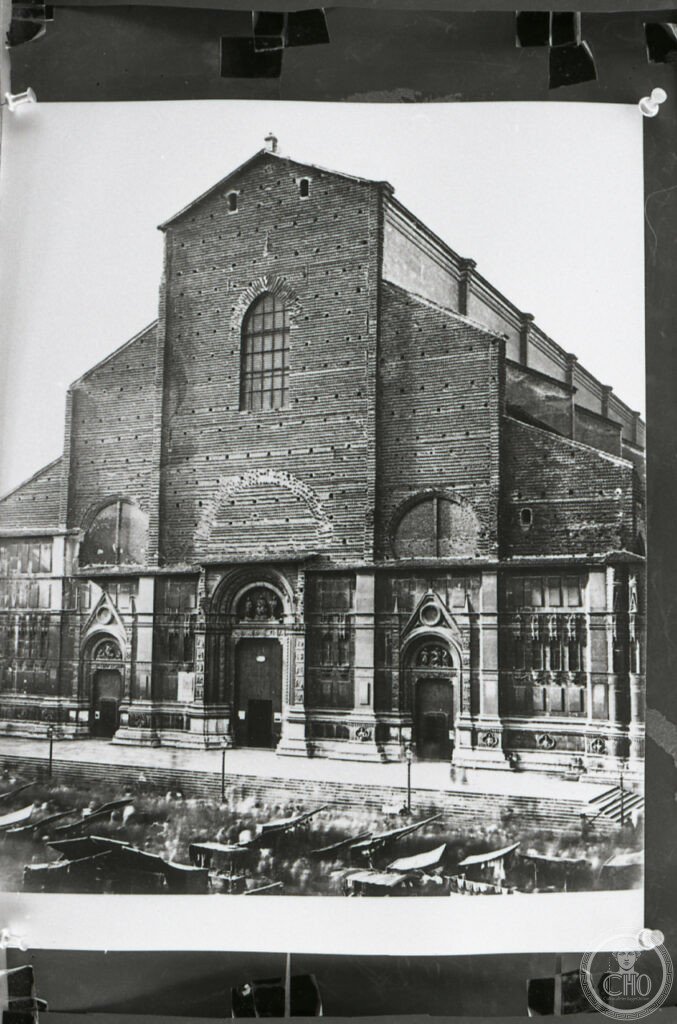
- Basilica di San Petronio (1390-incompiuta): The civic basilica of Bologna — the 5th largest church in Europe by interior volume (132 m long, 66 m wide, 45 m tall in the central nave) — was begun in 1390 and is STILL officially unfinished (the terracotta brick facade was completed only to mid-height; the original project called for a marble facing to the height of the nave and two flanking towers that were never built); the facade has three Gothic portals by Jacopo della Quercia (1425-1438 — the most important sculptural programme in Emilia) and the remains of a 1562 astrological meridian line by Egnazio Danti (the longest astrological meridian in Italy, replaced in 1655 by the Cassini meridian still visible in the floor).
- La Meridiana Cassini (1655): The brass meridian line inlaid in the floor of San Petronio (1655, Giovanni Domenico Cassini — the astronomer who later directed the Paris Observatory and discovered the gap in Saturn’s rings) is the most accurate astronomical instrument of the 17th century — 66.8 m long, the longest in Italy; it was used to precisely calculate the length of the solar year and verify the Gregorian calendar reform; it still works and casts a beam of sunlight through a pinhole in the dome on the summer and winter solstices and equinoxes.
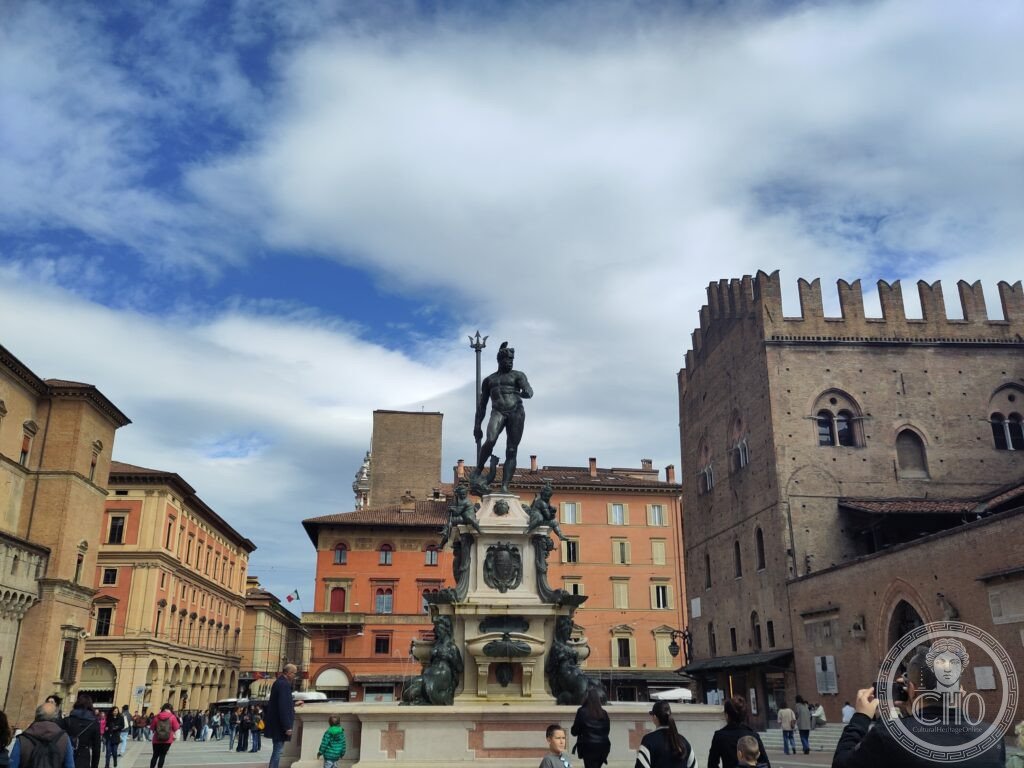
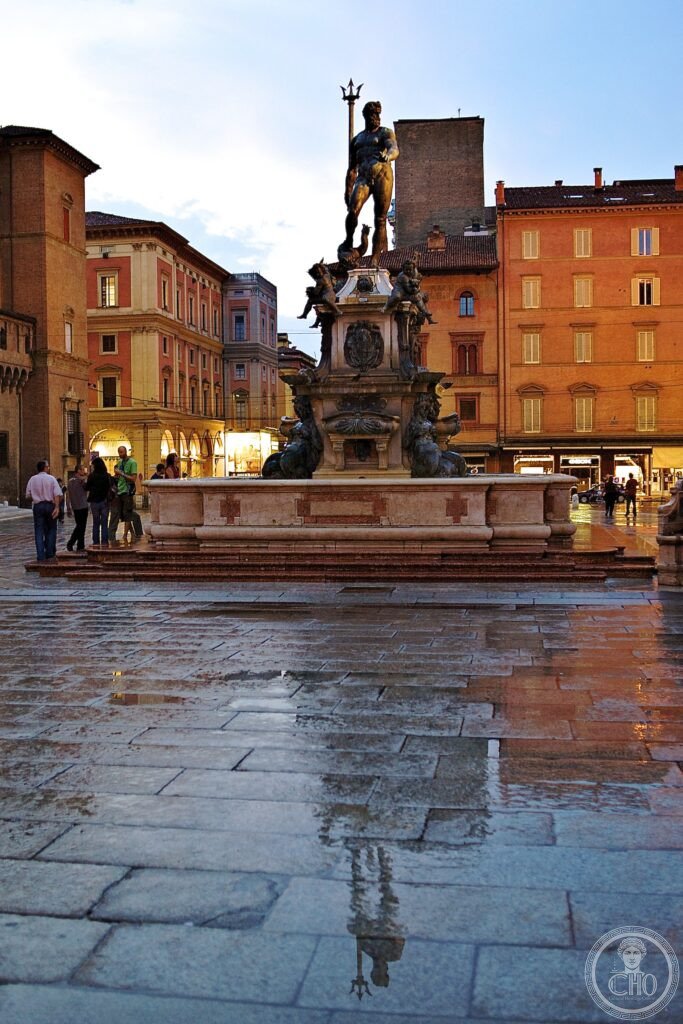
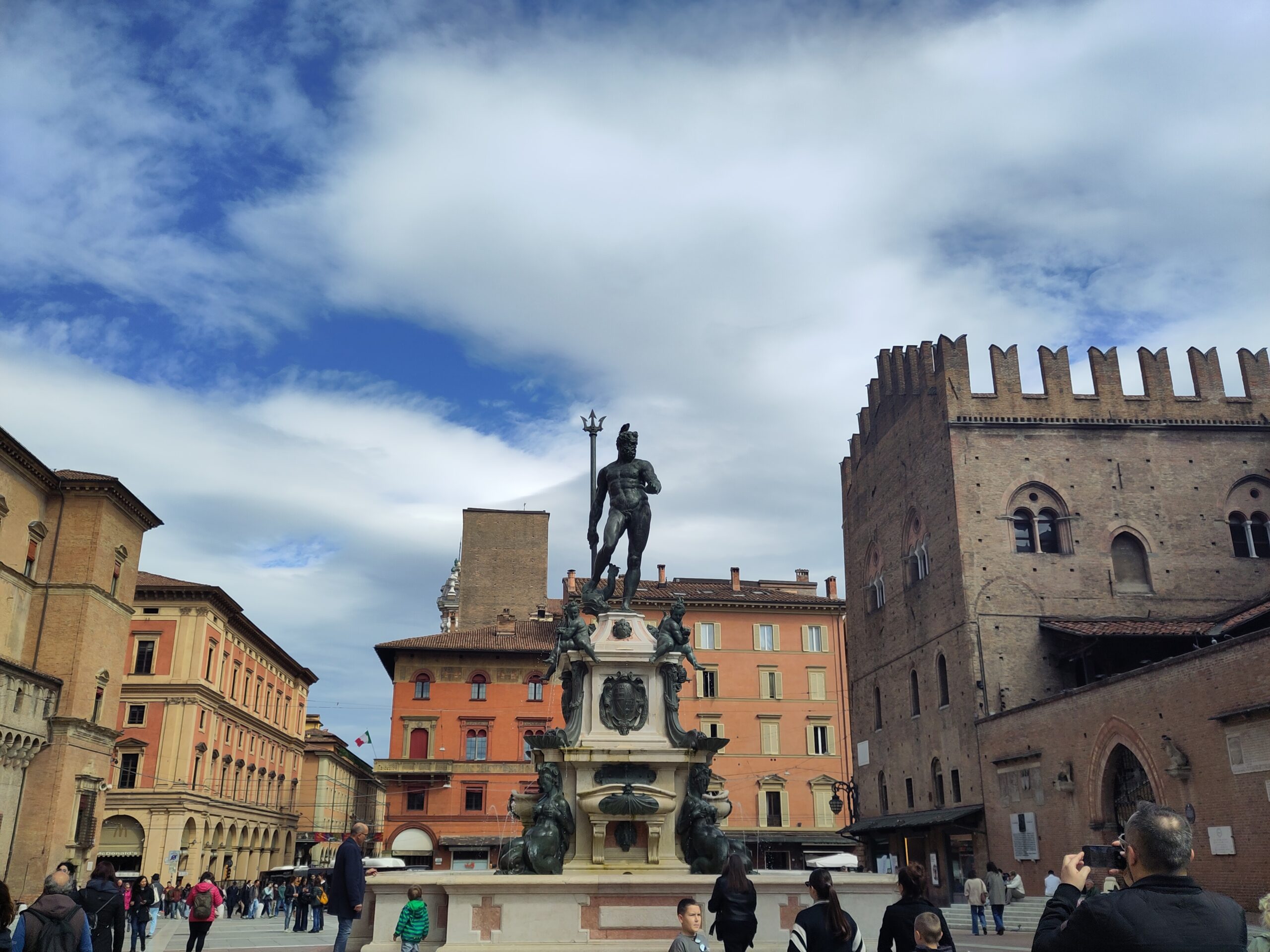
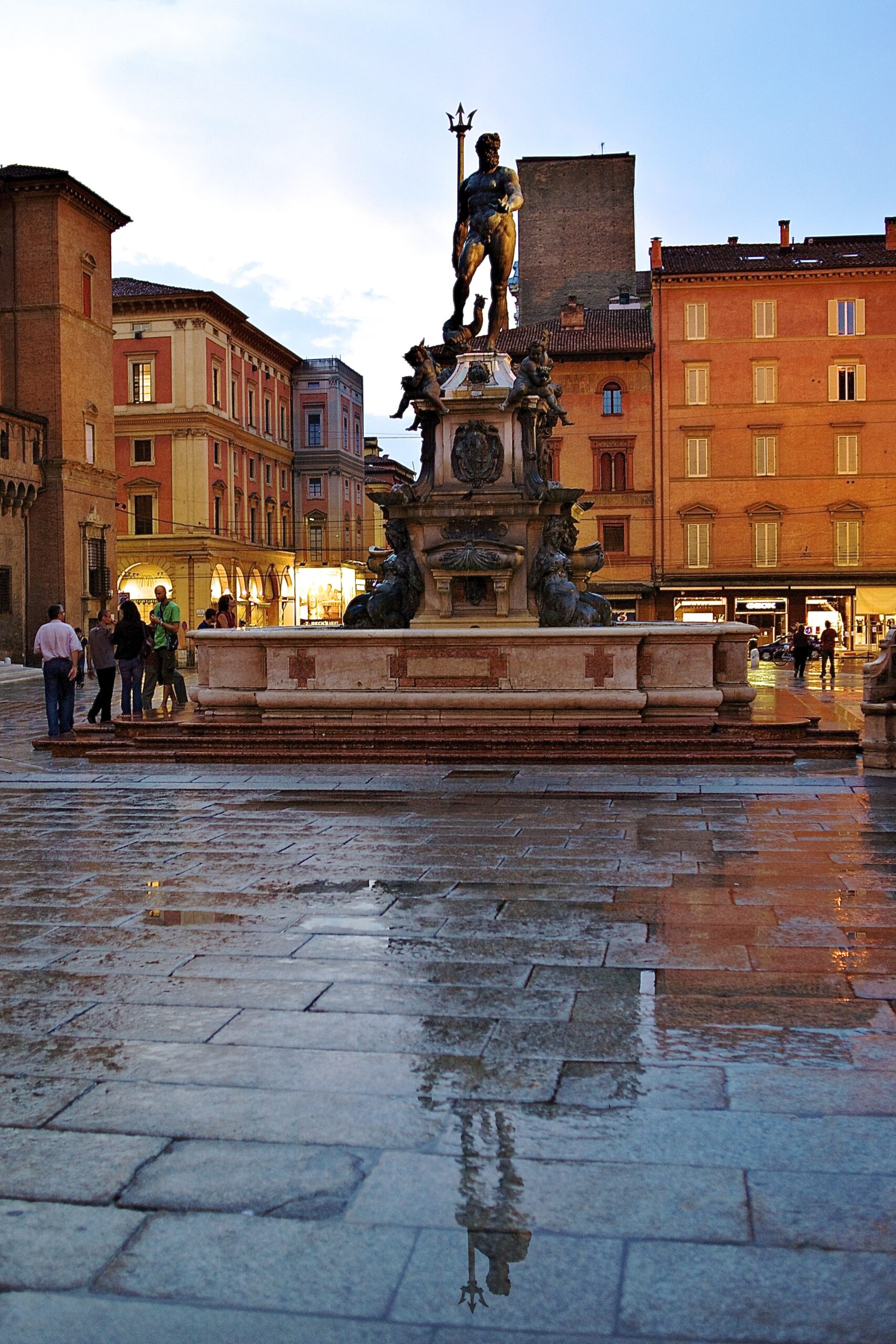
- Fontana del Nettuno (1566, Giambologna): The large bronze fountain in Piazza Nettuno (adjacent to Piazza Maggiore) was designed by Giambologna (Giovanni da Bologna, 1529-1608) for Cardinal Carlo Borromeo and cast by Zanobi Portigiani in 1566; the Neptune figure (4.5 m tall) was the largest bronze cast in Italy since antiquity at the time; the fountain’s four sirens (pressing their breasts to release water) caused a famous theological controversy — Pope Pius IV demanded that the sirens be clothed, and Giambologna reportedly made the Neptun lean back slightly so that his muscular torso would partially obscure the sirens from the papal viewpoint of the Via Galliera.
- UNESCO: 2021, rif. 1650.
- GPS: 44.4940, 11.3427 — Google Maps (Piazza Maggiore, Bologna).
History
The site of Piazza Maggiore was occupied by scattered buildings until the 13th century, when the Commune of Bologna resolved to demolish the existing structures and create a single large civic square; demolition and clearing took from approximately 1200 to 1246. The Palazzo dei Podestà (1200s, facing the square from the north side) and Palazzo Re Enzo (1246, built to house the imprisoned Holy Roman Emperor Frederick II’s son Enzo, King of Sardinia, who was held here for 23 years from 1249 to 1272) were among the first buildings fronting the new square. The Basilica di San Petronio was begun in 1390 under the architect Antonio di Vincenzo on the south side, replacing earlier churches on the site; despite the colossal scale of the project (at 132 m long, it was planned to surpass St. Peter’s in Rome), construction slowed after the first century due to funding disputes and the political complications of Bologna’s relationship with the Papal States.
What you see
Piazza Maggiore is Bologna’s living room — the most heavily used public space in the city (and one of the most used in Italy), with outdoor cinema in summer (the Arena Puccini / Cinema Sotto le Stelle summer series), political demonstrations, concerts, and the constant social life of Italian piazza culture. The essential visit: walk the entire perimeter under the porticoes (10 min) to appreciate the architectural diversity of the facades above the portico line; enter San Petronio (free) for the interior: note the scale (you are standing inside one of the largest Gothic spaces in the world), the Cassini meridian line in the floor (marked with a brass strip and hour/month circles), the Jacopo della Quercia portal sculptures on the exterior (between portal 1 and 2 is the most celebrated — the creation scenes), and the Bolognini Chapel frescoes (Giovanni da Modena, ca. 1410 — a vivid Hell scene that has been suggested as a source for Dante’s Inferno); climb to the terrace of Palazzo d’Accursio (Collezioni Comunali d’Arte) for the best view of the Piazza from above.
Gallery
Practical information
- Piazza Maggiore: Open at all times (public square). Basilica di San Petronio: open daily 07:30-18:00 (winter), 07:30-19:00 (summer), free admission; closed during major services. Palazzo d’Accursio (Collezioni Comunali d’Arte): open Tue-Sun 10:00-18:00, closed Monday; admission ~€6 (full), ~€3 (reduced). Fontana del Nettuno: always accessible in Piazza Nettuno (adjacent). The piazza is completely pedestrianized; the nearest car parks are Autosilo Indipendenza (300m north) and Parcheggio San Francesco (400m west).
- Cinema estivo: The “Cinema Sotto le Stelle” season (June-August) screens films in Piazza Maggiore on most evenings at sunset — free or very low cost, atmospheric in the open square; one of the oldest outdoor cinema series in Italy.
Getting there
Piazza Maggiore, Bologna (BO), Emilia-Romagna. GPS 44.4940, 11.3427. 10 min walk from Bologna Stazione Centrale (via Via dell’Indipendenza, under the portici). By bus: all city lines converge on Via Ugo Bassi / Via Rizzoli adjacent to the piazza. By car: Bologna is at the intersection of A1 (Milan-Rome), A13 (Padova), A14 (Adriatic). ZTL in the city centre — use park & ride or paid garages outside the ZTL boundary. Bologna Stazione Centrale served by Frecciarossa from Milan (1h05), Florence (35 min), Rome (2h10).
Nearby
- Le Due Torri (Torre degli Asinelli + Torre Garisenda) — 300 m east via Via Rizzoli; the twin medieval towers of Bologna (1109-1119), the most iconic image of the medieval city; Torre degli Asinelli (97.2 m) is climbable (500 steps).
- Palazzo Poggi (Museo di Palazzo Poggi) — 600 m north-east; the Renaissance palace of the Poggi family (1549), now the university museum complex; houses collections of military science (including original globes by Vincenzo Coronelli, the most famous globe-maker of the 17th century), anatomy, natural history, and cartography.
- Portico di San Luca (Arco del Meloncello) — 1 km south-west via Via Saragozza; the beginning of the world’s longest covered portico walk (3.8 km to the hilltop sanctuary).
Sources
- UNESCO: whc.unesco.org/en/list/1650.
- Wikipedia EN: Piazza Maggiore, Bologna.
- Fanti, Mario: Piazza Maggiore di Bologna, Bologna: Costa Editore, 2002.
Gallery
![Servizio fotografico : Bologna, 1973 / Paolo Monti. - Strisce: 5, Fotogrammi complessivi: 25 : Negativo b/n, gelatina bromuro d'argento/ pellicola ; 35 mm. - ((Sul portanegativi: N[I]K[MA]T FP4. - I fotogrammi nn. 10-22 sono mancanti. - Occasione: Campagna di rilevamento del centro storico. - Fonte: Agenda di Paolo Monti: Leica 1501-3000 Controllo numerazione (1950-1978), presso Archivio Paolo Monti](https://culturalheritageonline.com/wp-content/uploads/2026/06/Paolo_Monti_-_Servizio_fotografico_28Bologna2C_197329_-_BEIC_6348671.jpg)
Find it on the map
See this place and what’s around it →📷 Become a Cultural Heritage Online photographer
Share your photos of places: they stay published under your name as the author. The more they're seen, the more you get noticed — and soon a contest will reward the most appreciated photos.
Log in or sign up free to add a photo