

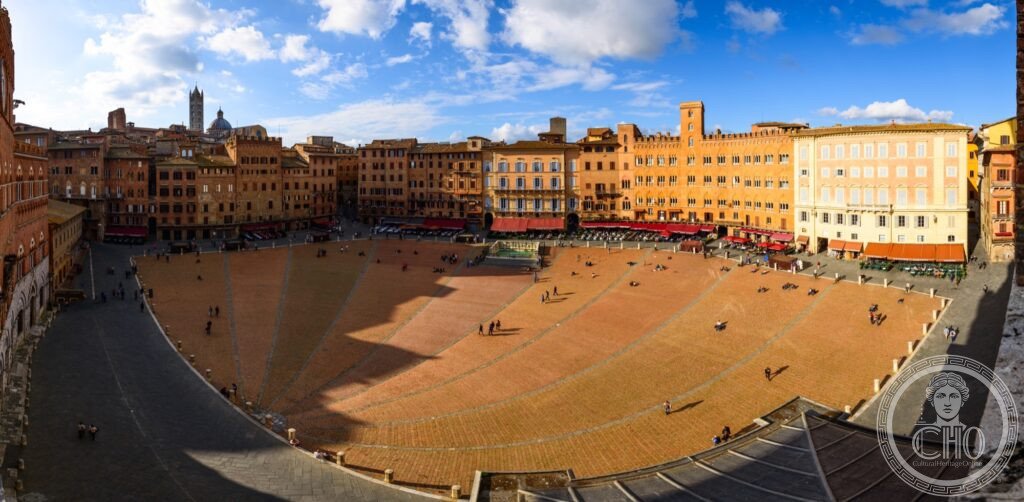
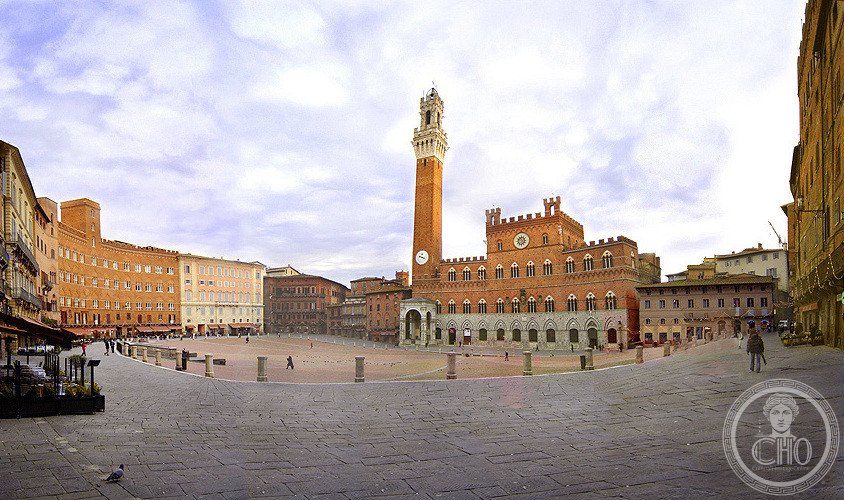
The shell-shaped piazza at the heart of medieval Siena, sloping toward the Palazzo Pubblico at its base — the most beautiful public square in Italy in the considered opinion of most visitors since the Renaissance, and the site of the Palio twice annually — and the Palazzo Pubblico itself, whose Sala dei Nove contains Ambrogio Lorenzetti’s “Allegory of Good and Bad Government” (1338–1340), the most complex secular fresco programme of the medieval period.
At a glance
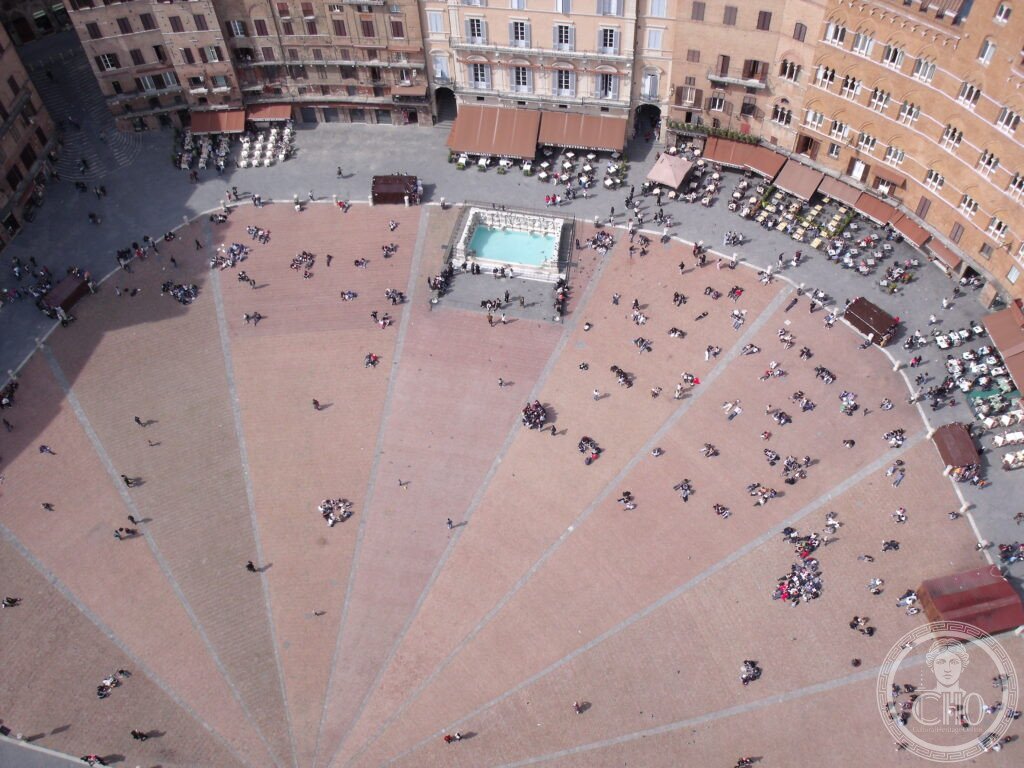
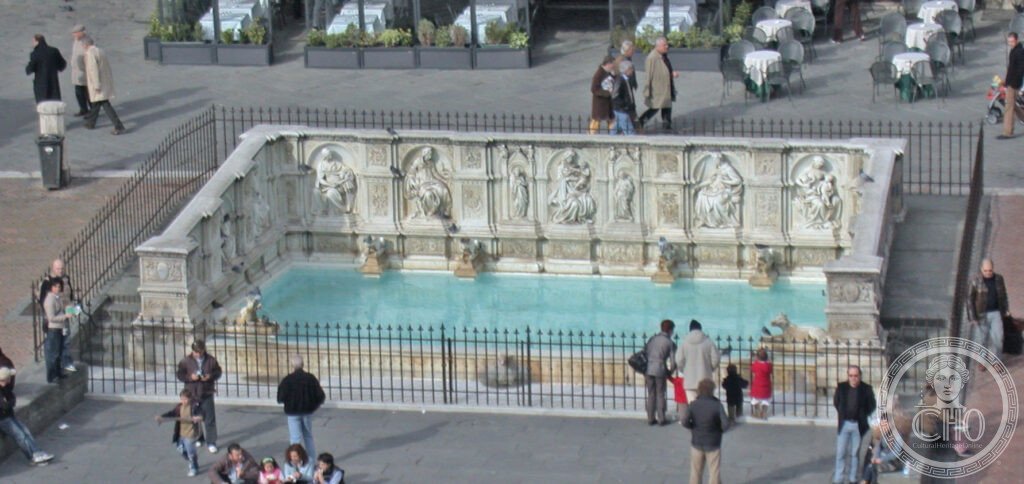
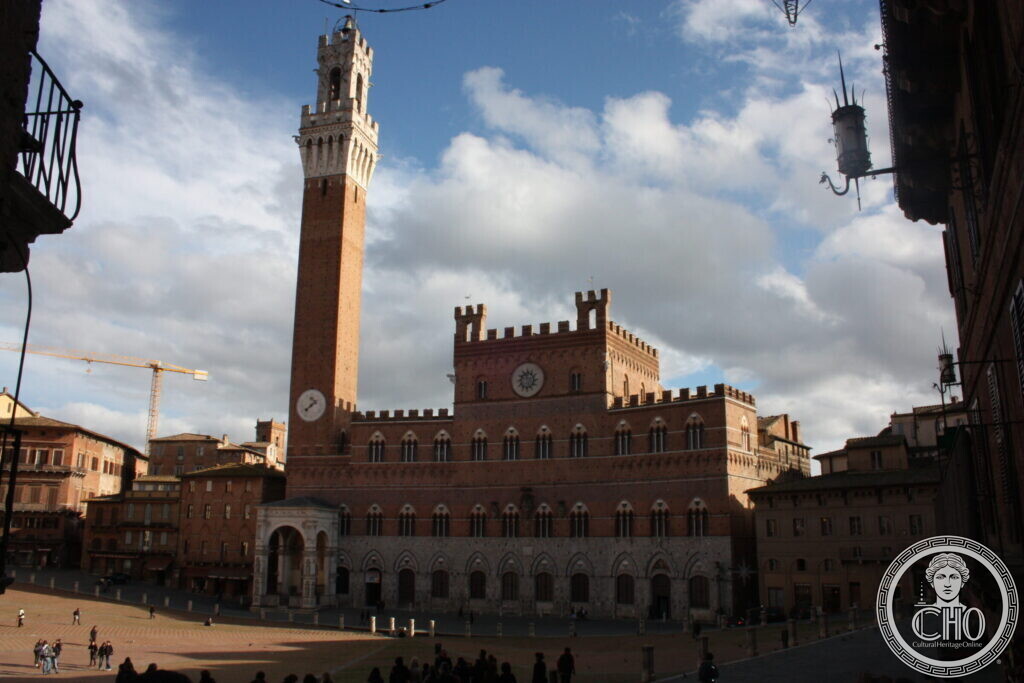
Piazza del Campo is the central public space of Siena, created in the thirteenth century by the demolition of private buildings to form a shared civic plaza. Its distinctive shell shape — nine segments of brick paving converging toward a central drain, the Fonte Gaia — is a product of the natural topography: the piazza occupies the junction of three medieval hills, and its sloping surface follows the hillside. At the lower end stands the Palazzo Pubblico (1297–1310), seat of the Nine (the merchant government of medieval Siena), with the slender Torre del Mangia (88 metres, 1338–1348) rising from its right side. At the centre of the piazza’s upper arc, the Fonte Gaia (1419, Jacopo della Quercia; now replaced by a copy) marks the terminus of the underground Bottini aqueduct.
Key facts
- Piazza creation: XIII century; current brick paving c. 1345
- Palazzo Pubblico: 1297–1310; seat of the Nine, Siena’s merchant government
- Torre del Mangia: 1338–1348; 88 metres; second-tallest medieval tower in Italy after the Asinelli in Bologna
- Lorenzetti frescoes: 1338–1340; Allegory of Good and Bad Government, Sala dei Nove
- Palio di Siena: Horse race around the piazza, 2 July (Palio dell’Assunta) and 16 August (Palio di Provenzano)
- UNESCO inscription: 1995, ref. 717 — “Historic Centre of Siena”
- GPS: 43.3183, 11.3317 — Google Maps
History
Siena reached its peak of political and economic importance in the thirteenth and early fourteenth centuries, when the banking houses of the Bonsignori, Tolomei, and Salimbeni controlled European credit operations from the Mediterranean to Flanders, and the commune’s wool and textile industries made it one of the wealthiest cities in Europe. The Palazzo Pubblico was built as the seat of this merchant oligarchy — the Nine (Noveschi) who governed Siena from 1287 to 1355. Its facade, in the distinctive Sienese Gothic idiom of white travertine and dark red brick with bi-lobed windows, established the visual standard for Sienese public architecture for the next century.
Ambrogio Lorenzetti’s frescoes in the Sala dei Nove (1338–1340) are the most ambitious secular fresco programme of the Italian Middle Ages and the first large-scale panoramic depiction of a real landscape in Western art since antiquity. The three-wall composition presents Tyranny (with its effects of violence, poverty, and urban collapse on one wall), Good Government (the just commune, personified as a crowned figure surrounded by Virtues, on a third wall), and the Effects of Good Government (the fourth wall: a panoramic view of a prosperous medieval city and its contado, with merchants trading, students studying, and peasants working the fields). The landscape panel is the first identifiable Italian city-view painting and the prototype for the later tradition of topographic representation.
What you see
The piazza is best understood from above — from the top of the Torre del Mangia (500 steps, well worth it) or from the rim of the Campo itself, looking down toward the Palazzo Pubblico. The nine sections of brick paving, separated by white marble strips, fan out from the central drain; in the hours before sunset the light crossing the curved surface creates a sculptural effect unique to this topography. The piazza is always inhabited: cafes on the upper rim, children playing on the brickwork, visitors sitting on the slope.
Inside the Palazzo Pubblico, the Museo Civico occupies the principal rooms of the medieval palace. The most important spaces are: the Sala del Mappamondo, with Simone Martini’s Maestà (1315) on the end wall and his equestrian portrait of Guidoriccio da Fogliano (1328, attribution disputed) on the opposite; and the Sala dei Nove, where Lorenzetti’s complete fresco cycle survives on three walls in its original condition — one of the few medieval civic fresco programmes to have reached the present without major damage or restoration.
Gallery
Practical information
- Piazza: Always open, free. Sitting on the Campo is permitted and traditional.
- Torre del Mangia: ~€10; daily from 10:00; closes 2 hours before sunset; book online in high season.
- Palazzo Pubblico / Museo Civico: ~€10; opening times vary — check operaduomo.siena.it.
- Palio (2 July and 16 August): The piazza is transformed; standing in the centre is free but requires arriving at dawn and staying 8+ hours without leaving. Grandstand seats require advance booking through the contrads (city quarters) — effectively impossible for tourists without local connections.
Getting there
Siena’s historic centre is pedestrianised; the city is surrounded by walls with restricted entry for vehicles. By car: park at the Parcheggio Il Campo or Parcheggio San Francesco (both outside the walls); 10 minutes’ walk down to the Campo. By train: Florence SMN to Siena (1h15 direct, or change at Empoli; trains are slow due to single track); then Siena railway station is 2 km from the Campo (uphill; take bus 7 or a taxi). By bus: Siena is better served by SITA/Flixbus from Florence (75 minutes, frequent); most buses arrive at Piazza Gramsci/Piazza del Sale, 5 minutes from the Campo. From Florence: 73 km, 1h15 by car; 1h15 by bus; 1h45 by train.
Nearby
- Duomo di Siena — 10 minutes on foot; the most important Gothic cathedral in Italy after Milan, with Nicola Pisano’s pulpit (1265–1268), Pinturicchio’s Piccolomini Library, and the Cattedrale Nuova (the never-completed extension that would have made it the largest church in the world)
- Pinacoteca Nazionale di Siena — 5 minutes on foot; the supreme collection of the Sienese school (Duccio, Simone Martini, Lorenzetti, Sassetta)
- Abbazia di San Galgano — 35 km south-west; the roofless Cistercian abbey with the sword in the stone (see nearby listing)
Gallery
Sources
- UNESCO: whc.unesco.org/en/list/717
- Wikipedia EN: Piazza del Campo
- Norman, Diana: Siena, Florence and Padua, New Haven, Yale UP, 1995
- Frugoni, Chiara: A Day in a Medieval City, Chicago UP, 2005
Find it on the map
See this place and what’s around it →Historical events at this place (4)
📷 Become a Cultural Heritage Online photographer
Share your photos of places: they stay published under your name as the author. The more they're seen, the more you get noticed — and soon a contest will reward the most appreciated photos.
Log in or sign up free to add a photo