
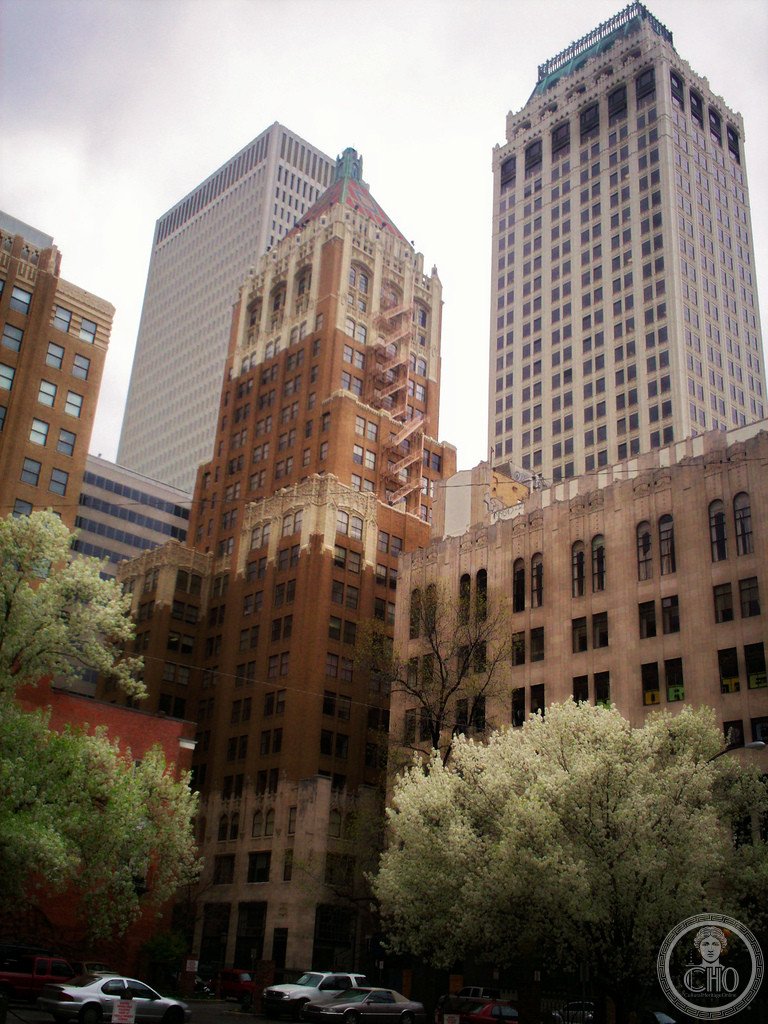
Waite Phillips named it by combining his own surname with “tower,” and the 24-story result is Tulsa’s most Gothic gesture toward the Art Deco era — built the same year as the Philbrook villa two miles south, twin monuments to the same oil fortune.
At a glance
The Philtower stands 24 stories above South Boston Avenue at Third Street in downtown Tulsa, completed in 1927 as the corporate headquarters of oil magnate Waite Phillips. Architect Edward B. Delk designed the building in a Gothic-influenced idiom — pointed arches, terracotta Gothic ornament, and a decorative crown — combined with the setback massing that characterizes Art Deco commercial towers of the period. The Philtower and the Philbrook Museum (the Phillips family estate, also built in 1927) represent the twin peaks of Waite Phillips’s investment in Tulsa during the decade when the city’s oil wealth produced an extraordinary concentration of significant architecture.
Key facts
- Address: 427 South Boston Avenue, Tulsa, Oklahoma 74103
- Completed: 1927
- Stories: 24
- Architect: Edward B. Delk (Kansas City)
- Developer: Waite Phillips (1883–1964)
- Style: Gothic-influenced Art Deco
- Status: National Register of Historic Places; active office building
- Name: “Philtower” — Phil(lips) + Tower
History
Waite Phillips was the younger brother of Frank Phillips, who founded Phillips Petroleum. Waite built his oil fortune independently, accumulating substantial holdings before selling them in 1925 and reinvesting in real estate. In 1927, at the peak of Tulsa’s boom decade, he simultaneously commissioned the Philtower office building and the Philbrook estate — both designed to reflect his success on a city-wide stage.
The building became the downtown center of his business operations. Phillips later gave the Philbrook estate to the city of Tulsa in 1938, stipulating that it become a public art museum — a gift that transformed Tulsa’s cultural landscape. His relationship with the Philtower was more complicated: he at one point gave the building to the Boy Scouts of America, then repurchased it. The building has functioned continuously as a downtown Tulsa office building through multiple ownership changes and remains a functioning commercial address today.
What you see
The Philtower’s lower floors present terracotta pointed-arch windows and Gothic ornamental panels — a vocabulary related to the American Gothic commercial tradition of the Tribune Tower in Chicago and the Woolworth Building in New York, but compressed into a regional oil-boom idiom. Above the lower ornamental zone, the shaft rises in more restrained limestone-and-terracotta courses, building to an elaborate crown with Gothic-derived decorative elements. The contrast between the exuberant Gothic base and the sparer upper shaft is one of the building’s characteristic visual qualities.
The building’s interior lobby preserves original ornamental metalwork and marble finishes from the 1920s. The South Boston Avenue facade is best seen from across the street, where the full vertical composition reads clearly against the Tulsa sky.
Practical information
- Active office building; lobby accessible during business hours
- Exterior terracotta details best examined from South Boston Avenue pavement
- The building sits at the northern end of Tulsa’s most architecturally significant street
- Street parking available on Boston Avenue and adjacent blocks
Getting there
The Philtower is in Tulsa’s downtown core at 427 South Boston Avenue. Tulsa International Airport is approximately 8 miles northeast. Tulsa Transit bus routes serve Boston Avenue. Driving: take US-75 to the downtown exits; the building is at the intersection of 3rd Street and South Boston Avenue.
Nearby
- Philbrook Museum of Art (1927) — Waite Phillips’s companion commission of the same year, the 72-room villa now a world-class art museum at 2727 South Rockford Road, approximately 2.5 miles south.
- Boston Avenue Methodist Church (1929) — Adah Robinson’s National Historic Landmark Art Deco church at 1301 South Boston Avenue, one mile south on the same street.
- Tulsa Art Deco Museum — dedicated to Tulsa’s remarkable concentration of Art Deco architecture, in downtown Tulsa on South Boston Avenue.
Sources
- National Register of Historic Places: Philtower Building nomination
- Wallis, Michael. Oil Man: The Story of Frank Phillips and the Birth of Phillips Petroleum. Doubleday, 1988
- Tulsa Preservation Commission: Philtower Building history
- Tulsa Art Deco Historic District documentation
- Wikimedia Commons: Philtower in Tulsa.jpg (CC BY 2.0)
Find it on the map
See this place and what’s around it →📷 Become a Cultural Heritage Online photographer
Share your photos of places: they stay published under your name as the author. The more they're seen, the more you get noticed — and soon a contest will reward the most appreciated photos.
Log in or sign up free to add a photoIs this page about you?
This page is read by travellers and heritage enthusiasts who find it on Google. Tell us how you are connected to this place and we will take it from there.