
Stone Chronicles of the Central Asian Steppe
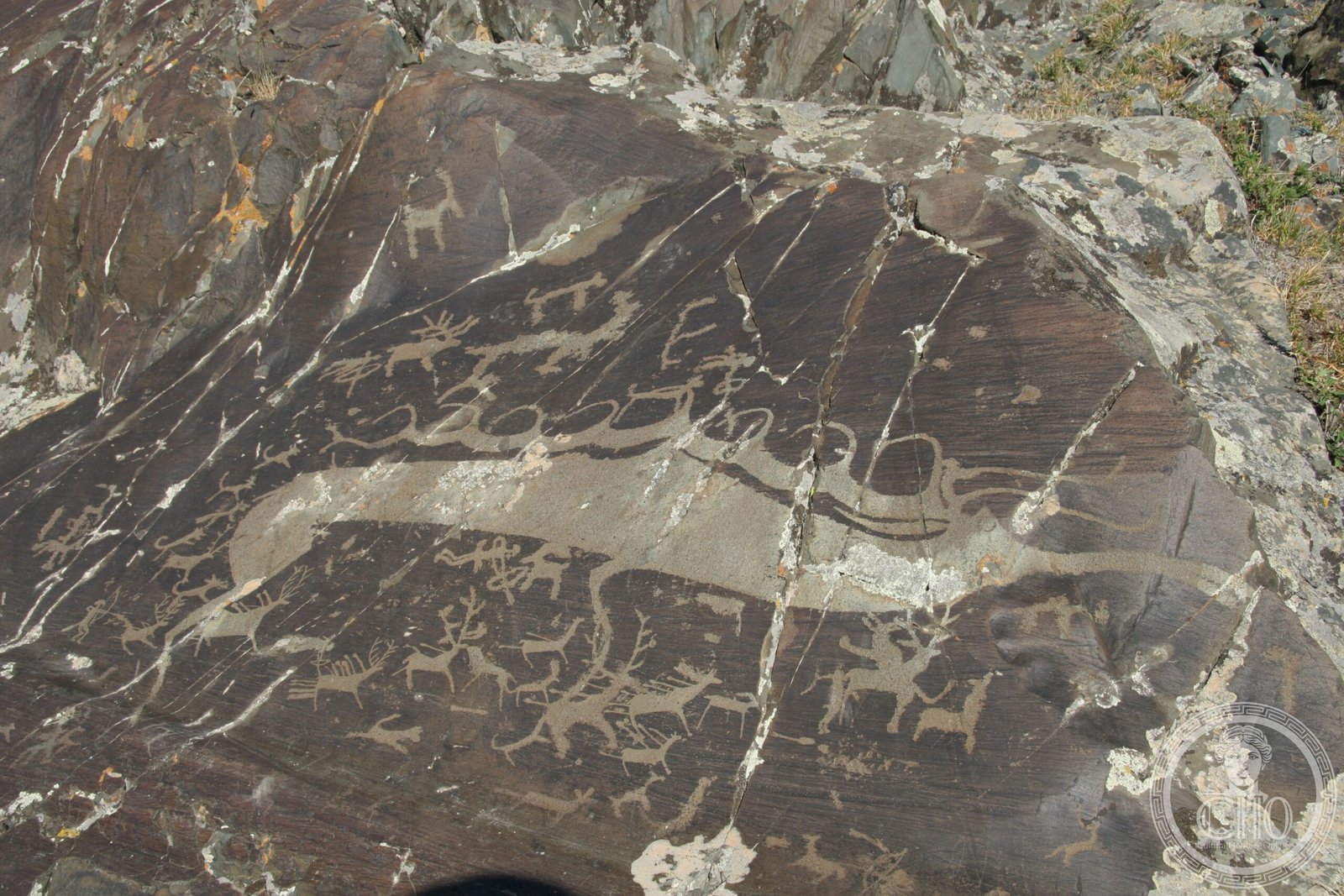
Deep in the Mongolian Altai Mountains, along the valley floors and rocky outcrops of Bayan-Ölgii Province, tens of thousands of petroglyphs have been engraved into dark basalt surfaces over a period spanning roughly 12,000 years. Inscribed by UNESCO in 2011, the Petroglyphs of the Mongolian Altai constitute one of the most extensive and chronologically continuous bodies of prehistoric rock art in Central Asia, recording the lifeways, beliefs, and environment of successive cultures from the Upper Palaeolithic through the Bronze Age.
The Three Principal Clusters
The World Heritage property comprises three distinct clusters. Tsagaan Salaa–Baga Oigor, the largest, contains over 10,000 individual carvings spread across valley walls and boulders near the confluence of two seasonal rivers. Khoid Tsenkheriin Agui (Cave of the Blue Sky North) includes rare polychrome paintings inside a natural rock shelter, among the oldest images in the ensemble. Aral Tolgoi, a rocky promontory above the floodplain, preserves several hundred carvings in exceptional condition due to its sheltered position and hard rock surface.
Scenes of the Palaeolithic World
The earliest carvings, attributed to the Upper Palaeolithic, depict large game animals — woolly rhinoceros, wild horses, ibex, and aurochs — rendered with a confident naturalism that echoes contemporaneous cave art in Western Europe. These images were not merely decorative: they likely served ritual functions related to hunting magic or clan identity in a landscape where megafauna determined survival. The consistent stylistic conventions across widely separated rock faces suggest shared cultural traditions among nomadic bands across the Altai region.
The Transition from Hunting to Herding
The Neolithic and early Bronze Age layers of carving illustrate one of prehistory's most significant cultural transitions: the shift from pure hunter-gatherer subsistence to pastoral nomadism. Images of domesticated cattle, sheep, and horses begin to appear alongside hunting scenes; human figures are shown on horseback and tending herds. The petroglyphs thus provide visual evidence for the domestication of the horse and the emergence of the steppe pastoralism that would define Eurasian civilisation for millennia.
Shamanic and Cosmological Imagery
Many carvings defy simple naturalistic interpretation and are thought to represent shamanic cosmology: antlered humanoid figures, sun discs, ritual dances, and abstracted symbols that recur across the three clusters. Scholars link these images to the deep spiritual traditions of Siberian and Central Asian shamanism, in which shamans served as intermediaries between the human world and the realm of animal spirits. The persistence of these symbolic forms across thousands of years attests to their enduring religious significance.
Environment and Landscape Setting
The petroglyphs are embedded in a dramatic Altai landscape of snow-capped peaks, glacier-fed rivers, and arid steppe valleys. The same natural routes that ancient peoples used to move herds through mountain passes run past many carving sites, suggesting the art was placed at natural waypoints along seasonal migration corridors. The landscape itself is integral to understanding the petroglyphs: the animals depicted are the same species that still inhabit the surrounding mountains, including the Altai argali sheep and the snow leopard.
Research and Ongoing Documentation
Archaeological surveys begun in the 1990s by joint Mongolian–French teams and continued by Mongolian institutions have documented more than 15,000 individual figures across the three clusters, with new carvings still being identified. 3D photogrammetry and digital tracing now allow researchers to capture details invisible to the naked eye and to monitor weathering rates. The documentation database is shared with UNESCO and forms the basis of the site's management plan, which prioritises minimal physical intervention.
Access and Local Communities
The site lies in remote Bayan-Ölgii, the westernmost province of Mongolia, inhabited largely by Kazakh nomadic herders. Access requires travel from Ölgii city by four-wheel-drive vehicle along rough tracks. Local communities serve as informal custodians of the petroglyphs, and the Mongolian government has worked to incorporate Kazakh cultural knowledge into site management. A small visitor centre at Tsagaan Salaa provides orientation, and guided tours led by local rangers are the recommended way to explore the carvings responsibly.
Find it on the map
See this place and what’s around it →📷 Become a Cultural Heritage Online photographer
Share your photos of places: they stay published under your name as the author. The more they're seen, the more you get noticed — and soon a contest will reward the most appreciated photos.
Log in or sign up free to add a photo