
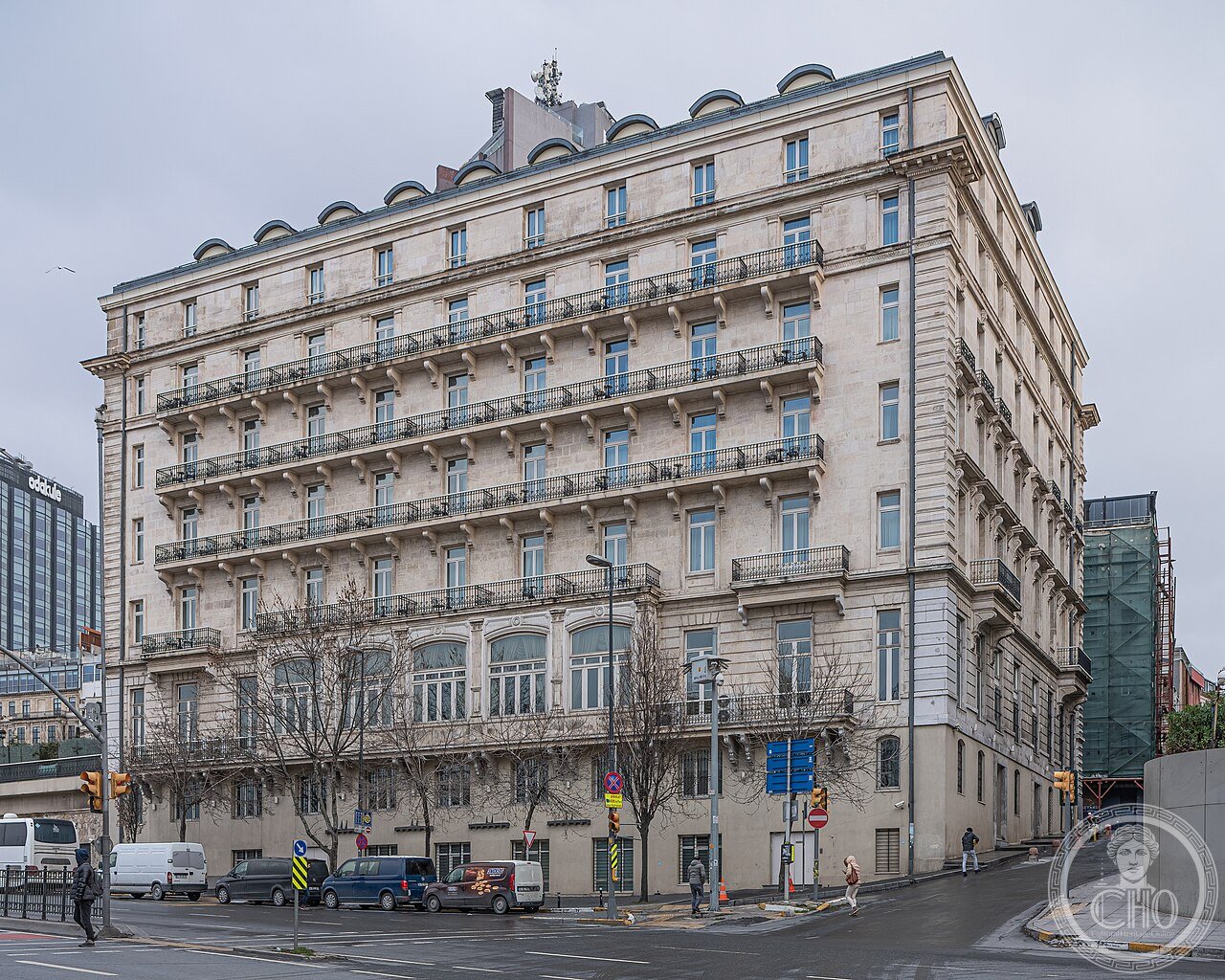
Pera Palace Hotel
Istanbul’s oldest European hotel rose from a practical need — somewhere elegant for Orient Express passengers to sleep — and became the city’s most storied address.
At a glance
Designed by Franco-Ottoman architect Alexandre Vallaury (1850–1921) and completed in 1895, the Pera Palace stands in the Tepebaşı quarter of Beyoğlu as the definitive example of late-Ottoman eclecticism. The building merges a Neoclassical exterior with Art Nouveau ironwork and an Oriental ballroom of gilded arabesques. It was the first building in the Ottoman Empire outside the imperial palaces to have electric lighting, and it housed the second electric elevator in all of Europe. Today the hotel operates as a 115-room luxury museum hotel, protected under Turkish cultural heritage law since 1983.
Key facts
- Built: 1892–1895 by Alexandre Vallaury (1850–1921)
- Style: Neoclassical with Art Nouveau and Oriental interiors
- Status: Operating luxury museum hotel, 115 rooms and 16 suites
- Address: Meşrutiyet Caddesi 52, Tepebaşı, Beyoğlu, Istanbul, Turkey
- GPS: 41.03111, 28.97361 — Open in Google Maps
- UNESCO/Listed: Protected under Turkish Cultural Heritage Law No. 2863 (1983, amended 2004)
History
The hotel was commissioned by the Compagnie Internationale des Wagons-Lits, the company that operated the Orient Express, to provide a fitting arrival point for passengers disembarking in Constantinople. Vallaury broke ground in 1892 and the hotel opened to guests in 1895. From the beginning it offered what no other Istanbul establishment could: hot running water, electric light throughout, and a cage elevator imported from France.
The twentieth century brought turbulence and celebrity in equal measure. A 1941 bomb attack in the adjacent street killed five people and shattered the hotel’s windows. After the Second World War, the property changed hands repeatedly, and it closed in 2006 for a comprehensive structural restoration that lasted four years. The hotel reopened on 1 September 2010 and was subsequently managed by Jumeirah Hotels from 2012 to 2017 before returning to independent ownership.
The Agatha Christie suite — Room 411 — has been preserved as a museum exhibit. Christie was a regular guest between 1926 and 1932, and the hotel is associated with the writing of Murder on the Orient Express. Atatürk also stayed here multiple times between 1915 and 1917; his room likewise survives as a period display.
What you see
The seven-storey facade on Meşrutiyet Caddesi reads as sober Neoclassical — rusticated stone base, arched windows framed by pilasters, a projecting cornice that runs the full width of the building. The palette is cream stone against pale ironwork balconies, restrained by Ottoman standards yet unmistakably European in rhythm and proportion.
Step inside and the register shifts. The Grande Salle ballroom deploys Moorish pointed arches, honeycomb muqarnas plasterwork, and deep burgundy upholstery in a composition Vallaury intended as a visual reference to the palatial interiors passengers had read about before boarding in Paris. The original hydraulic-electric elevator — a narrow cage of wrought iron and bevelled glass — still operates and remains one of the most photographed objects in the building.
Practical information
- Open to hotel guests and restaurant/bar visitors; museum rooms (Agatha Christie Room, Atatürk Room) accessible with hotel management permission
- Best visited in spring (April–May) or autumn (September–October) to avoid peak summer heat
- Guided heritage tours available through the hotel concierge
- Allow 1–2 hours to explore public spaces; overnight stay recommended to access all floors
Getting there
Istanbul Airport (IST) is approximately 50 km away; Sabiha Gökçen Airport (SAW) roughly 55 km. From Taksim Square — the functional centre of European Istanbul — the hotel is a 10-minute walk downhill along Meşrutiyet Caddesi. The nearest metro station is Şişhane (M2 line), a 5-minute walk. Trams (T1 line) stop at Karaköy, from which it is a 15-minute uphill walk through the Galata neighbourhood.
Nearby
- Galata Tower — Medieval Genoese tower (1348), 10-minute walk; panoramic views over the Golden Horn.
- Istanbul Archaeology Museums — Three-museum complex also designed by Vallaury (1891–1907), 25-minute walk through Eminönü.
- Church of Saint Anthony of Padua — Neo-Gothic Catholic church (1913) on İstiklal Caddesi, 5-minute walk.
- İstiklal Caddesi — Ottoman-era grand boulevard with Art Nouveau and Neoclassical apartment facades, directly above the hotel.
Sources
Find it on the map
See this place and what’s around it →Historical events at this place (2)
📷 Diventa un fotografo di Cultural Heritage Online
Condividi le tue foto dei luoghi: restano pubblicate con la tua firma come autore. Più vengono viste, più ti fai conoscere — e presto un concorso premierà le foto più apprezzate.
Accedi o registrati gratis per aggiungere una foto