
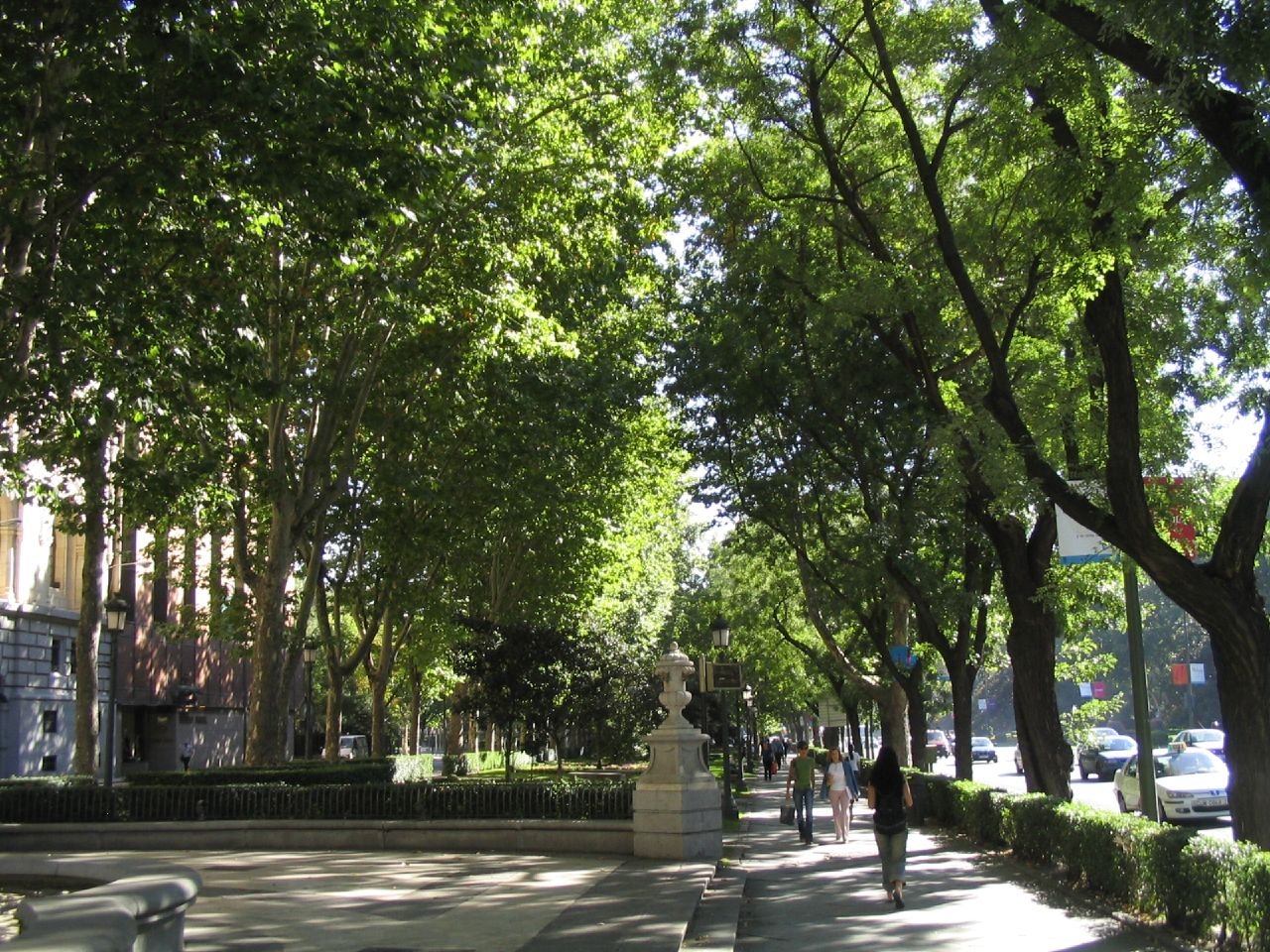
The great cultural axis of central Madrid — a coherent Enlightenment landscape of world-class museums, royal gardens, and public promenades — UNESCO World Heritage Site since 2021 as a Landscape of Arts and Sciences.
At a glance
The Paseo del Prado and Buen Retiro inscription covers approximately 127 hectares in the heart of Madrid, stretching from Atocha station in the south to the Cibeles fountain in the north. What UNESCO recognised in 2021 was not merely a set of individual monuments but a coherent cultural landscape: the rational 18th-century promenade laid out by King Carlos III, the world-class art museums that line it, the botanical garden, and the Buen Retiro park together form one of the world’s great cultural corridors. The three anchor museums alone — the Prado, Thyssen-Bornemisza, and Reina Sofía — hold collections that would individually rank among Europe’s finest. Together, arranged within walking distance on a single Enlightenment boulevard, they constitute an unparalleled concentration of art from the Renaissance to the present day.
Key facts
- UNESCO inscription: 2021, criteria i, ii, iv, and vi.
- Total inscribed area: approximately 127 hectares.
- Promenade created: 18th century, commissioned by King Carlos III, designed with Juan de Villanueva.
- Museo del Prado: opened 1819; world’s finest collection of Spanish painting including Velázquez, Goya, El Greco, and Bosch.
- Museo Thyssen-Bornemisza: the greatest private art collection assembled in the 20th century, donated to Spain.
- Museo Reina Sofía: modern and contemporary art including Picasso’s Guernica.
- Parque del Buen Retiro: 125-hectare royal park with Palacio de Cristal iron-and-glass pavilion and the Estanque boating lake.
- Real Jardín Botánico: Royal Botanic Garden founded 1774.
History
The Paseo del Prado was conceived in the 1760s as part of a Bourbon programme to modernise Madrid along Enlightenment principles. Carlos III, who had previously served as King of Naples and admired Italian rational urbanism, commissioned a redesign of the old meadow (prado) area east of the city centre. Architect Juan de Villanueva created a formal promenade with fountains and neoclassical architecture — one of the first large-scale urban planning projects in Spain. Villanueva also designed a building originally intended as a natural history museum; after the Napoleonic Wars it opened in 1819 as the Prado art gallery, displaying the accumulated royal collections of three centuries of Habsburgs and Bourbons.
The Buen Retiro Park, originally a private royal retreat created for Philip IV in the 17th century, was opened to the public in 1868 following the revolution that overthrew Queen Isabella II. The Crystal Palace within the park — an extraordinary iron-and-glass structure built for the 1887 Philippines Exhibition — is still used for major contemporary art installations under the Reina Sofía. The 20th century added the Reina Sofía museum in a repurposed 18th-century hospital and the Thyssen-Bornemisza collection in the former Villahermosa Palace. Together, 250 years of sequential institution-building created what UNESCO recognised in 2021 as an integrated landscape of arts and sciences.
What you see
Walking the Paseo del Prado from south to north takes about 20 minutes at a gentle pace, but the concentration of institutions means a full exploration requires days. At the southern end, the Museo Reina Sofía occupies a converted 18th-century hospital with a dramatic steel-and-glass extension by Jean Nouvel added in 2005. Guernica — Picasso’s monumental 1937 anti-war painting — hangs in a large room that visitors tend to enter in silence.
The Prado’s main Villanueva building is a long neoclassical structure in granite and brick. Inside, the galleries move chronologically from Flemish and Italian Renaissance masters through the extraordinary Spanish rooms: Velázquez’s Las Meninas, Goya’s Black Paintings, El Greco’s elongated saints. The permanent collection holds over 8,000 works, with around 1,300 on display at any time.
The Parque del Buen Retiro is the city’s democratic park — 125 hectares of formal gardens, promenades, woodland, and open spaces. The Estanque Grande lake at its heart has a rowing-boat hire tradition that predates the park’s public opening. The Palacio de Cristal, set within a naturalistic section of the park, is a remarkable 19th-century iron-and-glass pavilion that functions today as a contemporary art exhibition space.
Practical information
- Museo del Prado: Mon to Sat 10:00 to 20:00, Sun and holidays 10:00 to 19:00; approx. 15 euros; free Mon to Sat 18:00 to 20:00 and Sun 17:00 to 19:00.
- Museo Reina Sofía: Mon and Wed to Sat 10:00 to 21:00, Sun 10:00 to 14:30; closed Tuesday; approx. 12 euros; free Sat after 19:00 and all day Sunday.
- Museo Thyssen-Bornemisza: Tue to Sun 10:00 to 19:00; approx. 13 euros; closed Monday.
- Parque del Buen Retiro: Open daily, free entry; rowing boats available on Estanque Grande for a small fee.
- Paseo del Arte combined ticket: Discounted access to all three major museums; available at any of the three.
- Best season: Spring and autumn for mild weather; mornings and late afternoons best for avoiding queues at the Prado.
Getting there
- By metro: Lines 1 and 2 serve the area; Banco de España for the northern end, Atocha for the southern end, Retiro for the park.
- By high-speed train: Atocha station at the southern tip is Madrid’s main intercity terminus; AVE connections to Barcelona 2.5 h, Seville 2.5 h, Valencia 1.5 h.
- On foot: The entire inscription is comfortably walkable; the Paseo del Prado promenade is a pleasant 1.5 km walk connecting the anchor museums.
- By bus: Numerous EMT Madrid city bus lines serve the Paseo del Prado corridor.
Nearby
- Puerta del Sol and Gran Vía — Madrid’s historic commercial centre and iconic Grand Boulevard, 10 to 15 minutes walk west.
- Barrio de las Letras — The literary quarter where Cervantes and Lope de Vega lived and worked; atmospheric streets with Golden Age connections.
- Royal Palace of Madrid — The Bourbon royal palace and adjacent Almudena Cathedral, one of the largest royal palaces in Europe by floor area; 30 minutes walk west.
- El Escorial — The monumental 16th-century royal monastery-palace of Philip II, UNESCO WHS 1984; approximately 45 km northwest or 1 hour by Cercanías train.
- Aranjuez — The royal summer residence with formal French gardens on the Tagus river, UNESCO Cultural Landscape WHS 2001; approximately 50 km south.
Sources
Find it on the map
See this place and what’s around it →
📷 Become a Cultural Heritage Online photographer
Share your photos of places: they stay published under your name as the author. The more they're seen, the more you get noticed — and soon a contest will reward the most appreciated photos.
Log in or sign up free to add a photo