

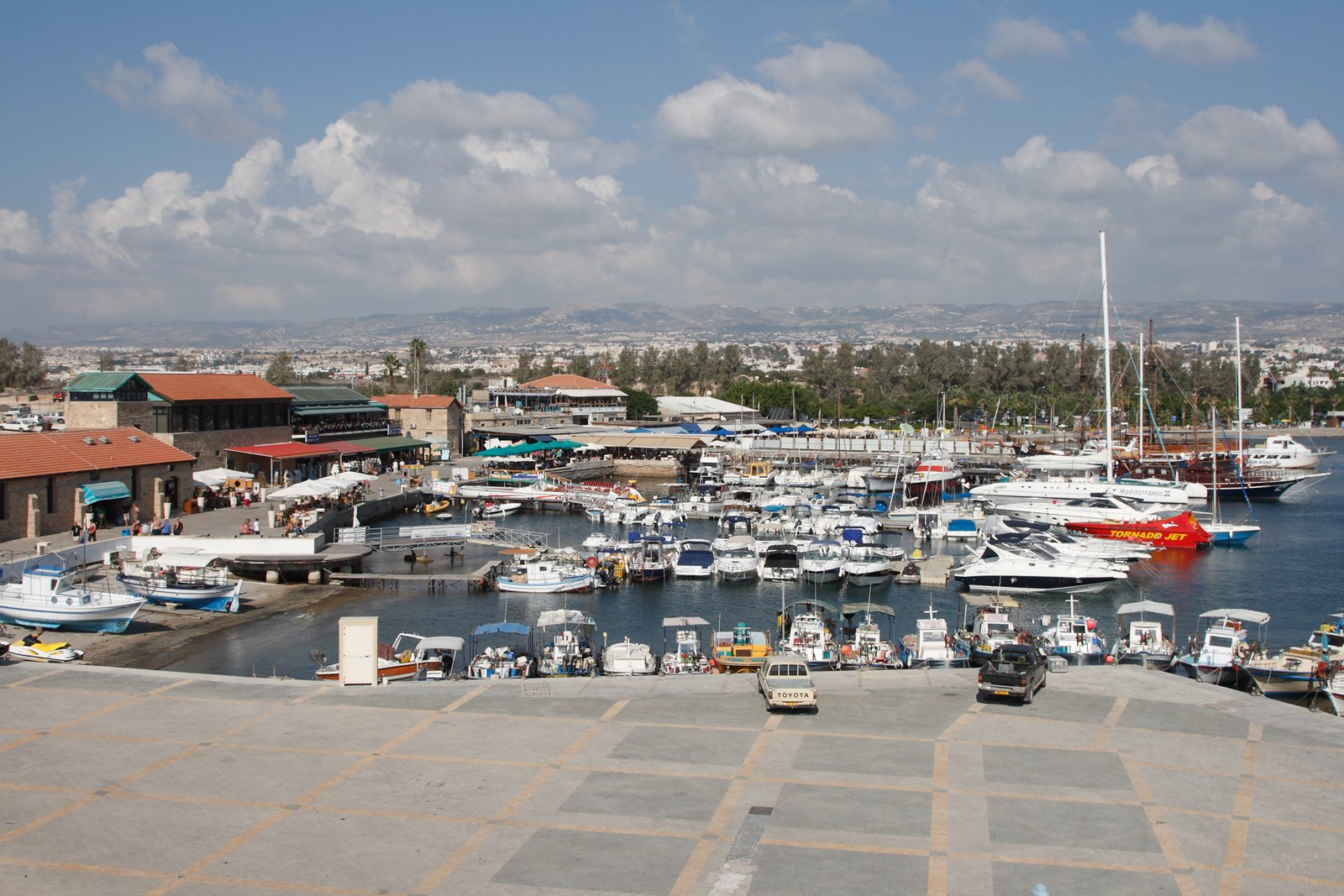
The city on the southwestern tip of Cyprus has been sacred to Aphrodite since antiquity, preserving the legendary birthplace of the goddess at the sea-rock of Petra tou Romiou, the ruins of her ancient sanctuary at nearby Kouklia, and one of the most extraordinary concentrations of late Roman floor mosaics anywhere in the world in the Paphos Archaeological Park.
At a glance
Paphos (also spelled Pafos) is a coastal city at the southwestern tip of Cyprus. It preserves traces of continuous human settlement from prehistoric times to the present, but its fame in antiquity rested on one claim above all others: this was the birthplace of Aphrodite, the Greek goddess of love, beauty, and desire, born from the sea foam near the great rock now called Petra tou Romiou. The Sanctuary of Aphrodite at Kouklia (ancient Palaepaphos, “Old Paphos”) was one of the most important religious sites in the ancient Greek world, drawing pilgrims from across the Mediterranean for over a thousand years. Nearby Kato Paphos (New Paphos), founded in the 4th century BCE and developed into a major Roman city, preserves an archaeological park that UNESCO inscribed as a World Heritage Site in 1980 — notable above all for the extraordinary richness and completeness of its late Roman floor mosaics: the House of Dionysos, House of Aion, Villa of Theseus, and House of Orpheus together form one of the finest mosaic ensembles anywhere in the ancient world.
Key facts
- UNESCO WHS: Paphos inscribed 1980 (the archaeological site of Nea Paphos/Kato Paphos)
- Aphrodite’s birthplace: Petra tou Romiou (Rock of the Greek), c. 25 km east of modern Paphos on the B6 road
- Sanctuary of Aphrodite: Kouklia village (ancient Palaepaphos/Old Paphos), c. 16 km east of modern Paphos
- Key mosaic houses: House of Dionysos (late 2nd–early 3rd century CE), House of Aion (mid-4th century CE), Villa of Theseus (2nd–5th century CE), House of Orpheus (2nd century CE)
- Other monuments: Tombs of the Kings (Hellenistic–Roman rock-cut necropolis), Odeon (2nd century CE), Agora, Saranta Kolones castle (Byzantine/Crusader)
- Roman provincial status: Nea Paphos was the capital of the Roman province of Cyprus from 58 BCE
- Early Christianity: Paul the Apostle and Barnabas visited and converted the Roman proconsul Sergius Paulus here (Acts 13:6–12)
- Modern city: Paphos is the fourth-largest city in Cyprus and a major tourist destination; Paphos International Airport serves direct international routes
History and significance
The area around Paphos has been inhabited since at least the Chalcolithic period (c. 3900–2500 BCE). Old Paphos (Palaepaphos, at modern Kouklia) was the original Bronze Age settlement and the site of the Sanctuary of Aphrodite, which was already established by at least the 12th century BCE, probably incorporating an even older Bronze Age fertility cult. The sanctuary at Kouklia was not a typical Greek temple with a cult statue; instead, it centred on a large conical stone (a baetyl or sacred stone), understood to be the embodiment of Aphrodite herself. Pilgrims came from across the Greek world — from Sappho’s Lesbos to the cities of Ionia — to worship at Palaepaphos.
New Paphos (Nea Paphos, at modern Kato Paphos) was founded as a port city approximately in the late 4th century BCE, reputedly by the Cypriot king Nikokles. It quickly grew in importance and became the capital of the Roman province of Cyprus after Rome’s annexation of the island in 58 BCE. The city’s wealth in the Roman period is reflected in the richness of its private mosaic floors: the House of Dionysos, discovered in 1962, preserves extraordinarily vivid scenes from Greek mythology including the story of Pyramus and Thisbe (one of the earliest known visual representations of this tale) and a famous Triumph of Dionysos. The Villa of Theseus — one of the largest private Roman buildings yet excavated in Cyprus — preserves a central mosaic of Theseus killing the Minotaur surrounded by a complex composition of Cretan geography. The House of Aion contains a five-panel mosaic of exceptional artistic quality, including a scene of the beauty contest of Cassiopeia judged by the Nereids.
Christianity came early to Paphos: the Book of Acts records that Paul and Barnabas visited the city around 45–46 CE and converted the Roman proconsul Sergius Paulus — one of the earliest recorded conversions of a Roman official to Christianity. Paphos suffered severe damage in earthquakes in 15 BCE and 77 CE and was gradually rebuilt, but the earthquakes of the 4th century CE, including the great earthquake of 365 CE, further reduced the city. By the Byzantine period, Paphos had diminished in political importance, though it remained a bishop’s seat. The medieval Frankish, Venetian, and Ottoman periods added further layers: the Tombs of the Kings (a rock-cut necropolis used by wealthy citizens, not actual royalty) are Hellenistic in origin but visible and accessible; the Saranta Kolones castle (Forty Columns) is a Byzantine fortress later used by the Crusaders and destroyed by another earthquake in 1222 CE.
What you see today
The Paphos Archaeological Park (Kato Paphos) is the UNESCO-inscribed site and the main area for visitors. The mosaic houses are covered by large protective canopy structures, with original mosaics visible in situ on the floors. The House of Dionysos is the best-preserved and most visited: a tour through its chambers reveals one of the finest collections of figurative Roman mosaics in existence. The House of Aion, smaller but of exceptional artistic quality, preserves its five-panel mythological composition. The Villa of Theseus and House of Orpheus complete the mosaic sequence. Outside the mosaic houses, the reconstructed columns and foundations of the Odeon (a small Roman theatre) and the agora area are visible, along with the ruined towers of Saranta Kolones castle. The Tombs of the Kings, about 2 km north of the archaeological park along the coast, are a separate UNESCO-associated site: a series of monumental rock-cut tombs of Hellenistic and Roman date, some with Doric peristyle courtyards — an extraordinary funerary landscape above the sea. Petra tou Romiou (the Rock of Aphrodite), about 25 km east on the coastal B6 road, is the legendary birthplace of Aphrodite: a group of sea stacks rising from turquoise water, one of the most photographed coastal landscapes in the Mediterranean.
Practical information
- Paphos Archaeological Park address: Kato Paphos, near the harbour (follow signs from the harbour front)
- Opening hours: Daily 08:15–17:00 (winter); 08:15–19:30 (summer); closed Christmas and New Year
- Admission: €4.50 adults for the main site; combined tickets with Tombs of the Kings available; Tombs of the Kings €2.50 separately
- Sanctuary of Aphrodite, Kouklia: Separate site, c. 16 km east; own admission €2.50; museum on site with finds including the original sacred stone (baetyl)
- Petra tou Romiou: Free access, roadside pull-offs on the B6; no facilities at the site itself
- Time needed: Paphos Archaeological Park: 2–3 hours; allow a full day for Park + Tombs + Sanctuary of Aphrodite at Kouklia
Getting there
Paphos International Airport (PFO) is one of Cyprus’s two international airports, with direct services to the UK, Germany, and other European cities. The archaeological park is in Kato Paphos (Lower Paphos), approximately 12 km from the airport. Within Paphos, local buses connect the airport, Kato Paphos harbour, and the main town. By car, the B6 coastal road connecting Paphos with Limassol passes Petra tou Romiou and the Sanctuary of Aphrodite at Kouklia; the drive from Paphos to Limassol takes approximately one hour. Kourion (about 40 km east) and Choirokoitia (about 55 km east) are comfortably combined with Paphos in a multi-day Cyprus itinerary.
Nearby
- Sanctuary of Aphrodite, Kouklia (Palaepaphos) — the ancient seat of the goddess’s cult, 16 km east; museum with the sacred conical stone
- Petra tou Romiou — the legendary birthplace sea-rock of Aphrodite, 25 km east on the B6 coastal road
- Akamas Peninsula — rugged coastal wilderness north of Paphos; sea turtle nesting beaches, Byzantine monastery of Agios Neophytos
- Kourion — clifftop Greco-Roman city with earthquake-victim skeletons and exceptional theatre, about 40 km east
- Tombs of the Kings — monumental Hellenistic/Roman rock-cut necropolis above the sea, 2 km north of the archaeological park
Sources
- UNESCO World Heritage List: Paphos (no. 79)
- Department of Antiquities, Republic of Cyprus: Nea Paphos Archaeological Site
- Daszewski, W.A. and Michaelides, D. Mosaic Floors in Cyprus. Ravenna, 1988
- Karageorghis, V. Cyprus: From the Stone Age to the Romans. Thames and Hudson, 1982
- Wikipedia: Paphos
Find it on the map
See this place and what’s around it →📷 Become a Cultural Heritage Online photographer
Share your photos of places: they stay published under your name as the author. The more they're seen, the more you get noticed — and soon a contest will reward the most appreciated photos.
Log in or sign up free to add a photo