
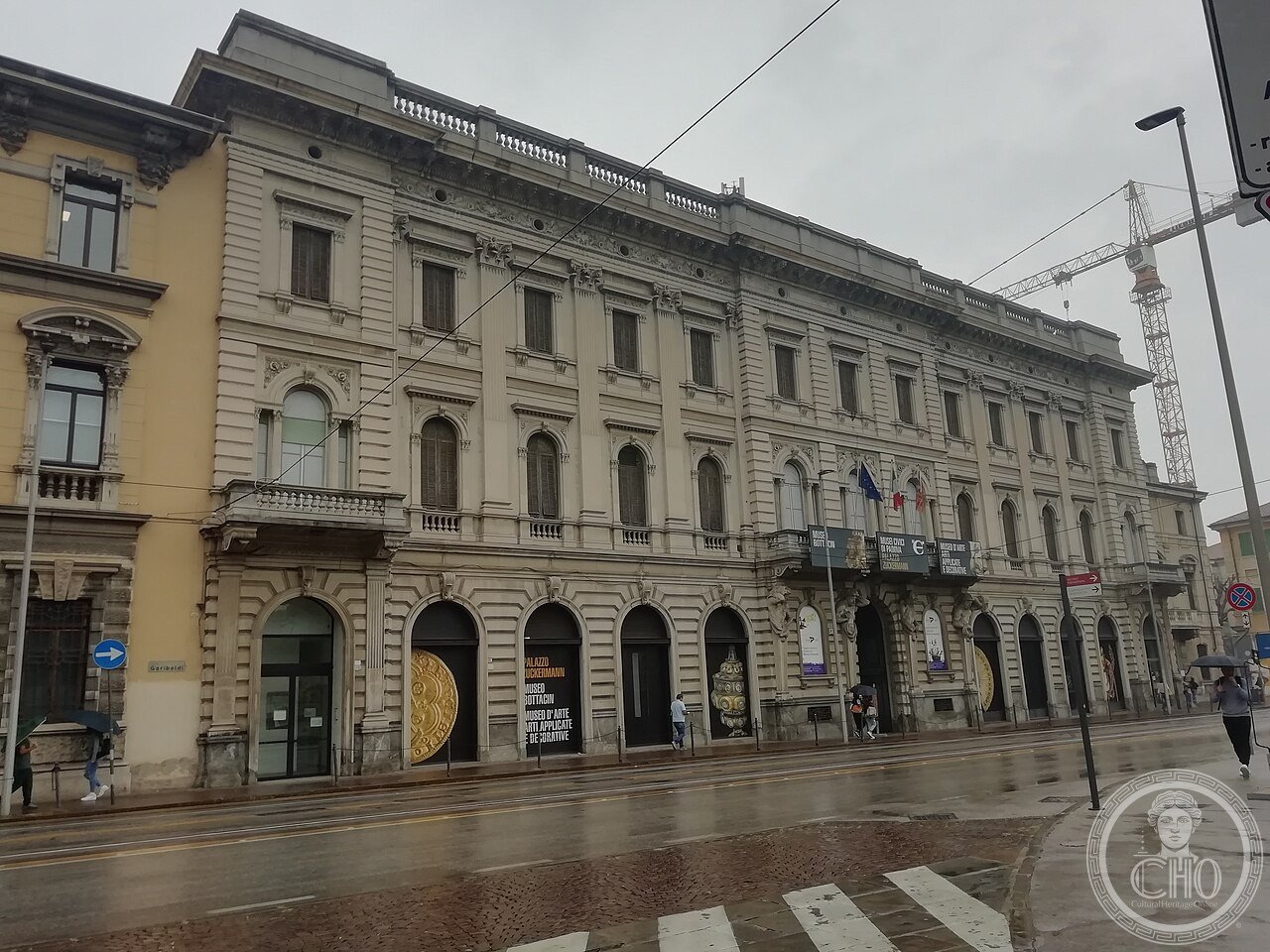

A Milanese architect’s eclectic statement on Padova’s main boulevard, built for an industrial entrepreneur in 1912–14 and now home to the Museo Bottacin’s celebrated coin collection and over two thousand works of applied art.
At a glance
Palazzo Zuckermann stands on Corso Garibaldi 33, steps from the Eremitani and the Scrovegni Chapel. Designed by Milanese architect Filippo Arosio between 1912 and 1914 for the industrial entrepreneur Cavalier Enrico Zuckermann, the building blends neoclassical massing with the curvilinear ornament and abundant glazing characteristic of the Italian Liberty movement at its late, more restrained phase. Since 2004 it has been part of the Padova Civic Museums, welcoming more than 350,000 visitors in 2022 alone.
Key facts
- Architect: Filippo Arosio (Milan)
- Client: Cavalier Enrico Zuckermann, co-owner of Zedapa metalware company
- Completed: 1914
- Address: Corso Garibaldi 33, 35122 Padova
- Style: Eclectic with Liberty references
- Current use: Museo di Palazzo Zuckermann (Padova Civic Museums)
- Opened as museum: 2004
- Visitors (2022): 350,156
- GPS: 45.4116, 11.8781
History
Enrico Zuckermann commissioned the palazzo at the height of his family’s involvement in Padova’s metallurgical industry; the company Zedapa, of which he was co-owner, made the family name a fixture of the city’s industrial expansion in the decade before World War One. The architect chosen, Filippo Arosio, was a Milanese practitioner working in the eclectic tradition but alive to the Liberty language then circulating through Italy’s northern cities.
The building’s post-war history included occupation by US military personnel, whose informal contribution remains visible on the attic level: a cycle of sports murals painted during their stay. After decades of varied use the palazzo was transferred to the Padova Civic Museums system. The two-year renovation completed in 2004 created a purpose-built museum environment while preserving the original staircase, courtyard, and principal rooms.
What you see
The facade deploys neoclassical compositional grammar — symmetrical bays, cornice articulation, a rusticated base — but the window surrounds and decorative panels carry the sinuous lines and stylised floral motifs that link the building to the Liberty movement. The multiple windows on each floor were designed to flood the interior with light, a preoccupation shared across Italian Art Nouveau domestic architecture of the period.
Inside, the Carrara marble staircase is the spatial centrepiece: its three-arch landing is lit by a stained glass window whose colour and pattern set the tone for the collection rooms above. The central courtyard preserves a section of Padova’s Roman city wall, making the palazzo an accidental archaeology site as much as a fin-de-siècle residence.
The collections
The ground and first floors house the Museum of Applied Arts, with over 2,000 works spanning the medieval period to the twentieth century: sixteenth-century majolica ceramics, eighteenth-century intarsia furniture, historic clothing, and jewellery. The second floor is reserved for the Museo Bottacin, one of Italy’s most important private numismatic collections. Its holdings include Greek, Roman, Byzantine, medieval, and Renaissance coins; a complete series of Venetian regional emissions; a comprehensive group of medals by the sixteenth-century Padovan goldsmith Giovanni Cavino; and paintings, sculptures, and antique weapons. A bronze bust of Doge Paolo Renier by Antonio Canova anchors the fine-arts section.
Practical information
- Opening hours: Check current times at padovamusei.it
- Admission: Combined ticket available with other Padova Civic Museums
- Time needed: 1–1.5 hours for both collections
- Accessibility: Elevator available to all floors
- Nearest landmark: Musei Civici Eremitani and Scrovegni Chapel are adjacent
Getting there
From Padova Centrale station, Corso Garibaldi is a 15-minute walk north-east. Palazzo Zuckermann is at n. 33, immediately adjacent to the Musei Civici Eremitani complex and minutes from the Scrovegni Chapel. By tram: take the SIR1 line to Eremitani stop. The palazzo and the Scrovegni Chapel can be combined in a half-day itinerary.
Sources
- Wikipedia (Italian): Palazzo Zuckermann
- Padova Musei Civici: padovamusei.it
- Wikimedia Commons: File:Padova – palazzo Zuckermann – 202109161135.jpg, photo by Luca.favorido, CC BY-SA 4.0
- Nominatim / OpenStreetMap: GPS 45.4116, 11.8781
Find it on the map
See this place and what’s around it →Record researched and written by Carla Szathvary for Cultural Heritage Online, 2026.
📷 Become a Cultural Heritage Online photographer
Share your photos of places: they stay published under your name as the author. The more they're seen, the more you get noticed — and soon a contest will reward the most appreciated photos.
Log in or sign up free to add a photoIs this page about you?
This page is read by travellers and heritage enthusiasts who find it on Google. Tell us how you are connected to this place and we will take it from there.