


A merchant’s palazzo on the south side of the Arno attributed to Bernardo Rossellino, notable for its rare surviving graffito facade and — for forty years — the headquarters of one of Italy’s leading institutes for the conservation and restoration of art.
At a glance
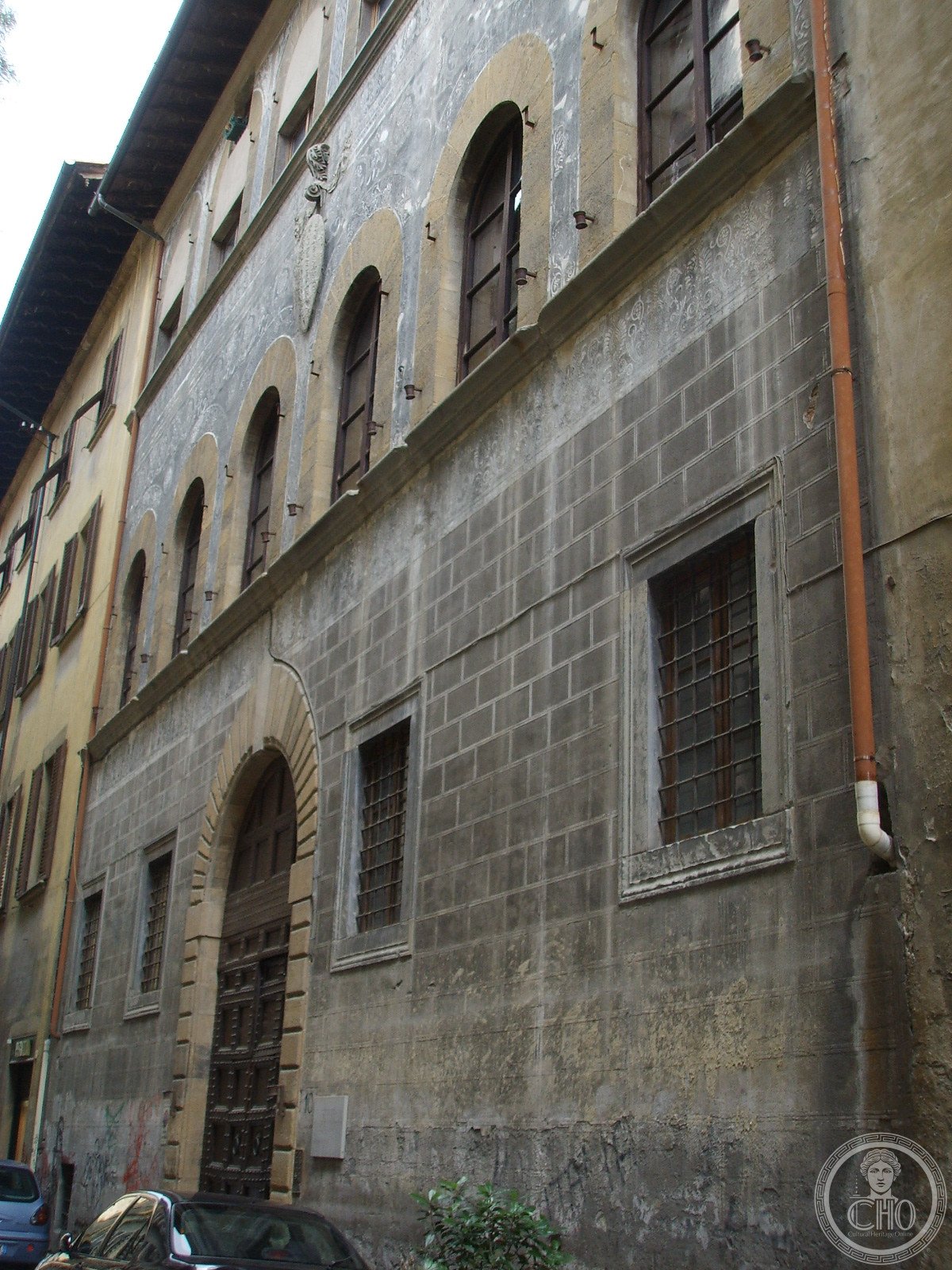
Palazzo Spinelli stands at Borgo Santa Croce 10 in the Oltrarno-adjacent quarter east of Santa Croce, one of the less-visited but architecturally distinguished streets in central Florence. Built between 1460 and 1470 for Tommaso Spinelli — treasurer to Pope Paul II and patron of the second cloister at Santa Croce — the palazzo is attributed to Bernardo Rossellino, the Florentine architect and sculptor who worked on Santa Croce for the same patron. Its defining external feature is a rare surviving graffito decoration: floral monochrome drawings scratched into the rendered facade above the rusticated ground floor, documented and photographed in the 1960s as among the best-preserved examples in the city.
Key facts
- Client: Tommaso Spinelli, treasurer to Pope Paul II
- Attributed architect: Bernardo Rossellino (also attributed: Il Cronaca)
- Built: c. 1460–1470
- Address: Borgo Santa Croce 10, 50122 Florence
- Heritage status: Listed in the 1901 national inventory of monumental buildings
- Istituto per l’Arte e il Restauro: headquartered here 1978–2010
- GPS: 43.7680, 11.2610
History
Tommaso Spinelli was among the most powerful Florentine bankers of the mid-fifteenth century: banker to the papacy, financier of Santa Croce’s second cloister and a chapel inside the church, owner of properties in Rome and a palazzo on the Grand Canal in Venice. His commission for Borgo Santa Croce was at the peak of that prosperity, and the architect he chose — Bernardo Rossellino, already active at Santa Croce for the same patron — was among the most accomplished of the generation trained under Brunelleschi and Alberti. The attribution has been contested (the name of Simone del Pollaiuolo, called Il Cronaca, has also been raised), but the palazzo’s design is consistent with Rossellino’s documented work in scale and in the handling of the portal.
The palazzo passed out of Spinelli hands at the end of the nineteenth century, passing by inheritance to the Rasponi di Ravenna and then, from 1934, to the Marchesi Malenchini, who commissioned a restoration by the Livornese architect Lando Bartoli. Further works by Mannelli and Cesare Benini in the 1920s and by Bartoli again between 1962 and 1965 modified the interior distribution while preserving the facade. In 1978, the piano nobile was occupied by the Istituto per l’Arte e il Restauro — one of Italy’s principal schools for the conservation of art, architecture, and heritage objects — which maintained its headquarters here until 2010.
What you see
The facade is the building’s principal attraction. The ground floor is rusticated with carved stone; above it, two upper floors carry the graffito decoration — a technique in which patterns are scratched through a dark plaster coat to reveal a lighter layer beneath, producing a monochrome drawing in negative. At Palazzo Spinelli the graffito presents floral motifs with rose imagery: alluding, as the documentation notes, to the thorns of the stem that give the Spinelli family their name. A band of rose-decorated decoration runs at first-floor level; above it, the pattern changes. The portal, unusually large for a Florentine house of this period, has a slightly projecting bugnato (rusticated stone) frame and is marginally off-axis with the interior entrance — a detail that became a standard observation in the architectural literature on the building.
The palazzo’s interior retains elements of the original spatial organisation: the courtyard, the main staircase, and portions of the decorated plaster surfaces that document the breadth of the original programme. The coat of arms — chiselled but still legible — remains above the portal.
Practical information
- Access: Exterior fully visible from Borgo Santa Croce at any time
- Interior: Not regularly open to the public; check for periodic openings via palazzospinelli.org
- Context: 5-minute walk from Santa Croce basilica and square
- Restoration courses: The non-profit Associazione Palazzo Spinelli continues to offer conservation and restoration training programmes in Florence
Getting there
From Santa Croce square, walk east along Borgo Santa Croce; the palazzo is at n. 10, on the right after two blocks. From Florence Santa Maria Novella station, bus C2 to Piazza Santa Croce (20 minutes). From Lungarno Generale Diaz, walk north 300 m. The building is easily combined with a visit to Santa Croce basilica (Michelangelo and Galileo tombs, Giotto frescoes) and the Museo dell’Opera di Santa Croce.
Nearby
- Basilica di Santa Croce — 300 m west, Franciscan Gothic basilica with Giotto frescoes, Michelangelo and Galileo tombs
- Museo Horne — 200 m south-west, a Renaissance palazzo housing a private collection of Florentine paintings and furniture
- Biblioteca Nazionale Centrale — 400 m south, Italy’s largest library, with regular exhibitions
- Ponte alle Grazie and Ponte Vecchio — 700 m west, on the Arno
Sources
- Wikipedia (Italian): Palazzo Spinelli (Firenze)
- Associazione Palazzo Spinelli: palazzospinelli.org
- Wikimedia Commons: File:Palazzo spinelli 01.JPG, Sailko, CC BY-SA 3.0
- Nominatim / OpenStreetMap: GPS 43.7680, 11.2610
Find it on the map
See this place and what’s around it →📷 Become a Cultural Heritage Online photographer
Share your photos of places: they stay published under your name as the author. The more they're seen, the more you get noticed — and soon a contest will reward the most appreciated photos.
Log in or sign up free to add a photoIs this page about you?
This page is read by travellers and heritage enthusiasts who find it on Google. Tell us how you are connected to this place and we will take it from there.