
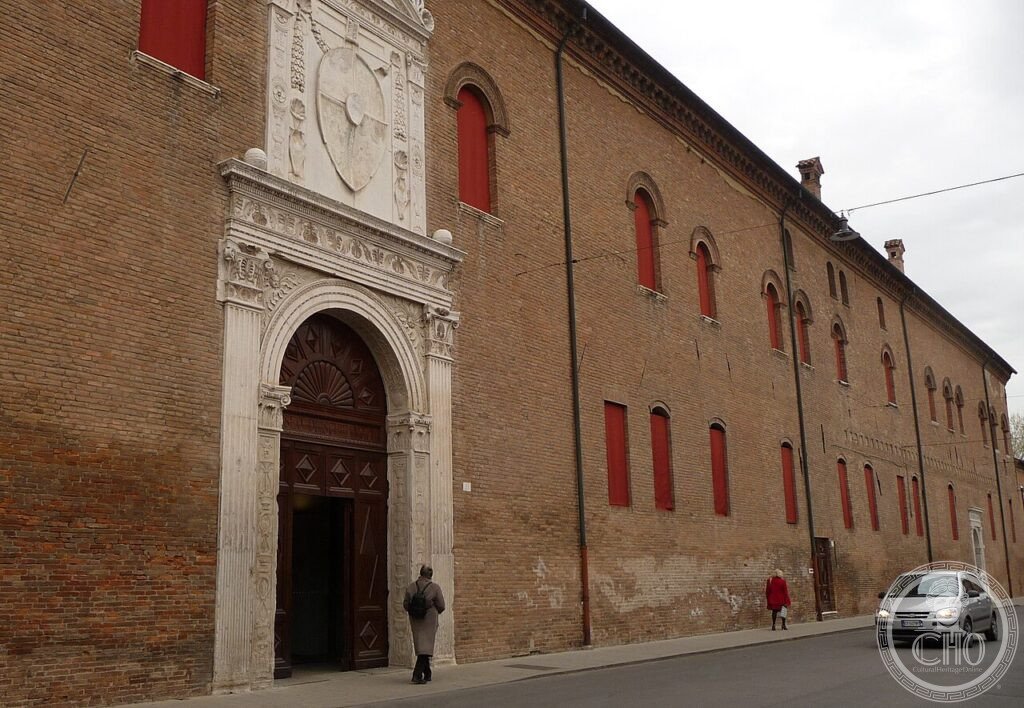
The most important secular fresco cycle in fifteenth-century Italy — twelve months of the court life of Borso d’Este, Duke of Ferrara, painted across the three registers of the Salone dei Mesi (1469–1471) by Francesco del Cossa and Ercole de’ Roberti, in a palace called “Schifanoja” (flee boredom) that Alberto V d’Este built in 1385 at the edge of the city as a pleasure residence — a pictorial document of unparalleled richness for the study of late medieval court culture, astrology, and classical iconography in Renaissance northern Italy.
At a glance
The Palazzo Schifanoia (from “schivar la noja,” flee boredom) is a late medieval–early Renaissance pleasure palace built at the eastern edge of Ferrara’s historic centre. It was begun in 1385 for Alberto V d’Este and substantially enlarged in the 1460s–1470s, when Borso d’Este commissioned the Salone dei Mesi — the hall of months — to be decorated with a complete fresco cycle representing each month of the year in three registers: the lowest register showing scenes from Borso’s court life; the middle register showing the decans (astrological sub-divisions of each month), derived from Arabic astronomical manuscripts; the upper register showing the Olympian deity who governs each month in the classical tradition.
The palace is included in the UNESCO inscription “Ferrara, City of the Renaissance, and its Po Delta” (1995, ref. 733), which covers the historic city centre and the delta landscapes to the east.
Key facts
- Construction: 1385 (Alberto V d’Este); enlarged 1460s–1470s (Borso d’Este)
- Salone dei Mesi: main hall 24 × 11 m; fresco cycle 1469–1471; three registers per month (court life / astrological decans / Olympian deities)
- Artists: Francesco del Cossa (April, March, May documented); Ercole de’ Roberti; other hands (not all months attributed securely)
- March month fresco: best-preserved; shows Borso d’Este hawking, attended by court; above: the decans of March (figures from Arabic astronomical tradition, unique in Italian Renaissance); above: Minerva ruling over March
- Cossa letter: 1470 letter from del Cossa to Borso protesting his payment rate (same per square foot as the other painters, despite his superior quality); the earliest known document in which a Renaissance artist demands differential payment for quality
- Museum: Museo Civico d’Arte Antica housed in the palace since 1898; collections of Este period goldsmith’s work, bronzes, paintings
- UNESCO: 1995, ref. 733 — “Ferrara, City of the Renaissance, and its Po Delta”
- GPS: 44.8366, 11.6245 — Google Maps
History
The palace takes its name from the Este family’s intention that it should be a place where the stresses of governance would not be allowed to intrude: “schifar la noia” in fourteenth-century Italian means specifically to “flee boredom,” and the palace’s location — just outside the main city fabric, at the edge of the Este gardens — was designed to make it a self-contained world for leisure and culture. Alberto V d’Este, who built the first structure in 1385, was continuing a tradition of Este pleasure palaces that went back to the Delizia di Belfiore, begun in 1386.
The major phase of construction came under Borso d’Este (Duke of Modena 1452–1471; first Duke of Ferrara from 1471), who enlarged the palace and commissioned the Salone dei Mesi fresco cycle. The choice to document each month of the court year in three registers — court life below, astrology in the middle, Olympian mythology above — reflects the specific intellectual culture of the Ferrara court under Borso: the Este had employed Guarino Veronese and the humanist circle that produced the first Italian translations of Plato and Aristotle; the interest in Arabic astronomical manuscripts (which provided the iconography of the astrological decans, unprecedented in Italian painting) was part of the same intellectual programme.
What you see
The palace exterior is unassuming — brick, with the addition of a marble portal added in the sixteenth century — and gives little sense of what is inside. The Salone dei Mesi occupies the entire first floor: a room 24 metres long and 11 metres wide, with the fresco cycle running continuously around three walls. The fourth wall (the window wall) has been partially damaged and is not painted. The cycle originally covered twelve months in full; today only six months (March through September) survive in good condition, and the condition is uneven: March and April are the best preserved, while some other months have lost their lower registers entirely to damp.
The most famous section is the April month panel, attributed entirely to Francesco del Cossa: the court scene shows Borso d’Este presiding over a hawking expedition, surrounded by a crowd of identifiable courtiers and attendants (some of whom can be matched to Este court records), with a landscape of the Po Delta behind them. In the middle register, the April decans are shown as exotic figures based on a Latin translation of an Arabic astrological treatise (the Picatrix); in the upper register, Venus rules April, surrounded by her court of lovers and musicians. The Cossa letter of 1470, in which the artist protests his fee, is reproduced in the museum and is essential reading for understanding the social position of the Renaissance artist.
Gallery
![Title: Allegory of April
Artists: Francesco del Cossa, Ercole de’ Roberti [1]](https://culturalheritageonline.com/wp-content/uploads/2026/06/Allegory_of_April_-_Francesco_del_Cossa_-_1-783x1024.jpg)
Practical information
- Museum: Via Scandiana 23, Ferrara. Open Tuesday–Sunday 9:30–18:00; closed Monday. Admission ~€6; free on the first Sunday of the month. The Salone dei Mesi is on the first floor and requires climbing the main staircase.
- Lighting: The Salone is large and sometimes underlit; bring binoculars to read the upper register (Olympian deities) which is 4–5 metres above floor level.
- Combined tickets: Available with other Ferrara civic museums (Palazzo dei Diamanti, Museo Medievale e Moderno, Casa Romei).
- Duration: 45–60 minutes for the Salone and the museum collections.
Getting there
Via Scandiana 23, Ferrara. In the eastern part of the historic centre, 15 minutes on foot from the Castello Estense and the railway station. By bus: Ferrara is a cycling city; most visitors arrive by bicycle (rental stations throughout the historic centre) or on foot. By train: Ferrara station is 20 minutes on foot from Palazzo Schifanoja or 10 minutes by bus (line 1 direction Piazza Travaglio). By car: A13 Bologna–Padova, exit Ferrara Nord or Ferrara Sud; follow signs to the historic centre; park at Piazzale Medaglie d’Oro or via the park-and-ride at the periphery (ZTL historic centre). From Bologna: 55 km, 40 minutes by train or 50 minutes by car (A13).
Nearby
- Castello Estense — 15 minutes west on foot; the moated Este fortress built by Niccolò II in 1385; the same year as Palazzo Schifanoja; still the symbolic centre of the city; the dungeons where Parisina Malatesta and Ugo d’Este were executed in 1425 can be visited
- Palazzo dei Diamanti — 10 minutes north-west; the extraordinary Este palace whose exterior is entirely clad in 8,500 diamond-point rusticated marble blocks (Biagio Rossetti, 1493–1567); one of the great Renaissance palace facades in Italy; now the main exhibition venue of Ferrara arte
- Cattedrale di Ferrara (San Giorgio) — 15 minutes west; Romanesque-Gothic cathedral begun 1135; the marble facade (1200–1230) with carved Months of the Year on the south portal is a direct visual precedent for the Salone dei Mesi theme
Sources
- UNESCO: whc.unesco.org/en/list/733
- Wikipedia EN: Palazzo Schifanoia
- Warburg, Aby: Italian Art and International Astrology in the Palazzo Schifanoia, Ferrara, 1912 (the foundational study; reprinted in “The Renewal of Pagan Antiquity,” Getty, 1999)
- Dempsey, Charles: The Portrayal of Love: Botticelli’s Primavera and Humanist Culture at the Time of Lorenzo the Magnificent, Princeton UP, 1992
Gallery
![Title: Allegory of April
Artists: Francesco del Cossa, Ercole de’ Roberti [1] and Gherardo di Andrea Fiorini.[2]
A wall painting from the Hall of the Months in the Schifanoia Palace, Ferrara.
Date: around 1469[2]
This is an extracted image. The original file can be found here: https://commons.wikimedia.org/wiki/File:Schifanoia Triumph Venus.jpg](https://culturalheritageonline.com/wp-content/uploads/2026/06/Allegory_of_April_-_Francesco_del_Cossa_-_1.jpg)
Find it on the map
See this place and what’s around it →📷 Become a Cultural Heritage Online photographer
Share your photos of places: they stay published under your name as the author. The more they're seen, the more you get noticed — and soon a contest will reward the most appreciated photos.
Log in or sign up free to add a photoIs this page about you?
This page is read by travellers and heritage enthusiasts who find it on Google. Tell us how you are connected to this place and we will take it from there.