
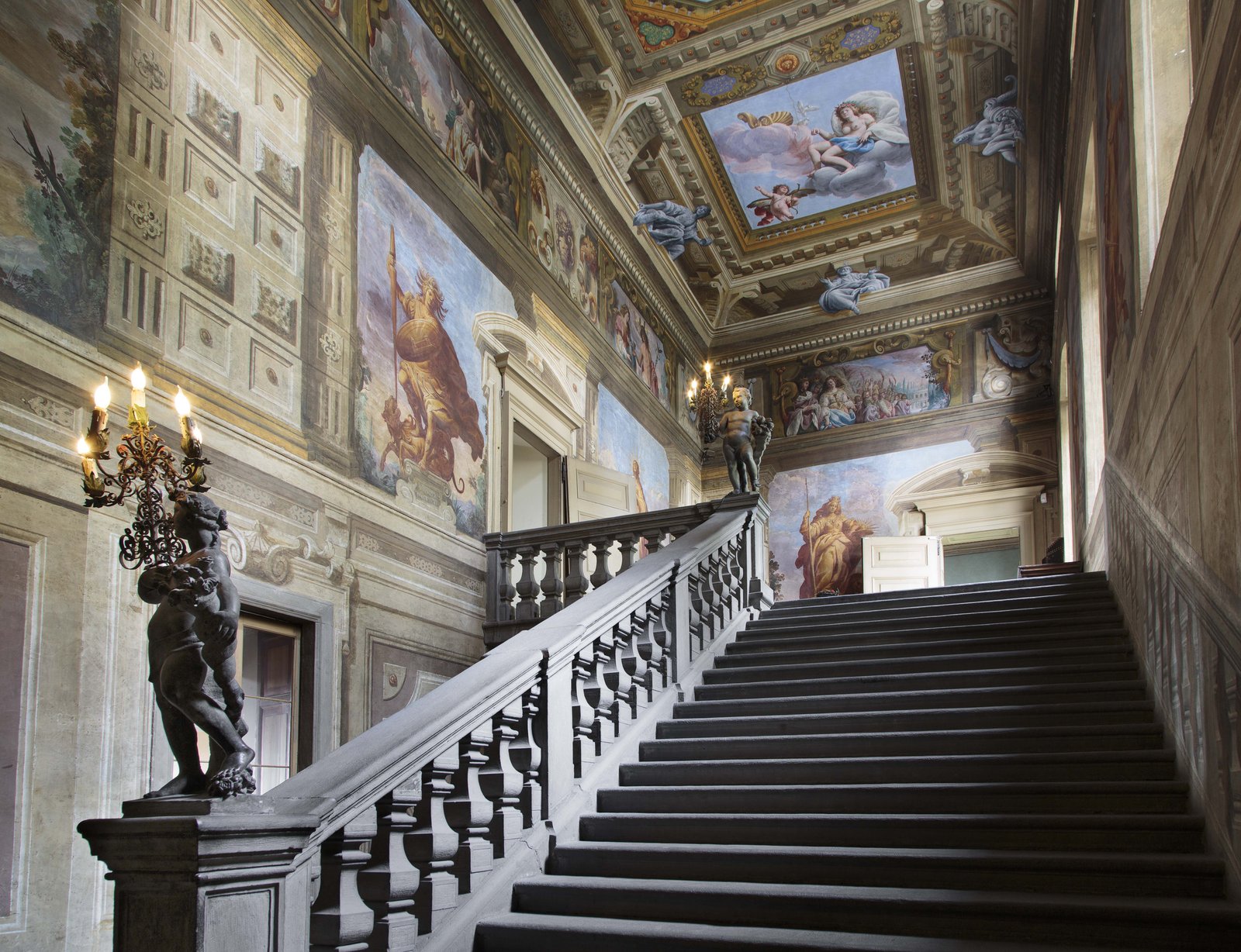
A Baroque palace in upper Bergamo, frescoed wall to ceiling by Gian Giacomo Barbelli and still hung with its Moroni portraits, above two hectares of terraced garden.
At a glance
Palazzo Moroni rises on Via Porta Dipinta, in the upper town of Bergamo. Francesco Moroni built it between 1646 and 1655 to mark his family’s rise, and the Moroni kept it for almost four centuries. Its piano nobile holds one of the earliest great fresco cycles of the Lombard Baroque, painted by Gian Giacomo Barbelli, whose subjects give the rooms their names. The gallery keeps three portraits by the sixteenth-century Bergamo master Giovan Battista Moroni, among them the Knight in Pink. Behind the house, Italian terraces and a two-hectare kitchen garden fall away down the hill — the largest private historic park in Città Alta. The Fondo Ambiente Italiano has run the palace since 2019.
Key facts
- Location: Via Porta Dipinta 12, Bergamo Città Alta, Lombardy
- Built: 1646–1655, for Francesco Moroni (1606–1674)
- Frescoes: Gian Giacomo Barbelli (1604–1656), 1649–1655, to a programme by Father Donato Calvi
- Gallery: three portraits by Giovan Battista Moroni, including the Knight in Pink (1560)
- Garden: Italian terraces and an ortaglia of about two hectares
- Managed by the FAI: since 2019
History
By the mid-seventeenth century the Moroni were among Bergamo’s leading families, and Francesco Moroni wanted a house to say so. Between 1646 and 1655 he raised the palace on Via Porta Dipinta, in the walled upper town, with rooms grand enough for a noble line on the rise.
To decorate them he turned to Gian Giacomo Barbelli, a painter from Cremona, who frescoed the piano nobile between 1649 and 1655 to an iconographic programme drawn up by the scholar-priest Donato Calvi. The result — the Age of Gold, the Giants, Hercules, Jerusalem Liberated — is among the first and most lavish flowerings of the Baroque in Lombardy. The family also kept paintings, including three portraits by the great sixteenth-century Bergamo painter Giovan Battista Moroni.
The Moroni held the house for almost four hundred years, leaving its rooms, gardens and collection unusually intact. In December 2019 the Fondazione Museo di Palazzo Moroni and the Fondo Ambiente Italiano agreed to restore, manage and open it; the palace and its gardens are now regularly open to the public.
What you see
The visit climbs. From the courtyard the frescoed Scalone d’onore leads up to the piano nobile, where Barbelli’s ceilings turn each room into its own myth. The Sala dell’Età dell’Oro holds the Moroni portraits, the Knight in Pink — Gian Gerolamo Grumelli, painted in 1560 — chief among them. Later rooms add nineteenth-century furniture, French porcelain and a Chinese drawing room.
Then the garden. Italian terraces step down the Colle di Sant’Eufemia past a nymphaeum and a hanging garden; below them spreads the ortaglia, two hectares of orchard and kitchen garden — real countryside inside the city walls, and the largest private historic park in Città Alta.
Practical information
- Open to visitors as a FAI property; check FAI opening times and booking
- Palace and gardens are both part of the visit — allow for stairs and slopes
- The garden is best in spring and autumn
- Allow 1.5 to 2 hours
Getting there
Palazzo Moroni is in Bergamo’s Città Alta, the walled upper town, on Via Porta Dipinta near the Sant’Agostino gate. The upper town is reached from the lower city by the funicular or on foot; Bergamo is on rail lines from Milan, and its airport lies a few kilometres out. Città Alta is largely pedestrian.
Nearby
- Piazza Vecchia and the Cappella Colleoni
- The Venetian walls of Bergamo (UNESCO World Heritage)
- The Accademia Carrara gallery
Sources
- Fondo Ambiente Italiano (FAI) — property page
- Visit Bergamo
- Wikipedia — Palazzo Moroni
- Fondazione Museo di Palazzo Moroni
Find it on the map
See this place and what’s around it →📷 Become a Cultural Heritage Online photographer
Share your photos of places: they stay published under your name as the author. The more they're seen, the more you get noticed — and soon a contest will reward the most appreciated photos.
Log in or sign up free to add a photoIs this page about you?
This page is read by travellers and heritage enthusiasts who find it on Google. Tell us how you are connected to this place and we will take it from there.