
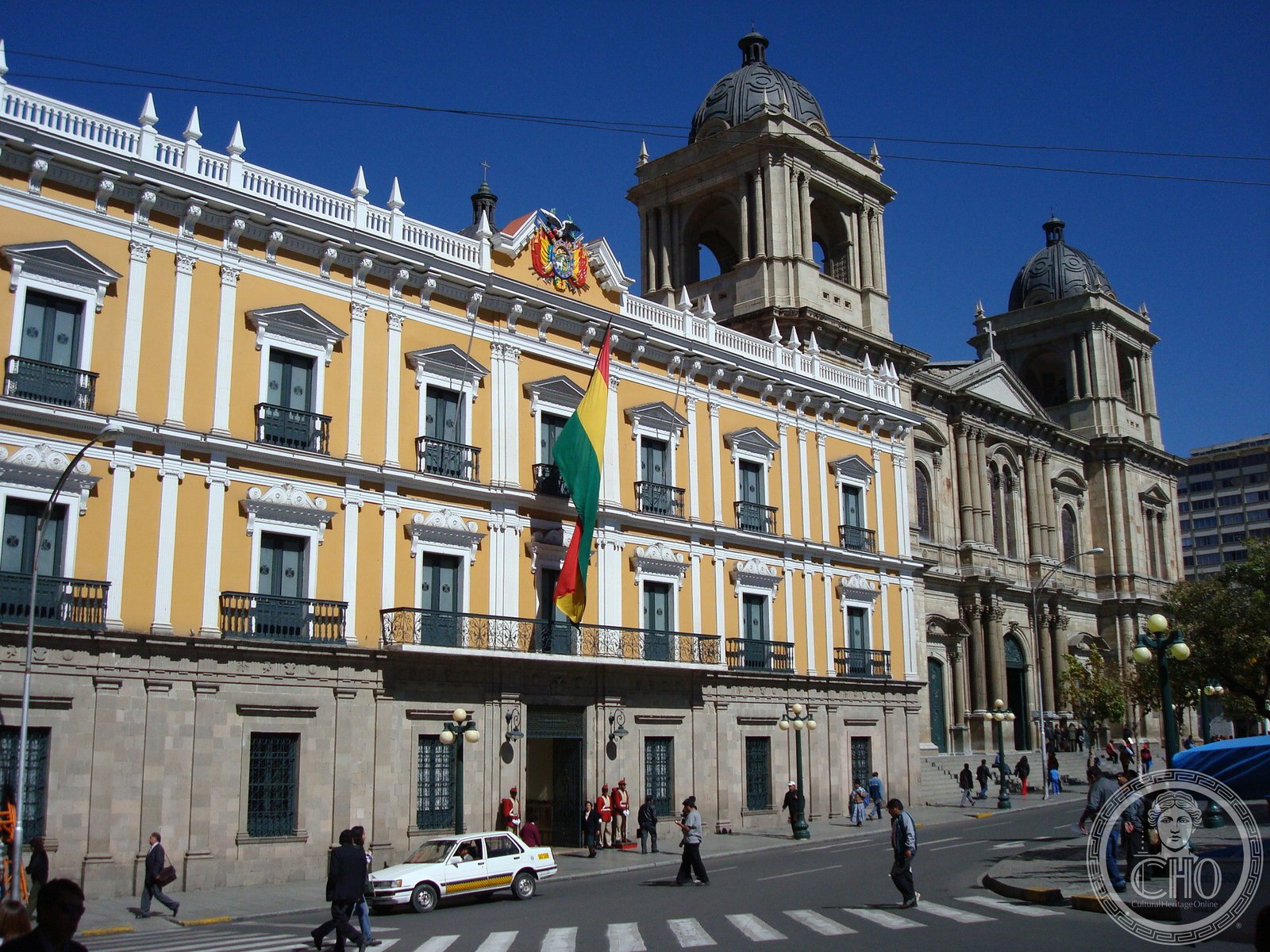
Bolivia’s presidential palace on Plaza Murillo in La Paz carries one of South America’s most violent sobriquets: the Burned Palace. The building has twice been torched by political mobs — first in 1875 during a coup against President Tomás Frías, and again in 1899 during the Federal Revolution — and its current neoclassical facade dates from a thorough reconstruction completed in 1907. The palace faces the Metropolitan Cathedral and the Legislative Palace across Plaza Murillo, forming one of the few intact colonial and neoclassical civic ensembles on the continent. Its most notorious moment came on 21 July 1946, when President Gualberto Villarroel was dragged from the building by a mob, hanged from a lamppost in the plaza below, and left on public display — an event that shocked the Western Hemisphere and resonated through Bolivian politics for decades. Since then the palace has witnessed military coups, democratic transitions, the Che Guevara era, and the political upheavals of the 2000s. It remains the seat of Bolivia’s executive power and the symbolic heart of the republic.
At a glance
- Type
- Presidential palace / government building
- Period
- Reconstructed 1907 (original 18th century)
- Style
- Neoclassical
- Location
- Plaza Murillo, La Paz, Bolivia
- Coordinates
- 16.4958° S, 68.1335° W
- Architect(s)
- Antonio Camponovo (1907 reconstruction)
Overview
The Palacio Quemado occupies the western flank of Plaza Murillo, La Paz’s ceremonial heart, at an altitude of approximately 3,640 metres above sea level — making it one of the highest national palaces in the world. The building serves as the official seat of Bolivia’s President and houses the executive offices of government. It is flanked by the neoclassical Legislative Palace (Congreso Nacional) and the Baroque-fronted Metropolitan Cathedral, together forming an ensemble that encapsulates three centuries of Bolivian civic architecture.
History
A colonial government building on this site dates to the 18th century. Political violence gave the palace its name: it was burned during the coup against President Tomás Frías in 1875, and gutted again during the Federalist civil war of 1899. The current neoclassical structure was rebuilt under architect Antonio Camponovo and completed in 1907 during the Liberal Party government of Ismael Montes. The defining trauma of the palace’s modern history occurred on 21 July 1946, when President Gualberto Villarroel — a nationalist populist aligned with Juan Perón — was hanged by a mob from a lamppost in Plaza Murillo, his body left exposed for hours. The palace survived the 1964 military coup of René Barrientos, the dictatorship of Hugo Banzer, the transition to democracy in 1982, and the popular uprisings of 2003 and 2019.
Architecture & Design
The facade is a restrained Neoclassical composition: a central portico with Ionic columns, a symmetrical arrangement of tall windows with pediment detailing, and a balcony on the piano nobile from which presidents have addressed crowds in Plaza Murillo. The interior retains its 19th-century reception rooms — gilded salons, formal audience chambers, and a ceremonial staircase. The building’s pale stone exterior, modest by the standards of European and North American presidential palaces, reflects Bolivia’s republican austerity and the high-altitude building traditions of the Andean plateau. The plaza ensemble — palace, cathedral, congress — was modelled loosely on Lima’s Plaza Mayor but at far smaller scale.
Cultural significance
The Palacio Quemado is the most politically charged building in Bolivia. Its burnt walls carry the memory of coups, popular uprisings, and constitutional transitions across 200 years of republican history. The hanging of President Villarroel in 1946 remains the single most traumatic event in modern Bolivian political memory. For Bolivians, the palace is both the seat of legitimate authority and the target of popular fury — a duality that no other building in the country embodies so completely. Plaza Murillo, which the palace anchors, was designated a protected heritage ensemble by the La Paz municipality.
Visiting today
The Palacio Quemado is not open to the public on a regular basis. Guided tours of the state rooms are occasionally organised on national holidays and during cultural heritage days. The exterior and Plaza Murillo are freely accessible at all times. The Changing of the Guard ceremony takes place at the palace entrance on weekdays. The nearby Museo Nacional de Arte and the Calle Jaén museum complex are accessible and provide essential context for colonial and independence-era La Paz.
Getting there
Plaza Murillo is in the historic centre of La Paz, approximately 1.5 km from the modern financial district of Sopocachi. By public transport: minibuses and micro-buses serving the city centre stop within 300 metres; the Mi Teleférico cable car network (Línea Roja) has a station at Mercado Lanza, a 10-minute walk. By taxi: 10–20 minutes from most central hotels depending on traffic. The city centre is largely pedestrianised around the plaza.
Sources & resources
Find it on the map
See this place and what’s around it →📷 Become a Cultural Heritage Online photographer
Share your photos of places: they stay published under your name as the author. The more they're seen, the more you get noticed — and soon a contest will reward the most appreciated photos.
Log in or sign up free to add a photoIs this page about you?
This page is read by travellers and heritage enthusiasts who find it on Google. Tell us how you are connected to this place and we will take it from there.