
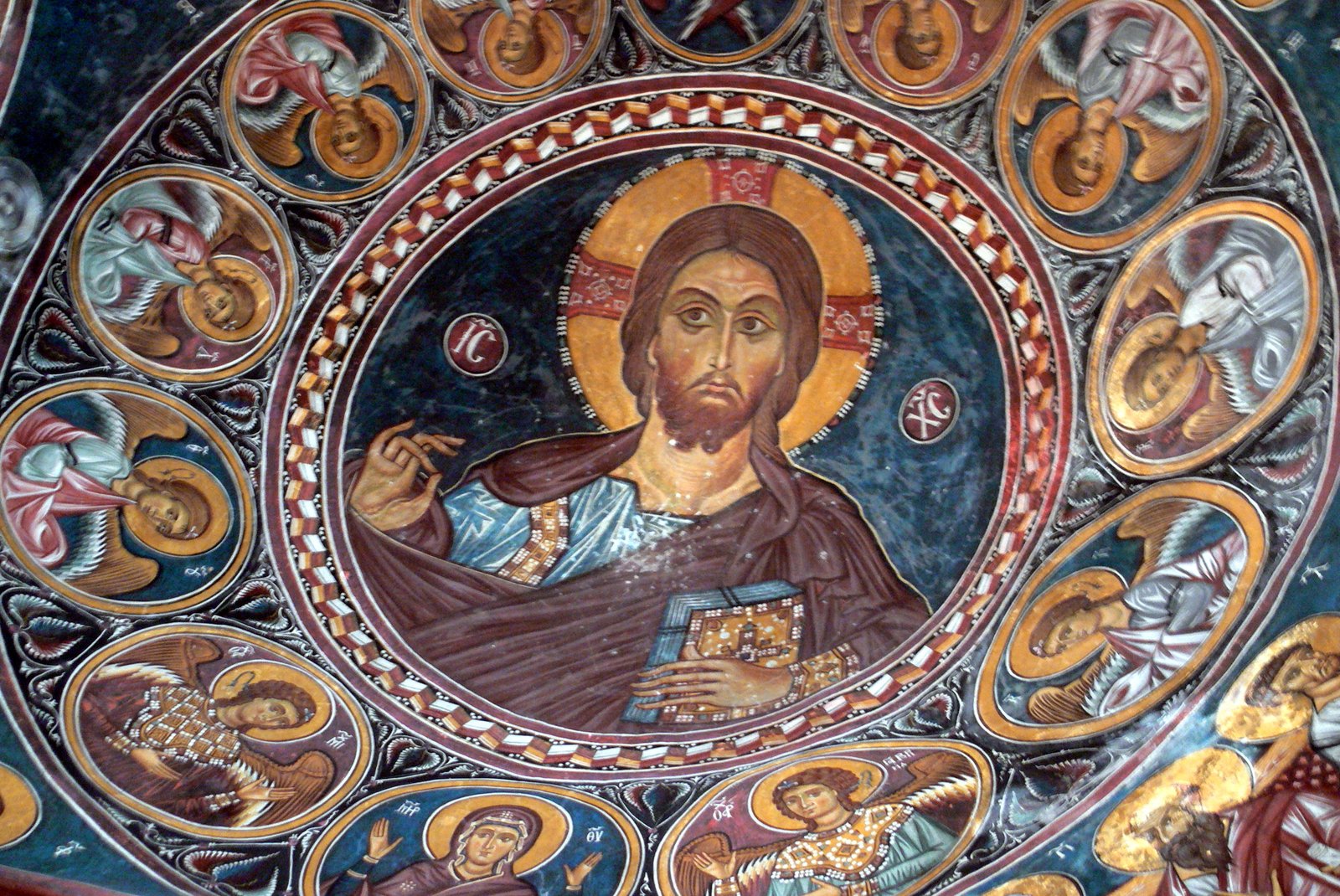
Nine Byzantine churches hidden in the mountains of central Cyprus contain a thousand years of unbroken Christian wall painting — among the finest Byzantine frescoes surviving anywhere in the Mediterranean world.
At a glance
The Troodos mountain range of central Cyprus was, for centuries, a place apart. While Byzantines, Crusaders, Venetians, and Ottomans each ruled the island’s coastal cities, the mountain communities were left largely to themselves — and it is in these mountain villages that an extraordinary tradition of Byzantine church painting survived intact. Nine churches and monasteries are inscribed by UNESCO (first in 1985, extended in 2001), their stone walls and timber-roofed interiors covered floor-to-ceiling with narrative frescoes spanning eleven centuries. Nowhere else in the Mediterranean can you trace the evolution of Byzantine painting — from rigid hierarchical formality to the expressive naturalism of the late Palaeologan period — in such a concentrated area.
Key facts
- UNESCO inscription: 1985 (initial, 3 churches); extended 2001 to 9 churches — World Heritage Site
- Period: 11th–18th century CE (Byzantine and post-Byzantine)
- Location: Troodos mountain range, Limassol District, central Cyprus
- Number of inscribed churches: 9
- Most famous church: Asinou Church (Panagia Forviotissa), 1105 CE — called the finest 12th-century Byzantine painting outside Constantinople
- Oldest inscribed church: Asinou Church (1105 CE)
- Art tradition: Byzantine and post-Byzantine wall painting, evolving over 1,000 years
History
Cyprus was a Byzantine province from the 7th century until 1191, when the island was seized by Richard I of England during the Third Crusade and subsequently ruled by the Crusader Lusignan dynasty. The Venetians followed (1489), then the Ottomans (1571). Each successive ruler held the coastal cities; the mountain communities retained their Greek Orthodox identity and their tradition of church building and decoration.
The earliest of the inscribed churches date to the late Byzantine period (11th century), when Cyprus was still a prosperous part of the Byzantine Empire and Constantinopolitan artistic influences flowed freely to the island. The frescoes of this period — hieratic, formally arranged, with gold grounds — are among the finest provincial Byzantine painting that survives anywhere.
Under the Lusignan Crusaders (12th–15th centuries), the Orthodox mountain communities continued to commission churches and frescoes — now absorbing some Gothic stylistic details from the Catholic Franks while maintaining the Byzantine iconographic programme. The result is a uniquely Cypriot synthesis: Byzantine theology expressed in increasingly humanised figures.
Under Venetian and Ottoman rule (15th–18th centuries), the tradition continued at diminished scale, producing the post-Byzantine paintings that complete the chronological sequence. The relative isolation of the mountain villages protected the churches from both iconoclasm and commercialisation.
What you see
The nine inscribed churches share a characteristic form: small stone structures, many with steep pitched timber roofs added in the medieval period to shed heavy mountain snow, built over earlier Byzantine chapels. Their exteriors are deliberately plain — the artistic wealth is entirely inside.
Asinou Church (Panagia Forviotissa, 1105 CE) is the masterpiece of the group. Its interior has been called the most complete example of 12th-century Byzantine painting outside Constantinople — every surface is covered in narrative cycles (the Dormition of the Virgin, the Last Judgment, the Forty Martyrs of Sebaste) painted with the refinement of Constantinopolitan court artists. The narthex was added in the 13th century and contains further layers of painting.
Agios Neophytos Monastery (1159 CE) is extraordinary for its origin: the monk Neophytos carved a hermit’s cave (enkleistra) into the cliff face and painted it himself, including a painted biography of his own life — perhaps the only medieval saint’s self-portrait cycle anywhere. The monastery grew up around his cave after his death.
Kykkos Monastery (11th century) is the wealthiest institution in Cyprus, founded by Emperor Alexios I Komnenos. It holds one of only three icons of the Virgin Mary said to have been painted by Luke the Evangelist, and its treasury contains gold and silver offerings accumulated over nine centuries.
The other inscribed churches — Panagia tou Araka, Church of the Nativity (Lagoudera), Stavros tou Agiasmati, Panagia of Podithou, Agios Nikolaos tis Stegis, and Timios Stavros of Pelendri — each contain substantial fresco cycles representing different phases and styles of the tradition.
Practical information
- Access: Most churches are locked; a caretaker holds the key and must be found locally (usually in the nearest village) — this is standard practice and part of the experience
- Opening hours: Variable; most accessible mornings daily; Asinou has a resident caretaker on site most days
- Admission: Small donation requested at most churches (€1–2)
- Dress code: Modest dress required — shoulders and knees covered; head coverings for women
- Photography: Permitted in most churches; flash photography may be restricted to protect the ancient frescoes
- Best time to visit: April–June and September–October; July–August is hot but the mountains are cooler than the coast
Getting there
The Troodos mountain churches are spread across a wide area of central Cyprus. A car is essential — there is no public transport to most of the inscribed churches. The nearest major city is Limassol, approximately 50 km south of the Troodos summit. Nicosia is 65 km north. The mountain roads are narrow and scenic; allow a full day to visit even 3–4 of the inscribed churches. A recommended circuit starts at Asinou Church (near Nikitari village, 50 km from Nicosia), then continues to Agios Nikolaos tis Stegis (near Kakopetria), Panagia tou Araka (near Lagoudera), and Lagoudera’s Church of the Nativity.
Nearby
- Troodos village and Mount Olympos — the highest point in Cyprus (1,952 m); ski resort in winter, hiking trails in summer
- Kykkos Monastery — the most visited and wealthiest monastery in Cyprus, accessible by paved road from Pedoulas village
- Omodos village — picturesque mountain village with the Timios Stavros Monastery, wine cellars, and traditional architecture
- Limassol — major coastal city 50 km south; Limassol Medieval Castle (13th century) and seafront promenade
- Paphos — 75 km west; UNESCO World Heritage Site with Roman mosaics and Tombs of the Kings
Sources
Find it on the map
See this place and what’s around it →📷 Become a Cultural Heritage Online photographer
Share your photos of places: they stay published under your name as the author. The more they're seen, the more you get noticed — and soon a contest will reward the most appreciated photos.
Log in or sign up free to add a photo