
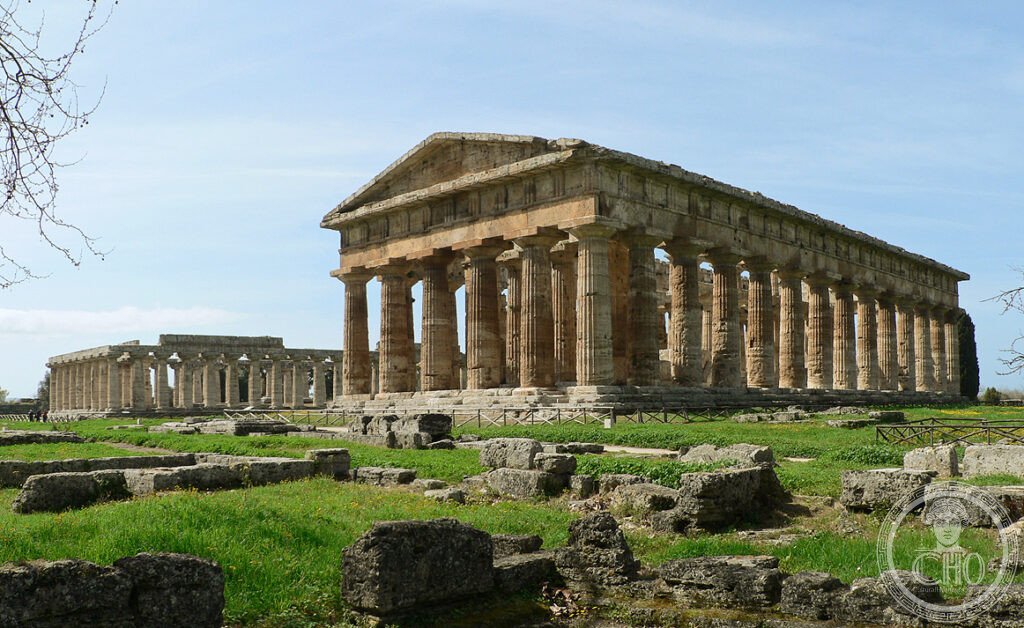
Paestum preserves three Doric temples among the best kept anywhere outside Greece, raised by Greek colonists on the Piana del Sele and left largely untouched as the ancient city slipped beneath vegetation and marshland for centuries before its rediscovery in the eighteenth century.
At a glance
Paestum lies on the Piana del Sele, a flat coastal plain in the Cilento region of Campania, about 40 km south of Salerno. The site preserves the remains of Posidonia, a Greek colony founded around 600 BCE by settlers from Sybaris, itself an Achaean colony from the Peloponnese. The Romans later renamed the city Paestum in 273 BCE. Its ancient walls, once five kilometres in circumference, are still partly visible.
Three Doric temples survive in varying states of preservation: the Temple of Hera I, known as the Basilica and dated to around 550 BCE; the Temple of Poseidon, built between 460 and 450 BCE and the best preserved of the three; and the Temple of Ceres, dated to around 500 BCE and now thought to have been dedicated to Athena.
Key facts
- Temple of Poseidon: built 460–450 BCE, measuring 59.98 m by 24.26 m, with six columns across the short sides and fourteen along the long sides.
- Material: travertine limestone quarried locally, the same stone used for the Basilica and the Temple of Ceres.
- Construction: blocks fitted without mortar, held by weight and precision cutting; the largest blocks weigh around 8 tonnes.
- Interior: two rows of seven columns inside the cella divide it into a nave and two aisles; the original wooden roof has not survived.
- Tomb of the Diver: painted tomb slabs dated 480–470 BCE, discovered in 1968, now held in the Museo Nazionale di Paestum.
History
Posidonia was founded around 600 BCE by colonists from Sybaris, who chose the site for its fertile plain and sheltered anchorage at the mouth of the Sele river. Around 400 BCE the Lucanians, an Italic people from the Apennines, conquered the city and renamed it Paistos in the Oscan language. The Greek population lost its former status but the temples remained in religious use, as archaeological evidence attests.
Rome established a Latin colony here in 273 BCE and renamed the city Paestum; a Roman forum was built between the two principal Greek temples, and Greek, Lucanian and Roman populations coexisted. Saracen raids in 549 CE devastated the city, and its inhabitants withdrew inland to the hilltop settlement now known as Capaccio. The abandoned city was gradually covered by vegetation and by the rising water table of the coastal plain, whose marshes brought malaria that persisted until land drainage in the 1920s. The temples survived partly because they were used as sheep pens and later quarried for building stone.
The site was rediscovered in the eighteenth century: Felice de Nigris produced the first modern description in 1745, and engravings by Grand Tour architects, including Giovanni Battista Piranesi and Robert Wood, brought Paestum wide attention. It became a regular stop on the Grand Tour, visited among others by the architect John Soane and the composer Brahms. In 1998 the site was inscribed by UNESCO as part of the Cilento and Vallo di Diano National Park, together with Velia and the Certosa di Padula, under reference 842.
What you see
Visitors generally follow the ancient Via Sacra from the Porta Marina, the main southern entrance. The Temple of Hera I, called the Basilica by early excavators who mistook it for a secular building, has an unusual arrangement of nine by eighteen columns with early, mushroom-shaped Doric capitals. Beyond it stands the Temple of Poseidon, the best preserved of the three, where two rows of internal columns still stand inside the cella.
Further along lies the Roman forum, built in 273 BCE, with the base of a Roman temple, the covered market known as the macellum, and an Italic-Corinthian Roman temple. The Temple of Ceres, now attributed to Athena, retains architectural terracotta sculptures including metopes depicting silenoi. The Museo Nazionale di Paestum, housed in a Dominican convent founded in 1256, holds the metopes from the Heraion at the mouth of the Sele and the Tomb of the Diver, whose five painted limestone slabs depict a symposium scene and, on the lid, the famous diving figure, considered the only complete surviving example of Greek figurative painting on a flat surface outside Egypt.
Practical information
- Suggested time: around three to four hours to see both the archaeological area and the museum, which is needed to understand the Sele metopes and the Tomb of the Diver.
- Best time to visit: May–June and September–October are recommended; midsummer brings intense heat with little shade across the site.
- Footwear: sturdy or comfortable shoes are advisable, as the ground is uneven.
- Tickets and opening times: check the Museo Nazionale di Paestum’s official channels for current admission and hours.
Getting there
Paestum is reached by train from Salerno on the Salerno–Reggio Calabria line, alighting at Capaccio-Paestum station, or by car from Salerno via the SS18. The nearest airport is Naples Capodichino.
Nearby
- Certosa di Padula — about 60 km away, the largest charterhouse in Italy, founded in 1306, part of the same UNESCO listing as Paestum.
- Velia/Elea — about 30 km away, a Greek colony founded around 540 BCE by Phocaeans, home to the Eleatic school of philosophy associated with Parmenides and Zeno, and site of the Porta Rosa, an early rounded arch.
- Amalfi Coast — about 40 km to the north, inscribed by UNESCO in 1997, including Ravello with its Villa Rufolo and Positano.
Sources
- UNESCO World Heritage List, reference 842
- Museo Nazionale di Paestum
- Zancani Montuoro, Paola & Zanotti-Bianco, Umberto, “Heraion alla Foce del Sele”
Find it on the map
See this place and what’s around it →📷 Become a Cultural Heritage Online photographer
Share your photos of places: they stay published under your name as the author. The more they're seen, the more you get noticed — and soon a contest will reward the most appreciated photos.
Log in or sign up free to add a photoIs this page about you?
This page is read by travellers and heritage enthusiasts who find it on Google. Tell us how you are connected to this place and we will take it from there.