
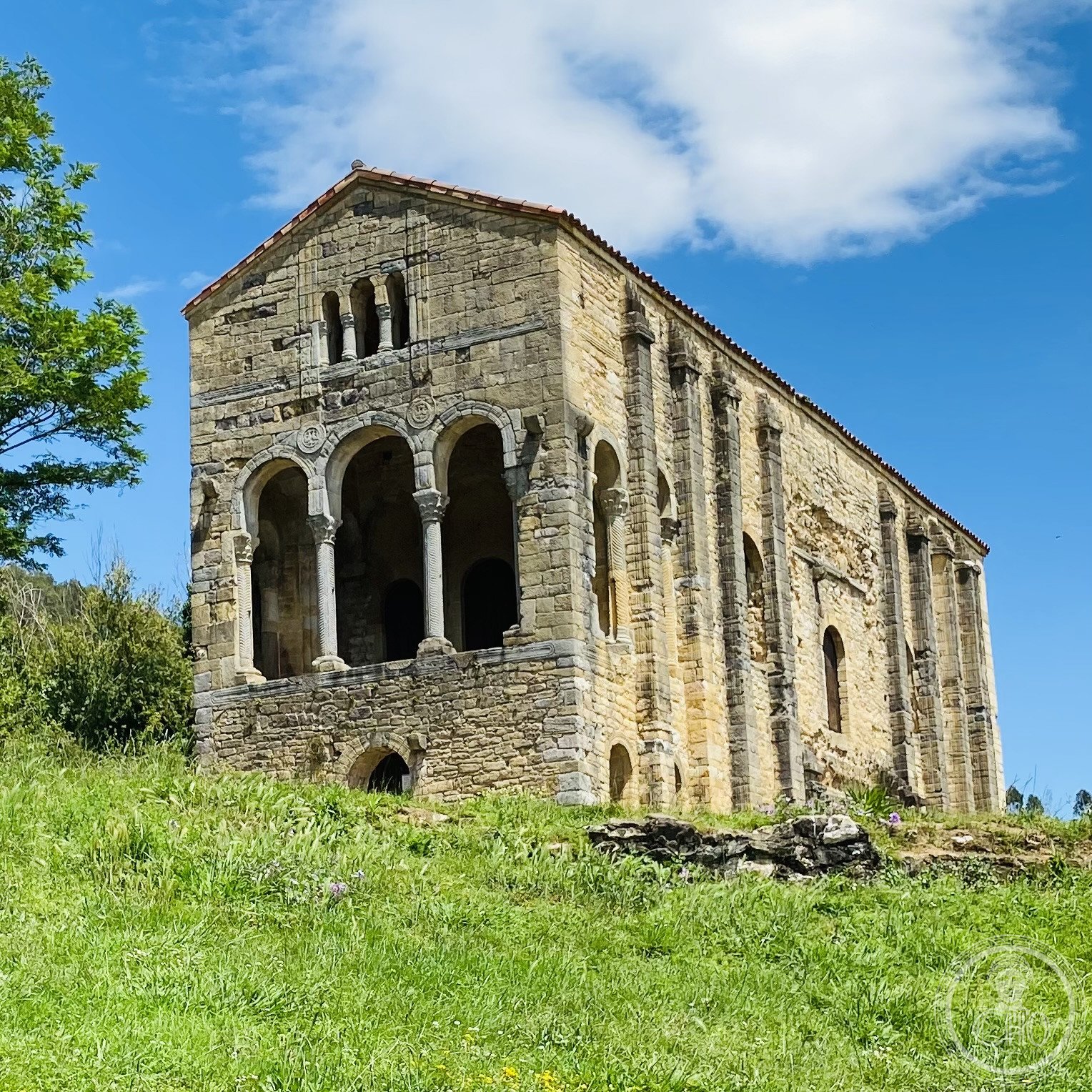
In the green hills of Asturias in northern Spain, a small group of 9th-century buildings represents one of the most important survivals of pre-Romanesque architecture in Europe: the Asturian style, a unique artistic achievement born in the Kingdom of Asturias — the Christian kingdom that held out against the Moorish conquest and preserved Visigothic and Roman traditions while developing a new architectural vocabulary that would directly influence Romanesque art. These monuments at Oviedo are the finest witnesses to that extraordinary moment. UNESCO 1985.
Significance and overview
The UNESCO World Heritage property “Monuments of Oviedo and the Kingdom of the Asturias” encompasses a group of pre-Romanesque buildings dating primarily from the 9th century, located in and around Oviedo, the capital of Asturias. UNESCO originally inscribed three monuments in 1985 (ref. 312): Santa María del Naranco (a royal palace hall converted into a church), San Miguel de Lillo (a palatine chapel), and Santa Cristina de Lena (a rural church on a hilltop). The inscription was extended in 1998 to include the Foncalada fountain and the Camera Santa (the relic chapel within Oviedo Cathedral), as well as the San Julián de los Prados basilica (Santullano), one of the largest surviving pre-Romanesque buildings in Europe.
Collectively, these buildings illustrate the distinctive Asturian architectural style — characterised by tall, narrow proportions, barrel vaults, exterior decorative arcading, and sophisticated decorative stonework — that flourished in the Kingdom of Asturias between c. 718 and 924 CE.
Historical background
The Kingdom of Asturias was founded in 718 CE by Pelayo, the Visigothic nobleman who defeated a Moorish force at the Battle of Covadonga and established a Christian kingdom in the mountainous north of the Iberian Peninsula. Oviedo became the capital under King Fruela I (c. 760) and was developed by successive kings into a significant royal and ecclesiastical centre. King Ramiro I (842–850) was the great builder: Santa María del Naranco and San Miguel de Lillo were both constructed during his reign, on the slopes of Monte Naranco above the city.
The Asturian kingdom was the direct political and cultural ancestor of the Kingdom of León and, through it, of the later Kingdom of Castile — making Oviedo a founding moment of Spanish national history. The Christian reconquest of the Iberian Peninsula (Reconquista) is traditionally dated from Covadonga in 718. Oviedo’s cathedral houses the Camera Santa, a reliquary chapel containing some of the most important early medieval treasures in Spain, including the Cross of the Angels (808) and the Cross of Victory (908).
Key features
Santa María del Naranco (built c. 848) is the masterwork of Asturian architecture: a two-storey rectangular building on the slopes of Monte Naranco, originally a royal hall (aula regia) and converted to a church in the 12th century. Its exterior arcading, barrel vault, and decorative medallions fuse Roman structural logic with Visigothic ornament and anticipate the aesthetic of Romanesque architecture. San Miguel de Lillo, nearby, is a palace chapel noted for its carved decorative panels and for the extraordinary quality of its carved stone screen.
Santa Cristina de Lena (c. 850), south of Oviedo in the Lena valley, is a small hilltop church of perfect proportions, with a distinctive raised sanctuary separated from the nave by a carved stone iconostasis — a feature unique in Western church architecture of the period. The San Julián de los Prados basilica (Santullano, c. 830) is entirely decorated with painted architectural trompe-l’œil frescoes, the largest surviving pre-Romanesque fresco programme in Spain.
Cultural importance
The Asturian monuments are fundamental to the understanding of early medieval European art. They represent the survival and transformation of late antique and Visigothic artistic traditions through the politically and culturally isolated kingdom of Asturias, producing an original synthesis that directly influenced the emergence of Romanesque art in northern Spain and, through the Camino de Santiago pilgrimage routes, in France. Oviedo is itself a major stop on the Camino Primitivo — the oldest Jacobean pilgrimage route, predating the Francés by centuries.
UNESCO criteria
The monuments were inscribed under criteria (i), (ii), and (iv). Criterion (i) recognises Santa María del Naranco and associated buildings as masterpieces of Asturian architecture and human creative genius. Criterion (ii) acknowledges the Asturian style as an important interchange of artistic values between late antique, Visigothic, and emerging Romanesque traditions. Criterion (iv) identifies these monuments as outstanding examples of an architectural ensemble illustrative of a significant stage in the history of medieval Europe.
Visitor experience
The two Monte Naranco monuments (Santa María del Naranco and San Miguel de Lillo) are a 20-minute uphill walk or short taxi ride from central Oviedo; guided tours are available. Santa Cristina de Lena requires a 45-minute drive south and a short uphill walk to the church; it is open on limited hours (check locally). Santullano is in central Oviedo and can be combined with a visit to the city’s cathedral (Camera Santa, Treasure) and the Plaza Alfonso II. Oviedo’s old city has excellent accommodation, restaurants, and sidrerías (cider houses).
Getting there
Oviedo is served by Asturias Airport (Oviédo/Avilés; flights from Madrid, Barcelona, and several European cities). By train from Madrid Chamamartín (ALVIA or AVANT; 4.5–5 hours). By car from Bilbao: 3 hours west via the A-8 coast road. GPS (Santa María del Naranco): 43.370° N, −5.900° E.
Nearby context
Covadonga, the site of the legendary Battle of 718 and the starting point of the Reconquista, is 70 km east of Oviedo in the Picos de Europa National Park. The Picos de Europa — a dramatic limestone mountain range — are within 1–2 hours and offer extraordinary hiking. The Camino Primitivo (the oldest Jacobean pilgrim route) begins in Oviedo and leads to Santiago de Compostela (240 km west). The Asturian coast (Gijón, Villaviciosa) is 30 minutes north.
Find it on the map
See this place and what’s around it →📷 Become a Cultural Heritage Online photographer
Share your photos of places: they stay published under your name as the author. The more they're seen, the more you get noticed — and soon a contest will reward the most appreciated photos.
Log in or sign up free to add a photo