
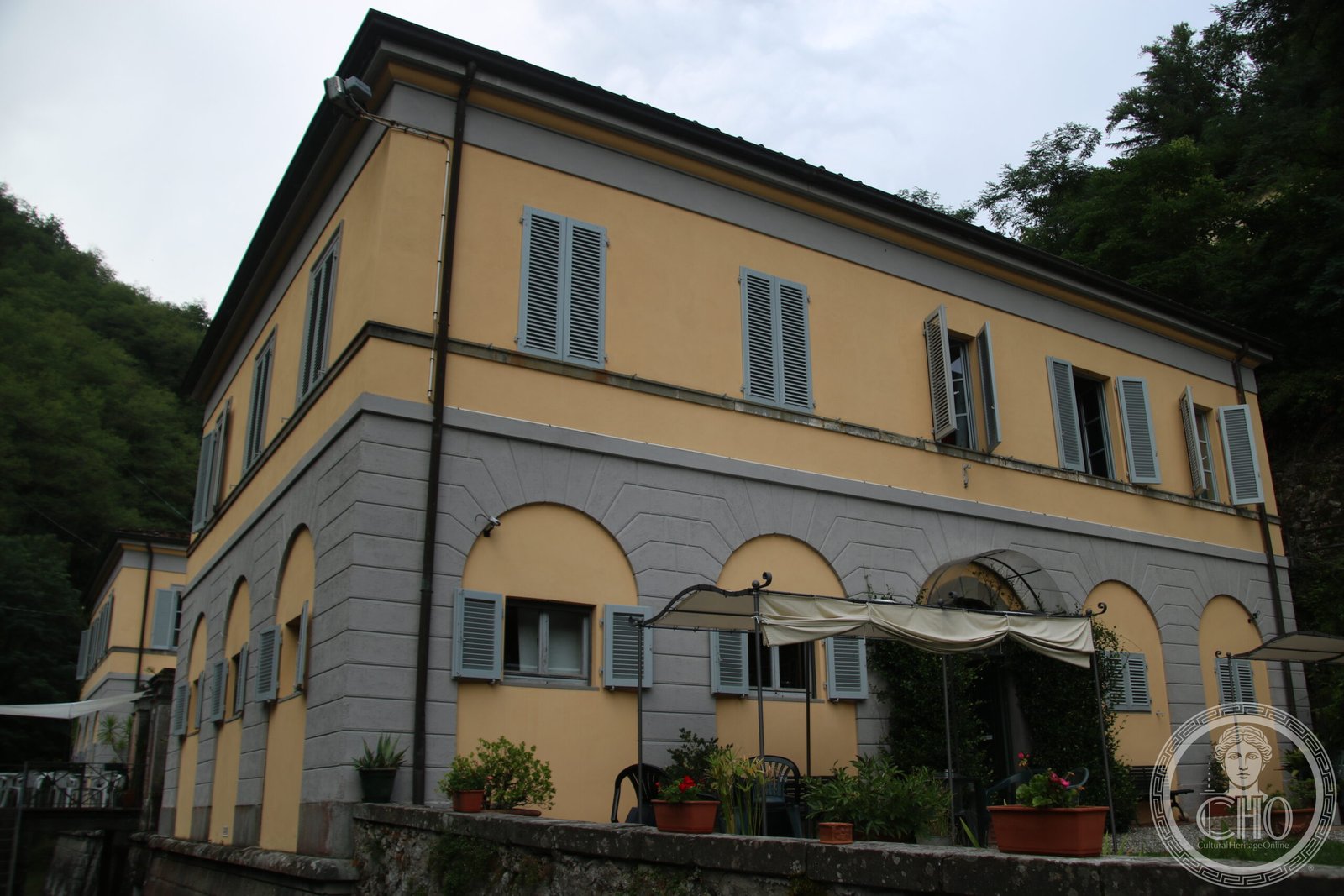
A thermal hospital of 1826, built for the poor by a Russian prince, in the spa town that once drew Byron and Shelley to its waters.
At a glance
At Bagni Caldi, above the old spa town of Bagni di Lucca, the Demidoff complex was built as a charity: a thermal hospital where the poor could also take the cure. It was the gift of the Russian prince Niccolò Demidoff, who settled in Tuscany in the early 19th century. Raised in 1826 to a design by the engineer Pietro Ruelle — a building also linked to the architect Lorenzo Nottolini — it is a sober neoclassical work with a double loggia onto a courtyard. Nearby, the prince added a domed chapel in 1831 that echoes the Pantheon.
Key facts
- Built: 1826
- Engineer: Pietro Ruelle (also attributed to architect Lorenzo Nottolini)
- Founded by: Prince Niccolò Demidoff, as a thermal hospital for the poor
- Style: sober neoclassical, with a double loggia
- Chapel: a domed, Pantheon-like chapel of 1831 by Giacomo Marracci
- Location: Piazza San Martino, Bagni Caldi
- Coordinates: 44.012430, 10.579221 — Google Maps
History
Bagni di Lucca was one of Europe’s fashionable spas in the first half of the 19th century, a Romantic resort that drew the Anglo-Florentine set and visitors such as Byron and Shelley. Among its patrons was Niccolò Demidoff, head of a Russian family of industrialists and collectors who had made Tuscany a second home.
Demidoff wanted the cure open to more than the fashionable. In 1826 he founded a thermal hospital at Bagni Caldi where the poor could be treated, and in 1831 he completed the complex with a chapel by Giacomo Marracci. The buildings are a reminder that the great age of the Italian spa had a charitable face as well as a glamorous one.
What you see
The hospital is plain and dignified, its courtyard framed by a double loggia — architecture meant to serve rather than to dazzle. The drama is saved for the chapel: a cylindrical, domed building with a Corinthian pronaos, restating the severe forms of the Roman Pantheon on a small Tuscan hillside.
Together they form one of the most complete survivals of Bagni di Lucca’s spa heyday, a few minutes above the river at Bagni Caldi.
Practical information
- The Demidoff complex stands in the Bagni Caldi quarter, above the town; the exteriors are the draw.
- Combine with a walk through Bagni di Lucca’s spa hamlet of Ponte a Serraglio.
- Respect any private or restricted areas of the complex.
Getting there
Bagni di Lucca lies in the Serchio valley north of Lucca, on the railway towards Aulla. From the station and the river hamlet of Ponte a Serraglio, the Bagni Caldi quarter and the Demidoff complex rise on the slope above.
Nearby
- Ponte a Serraglio — the riverside heart of the historic spa
- The 19th-century thermal establishments of Bagni Caldi
- The Serchio valley and the road to the Garfagnana
Sources
- Comune di Bagni di Lucca / Pro Loco — thermal buildings
- Catalogo generale dei Beni Culturali (ICCD)
- Histories of the Demidoff family in Tuscany
Find it on the map
See this place and what’s around it →📷 Become a Cultural Heritage Online photographer
Share your photos of places: they stay published under your name as the author. The more they're seen, the more you get noticed — and soon a contest will reward the most appreciated photos.
Log in or sign up free to add a photoIs this page about you?
This page is read by travellers and heritage enthusiasts who find it on Google. Tell us how you are connected to this place and we will take it from there.