
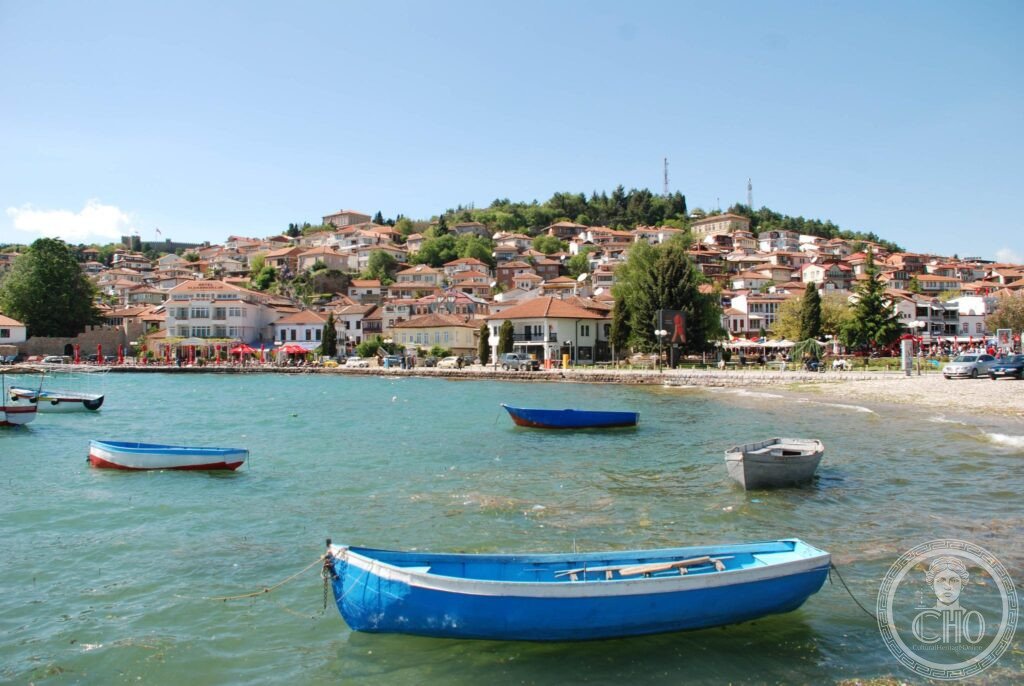
Ohrid sits above one of Europe’s oldest lakes, its steep old town layered with Byzantine churches built over thirteen centuries. It was here, in 886 CE, that Saint Clement developed the Cyrillic alphabet that would carry literacy across the Slavic world.
At a glance
Ohrid is a lakeside city in North Macedonia whose old town preserves a dense cluster of Byzantine churches, some dating from the 7th century, alongside the remains of Samuel’s medieval fortress. Local tradition speaks of 365 churches, one for each day of the year, though the true number of surviving Byzantine buildings is smaller and spans several centuries of construction.
The city grew from the ancient Greek settlement of Lychnidus and became, under the Bulgarian Empire, a centre of Slavic learning after Saint Clement arrived from Moravia in 886 CE. Both the city and the adjoining Lake Ohrid, reckoned among the oldest lakes in Europe, are inscribed together as a UNESCO cultural and natural World Heritage Site.
Key facts
- Cyrillic alphabet: developed at Ohrid, most likely by Clement of Ohrid working from the Glagolitic script that Cyril and Methodius had created in Thessaloniki, and named after Cyril in honour of the missionary tradition.
- Ohrid Literary School: founded by Clement around 886 CE, considered the oldest Slavic centre of higher learning; he is said to have trained several thousand priests and teachers over three decades.
- Samuel’s Fortress: hilltop fortification above the old town, built up under the Bulgarian Emperor Samuel between 976 and 997 CE, incorporating earlier Byzantine walls.
- Lake Ohrid: one of the oldest lakes in Europe, thought to be between one and five million years old, home to over two hundred endemic species including the Ohrid trout.
- UNESCO status: inscribed as a combined cultural and natural World Heritage Site in 1979 and 1980.
- Coordinates: 41.1189° N, 20.8019° E.
History
Ohrid’s story begins with the ancient Greek settlement of Lychnidus, known to the Romans by the same name and linked to the wider Mediterranean world by the Via Egnatia. Christianity took hold in the region by the 4th century, and Emperor Justinian I fortified the city walls in 535 CE. The decisive turn came in 886 CE, when Clement of Ohrid arrived with a mission from the Bulgarian Tsar Boris I to bring Slavic-language literacy to the clergy, using the Glagolitic texts developed by Cyril and Methodius in Thessaloniki. At Ohrid, Clement is credited with simplifying that script into what became the Cyrillic alphabet, and in 893 CE he became the first bishop to conduct services in the vernacular Slavic tongue. He died in the city in 916 CE.
Ohrid served as the capital of the Bulgarian Empire under Emperor Samuel between 997 and 1014 CE. In 1014, Byzantine Emperor Basil II crushed Samuel’s forces at the Battle of Kleidion and, according to tradition, ordered the mass blinding of thousands of captured Bulgarian soldiers, sending them home under the guidance of the few left with one eye. Samuel is said to have died of shock at Ohrid two days after seeing his blinded army return, an episode that earned Basil II the epithet Bulgar-Slayer. The city’s archbishopric gained autonomous status within Orthodox Christianity from 1018. Ottoman forces took Ohrid in 1394, and it remained under Ottoman rule until the First Balkan War of 1912 brought it into Serbian, then Yugoslav, hands. North Macedonia became independent in 1991, and Ohrid and its lake were jointly inscribed by UNESCO in 1979 and 1980.
What you see
The Church of Saint John the Theologian at Kaneo stands on a cliff promontory directly above the lake, a small single-nave Byzantine building with a trefoil apse dating from the late 13th century and among the most photographed medieval churches in the Balkans. In the old town, the Cathedral of Sveta Sofija is an 11th-century double-aisled basilica with three apses; its Byzantine frescoes were whitewashed under Ottoman rule and have since been restored. At Plaosnik, excavated remains show a 5th-century early Christian basilica beneath a 9th-century church associated with Clement, with the layers of construction visible on site; his tomb was identified here during excavations in 2002.
Samuel’s Fortress crowns the hill above the old town, its medieval Bulgarian walls incorporating earlier Byzantine masonry, with substantial stretches still standing and views across the lake and city. Below it, an ancient Hellenistic theatre dating from around 200 BCE was excavated in the 1980s and is now used for outdoor performances during the summer festival held in July and August. Some fifteen kilometres south of the city, the Sveti Naum Monastery was founded around 900 CE and rebuilt in the 16th century; it stands beside underwater springs that feed into the lake and holds the tomb of Naum, Clement’s fellow missionary.
Lake Ohrid itself, ranked among the world’s oldest lakes alongside Tanganyika and Baikal, has been isolated from other water systems for its entire existence, allowing more than two hundred species found nowhere else to evolve, including dozens of endemic snails and fish species along with the Ohrid trout.
Practical information
- Entry to churches and sites: most charge a small entrance fee or none at all; opening hours vary and are best checked with the local tourist office or the sites themselves before visiting.
- Getting around the old town: the historic quarter is pedestrian and built on a steep hillside, so comfortable footwear is advisable; cars should be left in the car parks at the base of the old town.
- Samuel’s Fortress: reachable on foot from the old town, with extended hours in summer; check locally for current arrangements.
Getting there
Ohrid has its own airport, St Paul the Apostle, with a limited range of international connections. Travellers can also fly into Skopje and continue to Ohrid by bus, a journey of a few hours with services running at regular intervals; current timetables and fares are best checked with the carrier or the airport’s own information channels.
Nearby
- Sveti Naum Monastery — around 15 km south of Ohrid, a lakeside monastery founded around 900 CE and rebuilt in the 16th century, set beside underwater springs.
- Plaosnik — within the old town, the excavated complex of Clement’s church and school, with visible layers from the 5th to the 9th centuries.
- Ancient Theatre — a Hellenistic-era theatre below Samuel’s Fortress, used today for the summer festival’s outdoor performances.
- Town Museum of Ohrid — a local collection covering the city’s history and archaeology.
Sources
- UNESCO
Find it on the map
See this place and what’s around it →📷 Become a Cultural Heritage Online photographer
Share your photos of places: they stay published under your name as the author. The more they're seen, the more you get noticed — and soon a contest will reward the most appreciated photos.
Log in or sign up free to add a photo