
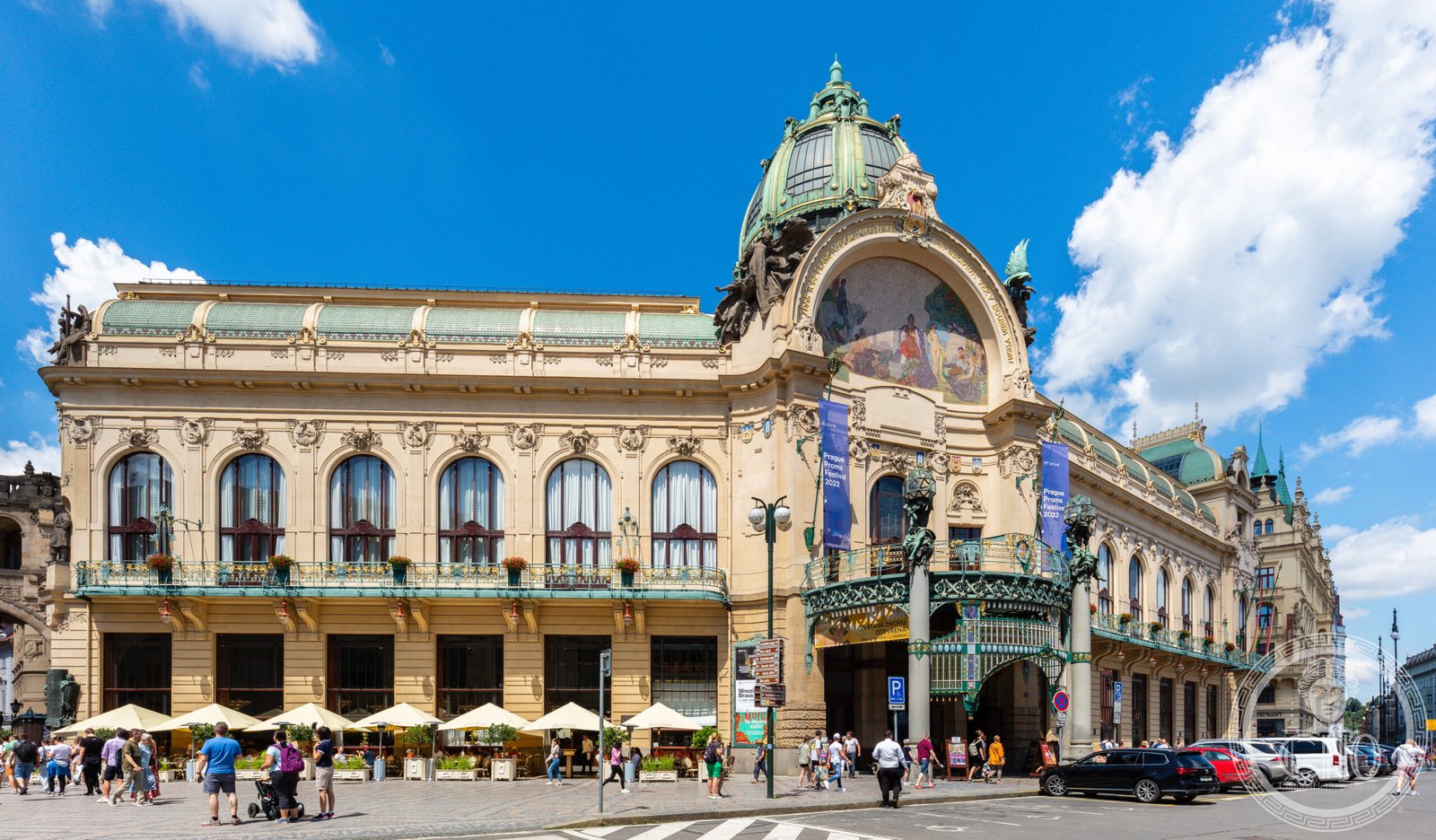

Built between 1905 and 1912 on the site of a demolished medieval royal palace, Obecní dům stands as the defining monument of Czech Art Nouveau and the place where Czechoslovakia declared independence in 1918.
At a Glance
Obecní dům occupies the eastern edge of Prague’s Old Town at Náměstí Republiky 5. Architects Antonín Balšánek and Osvald Polívka designed the building for the city of Prague, coordinating a generation of Czech artists to decorate every surface. The result is one of the most coherent Art Nouveau interiors in Central Europe. The centrepiece is Smetana Hall, a concert hall and ballroom crowned by a glass dome. The ground floor holds a period café, a French restaurant, a wine bar, and an American bar, all surviving largely intact. Most rooms are accessible only by guided tour.
Key Facts
- Address: Náměstí Republiky 5, Prague 1, Czech Republic.
- Construction: 1905–1912.
- Architects: Antonín Balšánek and Osvald Polívka.
- Style: Art Nouveau (Czech Secession).
- Landmark event: Czechoslovak declaration of independence proclaimed here, 28 October 1918.
- Main hall: Smetana Hall — concert hall and ballroom with glass dome.
- GPS: 50.08762, 14.42824 — View on Google Maps.
History
The site at Náměstí Republiky has been significant for Prague since the late fourteenth century. Around 1380, King Wenceslas IV built a Royal Court palace here; successive kings resided in it from 1383 to 1485. The palace was later used as a seminary and eventually fell into disrepair. By the time the city of Prague decided to demolish it in the early twentieth century, the structure had been vacant for decades.
The competition for a new civic building was held in the early 1900s, and the commission went to Antonín Balšánek with Osvald Polívka overseeing much of the decorative programme. Construction ran from 1905 to 1912. Prague’s leading painters and sculptors contributed to the interior: Karel Špillar designed the entrance mosaic titled Homage to Prague; Ladislav Šaloun executed the two large sculptural groups flanking the main entrance, The Degradation of the Nation and The Resurrection of the Nation; Alfons Mucha, Jan Preisler, and Max Švabinský contributed paintings to various ceremonial rooms.
The building’s single most consequential moment came on 28 October 1918, when the Czechoslovak declaration of independence was proclaimed inside Obecní dům, marking the foundation of the First Czechoslovak Republic. This event transformed the building from a civic palace into a site of national memory. The building underwent a major restoration in the 1990s following decades of minimal maintenance during the Communist period.
What You See
The facade facing Náměstí Republiky announces its programme without restraint. A large mosaic — Karel Špillar’s Homage to Prague — fills the lunette above the central entrance portal. Flanking the portal at ground level, Ladislav Šaloun’s bronze sculptural groups depict the humiliation and the renewal of the Czech nation. The dome above Smetana Hall rises from the roof in greenish copper, visible from several streets away. The overall massing is symmetrical, with projecting wings and layered ornamental bands that grow denser toward the upper floors.
Inside, Smetana Hall occupies the core of the building. The hall’s glass dome floods the interior with diffused light; the ironwork balconies and painted medallions are by multiple hands, all working to a unified programme. The Mayor’s Salon — known in Czech as Primátorský sál — was decorated entirely by Alfons Mucha, who painted the ceiling and walls with allegorical figures representing Slavic virtues. The café to the left of the main lobby and the French restaurant to the right retain their original dark-wood panelling, ceramic tile work, and leaded glass partitions.
Art Nouveau Interior
Obecní dům is unusual among Art Nouveau buildings in Central Europe because it was not the work of a single artist-architect but a coordinated civic commission. The city of Prague hired the country’s leading decorative painters and sculptors and assigned each a specific room or surface. Alfons Mucha, already internationally recognised for his Paris poster work, returned to Prague to complete the Mayor’s Salon — his only surviving monumental interior in the Czech Republic. Jan Preisler contributed allegorical paintings in the Rieger Hall. Max Švabinský, known for his graphic work, painted panels in the Sladkovský Hall.
The programme results in a building where no two rooms share the same palette, yet the whole reads as coherent. The basement wine bar and American bar carry the decorative logic down to the lowest level: curved ceramic counters, gilded columns, and painted ceilings that would not look out of place one floor above. This density of original material — largely unaltered since 1912 — gives Obecní dům an archival quality rare in a building that remains in active daily use.
Practical Information
- Access: The café, restaurant, wine bar, and American bar are open to the public without a ticket.
- Guided tours: Required to access Smetana Hall, the Mayor’s Salon, and most ceremonial rooms; tours depart from the main lobby.
- Concerts: Smetana Hall hosts regular classical music events; tickets sold separately through the Prague Spring Festival and other promoters.
- Time needed: 30 minutes for the ground-floor public areas; 90 minutes for a full guided tour.
- Getting there: Náměstí Republiky metro station (Line B, yellow line) is immediately adjacent; tram stops on Náměstí Republiky serve multiple lines.
Nearby Heritage
- Powder Tower (Prašná brána): The late-Gothic tower stands immediately adjacent to Obecní dům, connected by a covered passage; it served as the eastern gate of the Old Town from the fifteenth century.
- Old Town Square (Staroměstské náměstí): A ten-minute walk west through the medieval street grid; the Astronomical Clock (Orloj) and the Church of Our Lady before Týn face the square.
- Art Nouveau Hotel Paris Prague: A few hundred metres north on U Obecního domu, another intact example of Czech Secession architecture from the same decade.
Sources
- Wikipedia, Municipal House (article page ID 14282081).
- Wikidata, Q2334312 — Obecní dům.
- Wikimedia Commons, Category: Municipal House (Prague).
Find it on the map
See this place and what’s around it →Record researched and written by Luigi De Marchi for Cultural Heritage Online, 2026.
📷 Become a Cultural Heritage Online photographer
Share your photos of places: they stay published under your name as the author. The more they're seen, the more you get noticed — and soon a contest will reward the most appreciated photos.
Log in or sign up free to add a photoIs this page about you?
This page is read by travellers and heritage enthusiasts who find it on Google. Tell us how you are connected to this place and we will take it from there.