
Five flat peaks and the home of Manjushri
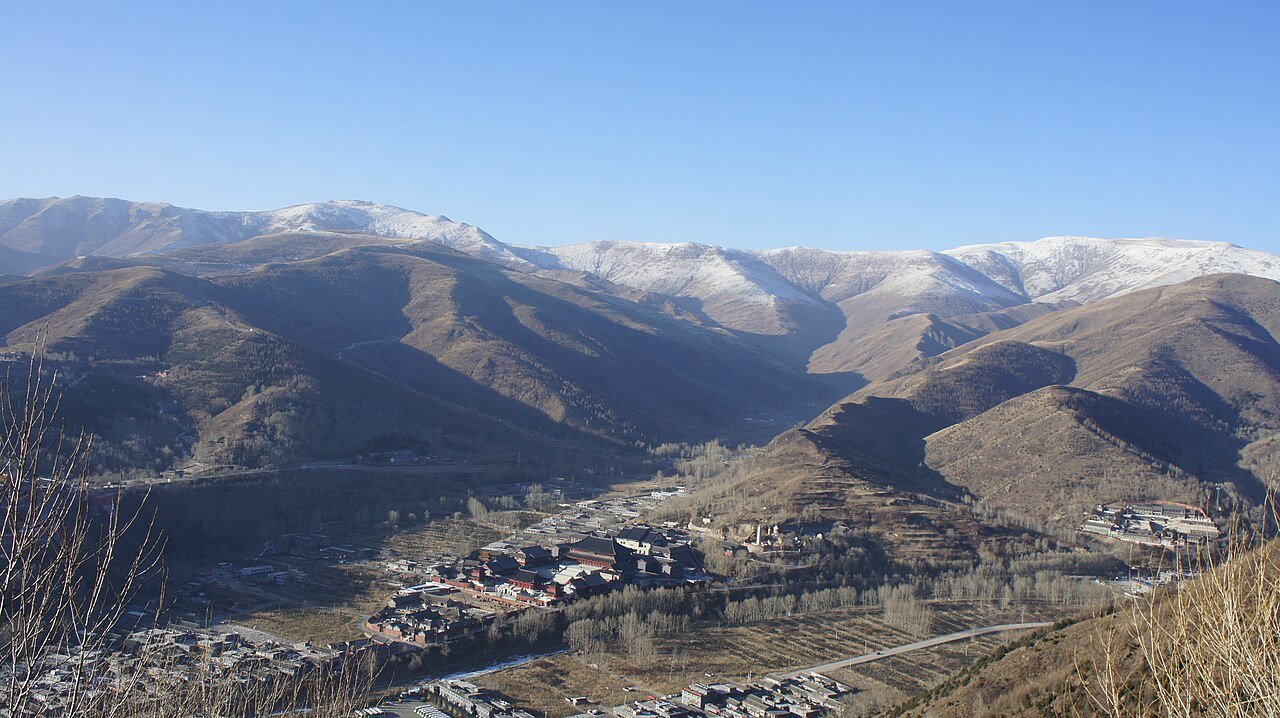
Mount Wutai — “Five Terrace Mountain” — rises to 3,061 metres in the Shanxi highlands of northern China, its defining feature the five flat-topped summits enclosing a broad highland valley. For Chinese Buddhists, Wutai Shan is not merely a beautiful landscape but the earthly paradise of Manjushri (Wenshu), the Bodhisattva of Wisdom — the divine being who chose this particular mountain as his permanent abode and who may be encountered here by the sufficiently enlightened pilgrim. The belief, documented from the 5th century CE, has drawn emperors, monks, and pilgrims to these peaks for over 1,500 years.
UNESCO inscription: a living landscape of Buddhist practice
Inscribed in 2009, Mount Wutai was recognised by UNESCO as an outstanding example of a sacred Buddhist mountain that has preserved an extraordinary concentration of ancient religious architecture within a living religious community. The 53 monasteries active on the mountain include buildings from five dynasties, making Wutai Shan the richest repository of Tang-dynasty Buddhist architecture surviving anywhere in China.
The oldest wooden buildings in China: Tang-dynasty architecture
Among the 53 monasteries, two contain structures of extraordinary rarity: wooden halls built during the Tang dynasty (618–907 CE), the oldest surviving timber-frame buildings in China. The East Main Hall of Foguang Temple (built 857 CE) and the Main Hall of Nanchan Temple (built 782 CE) are the oldest wooden buildings in East Asia, preserved by the mountain’s isolation and the communities that maintained them across twelve centuries.
A pan-Buddhist mountain: Chinese, Tibetan, and Japanese pilgrims
Mount Wutai is uniquely revered across the major traditions of Asian Buddhism. Han Chinese Buddhists have made it a pilgrimage destination since the Northern Wei dynasty (386–534 CE). Tibetan and Mongolian pilgrims began arriving in large numbers from the 13th century when Kublai Khan patronised the mountain; the Qing dynasty emperors maintained several Tibetan-rite monasteries here. Japanese pilgrims have visited since the 8th century; the monk Ennin’s diary of his pilgrimage in 838–839 CE is a primary source for Tang China.
The monastery valley: Taihuai and its 39 active temples
The largest concentration of monasteries is in Taihuai village, where 39 active temples crowd the valley floor, their white dagobas and glazed-tile roofs visible from kilometers away. The Xiantong Temple (founded 68 CE, rebuilt many times) is the largest and oldest on the mountain. The Tayuan Temple, whose great white pagoda (built 1301) is the emblem of Wutai Shan, serves as the focal point for Tibetan Buddhist pilgrimage. The Pusading Temple, on the hilltop above the village, was the residence of the Qing imperial lamas.
The highland environment: alpine meadows and sacred springs
The five flat summits rise above the treeline into an alpine environment of grasslands and wildflowers that is strikingly different from the forested valleys below. The North Peak (Beitai, 3,061 m) is the highest point on the Shanxi plateau and offers panoramic views across the loess highlands. The mountain’s snow cover, lasting from October to April, is celebrated in Chinese landscape painting as an emblem of spiritual purity.
Pilgrimage on foot: circumambulating the five peaks
The traditional circumambulation of all five peaks — a pilgrimage circuit of approximately 75 km — takes 3–5 days and passes through dozens of monasteries, prayer halls, and sacred springs. The route is walked by thousands of pilgrims each year, most of them Han Chinese Buddhists performing a vow (prostrating their bodies on the ground with each step is a more demanding variant). The circuit is most frequented in summer, when the highland meadows are in flower and the peaks are free of snow.
Visiting Mount Wutai
The mountain is 5 hours by bus from Beijing and accessible from Taiyuan. Accommodation ranges from monastery guesthouses (where guests participate in early-morning prayers) to modern hotels in Taihuai village. The best months are June–September; winter closes most passes but offers an extraordinary landscape of snow-covered temples. A park entry fee covers access to the valley; individual temples charge separate admission. The oldest wooden halls (Foguang and Nanchan temples) require a 30 km round trip by vehicle from Taihuai.
Find it on the map
See this place and what’s around it →📷 Become a Cultural Heritage Online photographer
Share your photos of places: they stay published under your name as the author. The more they're seen, the more you get noticed — and soon a contest will reward the most appreciated photos.
Log in or sign up free to add a photo