
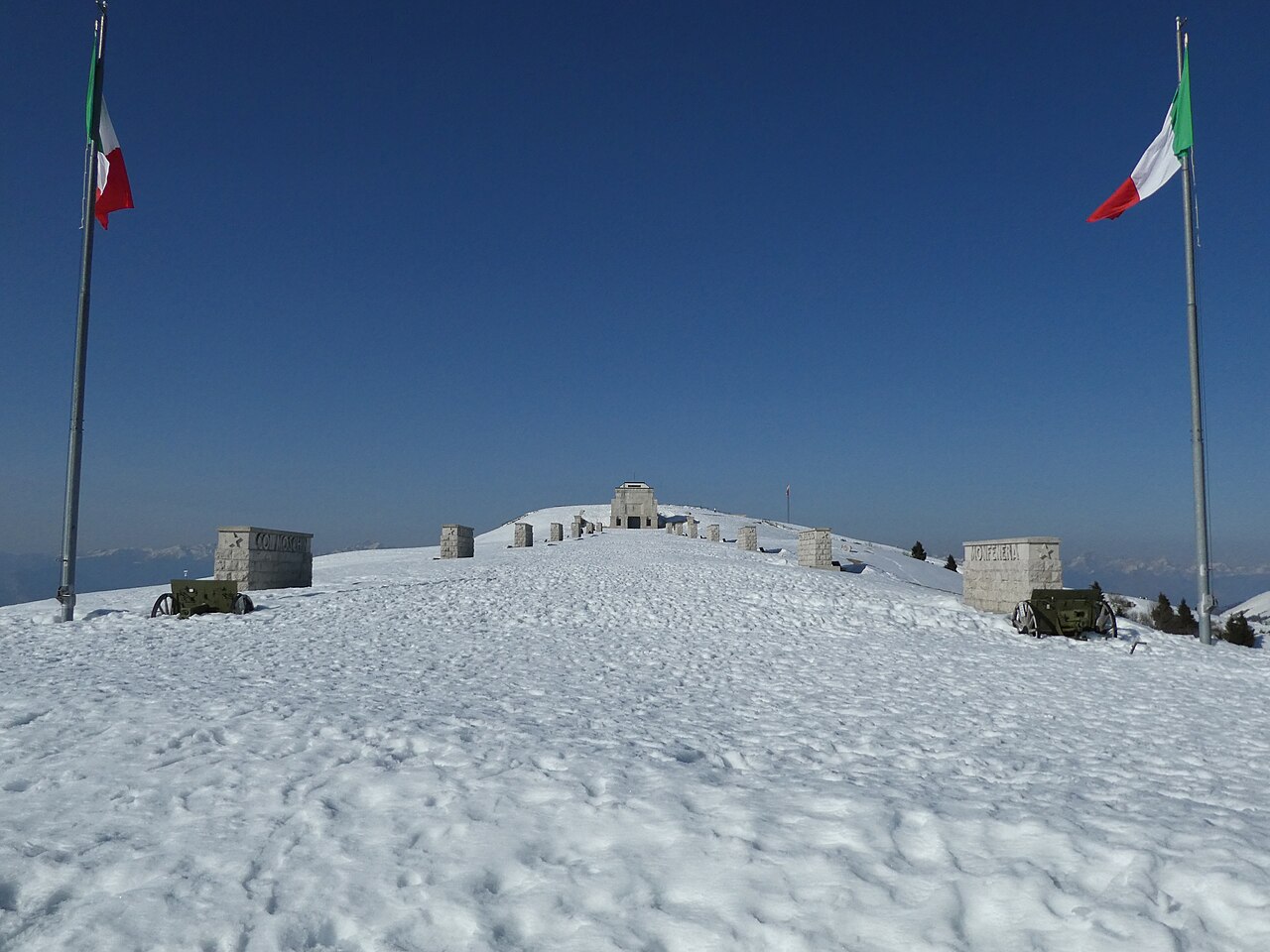
The Ossario del Monte Grappa stands on the summit of Monte Grappa at 1,775 metres above sea level, on a ridge that was one of the bloodiest contested positions of the entire Italian Front in the First World War. Between November 1917 and November 1918 — the year between Caporetto and the final offensive at Vittorio Veneto — Italian forces held the Grappa massif against eleven major Austro-Hungarian attacks. The fighting was Alpine warfare at its most brutal: artillery on narrow ridges, infantry in trenches cut into rock, with no possibility of flanking or retreat. When the war ended, the bodies of tens of thousands of soldiers remained on the mountain.
The Sacrario — designed by architect Giovanni Greppi with sculptor Giannino Castiglioni, the same team that later designed the Redipuglia memorial — was built between 1932 and 1935 during the fascist era. It contains the remains of 12,615 Italian soldiers (5,365 identified, 7,250 unknown) and, unusually, 10,295 Austro-Hungarian soldiers — a joint ossuary that reflects both the scale of the loss and the pragmatic impossibility of separating the dead after nearly two decades on the mountain.
The Architecture
Greppi and Castiglioni designed the Sacrario as a terraced complex descending from the summit chapel. The main chapel of the Madonna del Grappa stands at the highest point; below it, colonnaded walkways and staired terraces descend the south face of the ridge. The material is local stone throughout — the same rock the soldiers dug their trenches into. The architectural vocabulary is the severe stripped classicism of the fascist period: no decorative columns, no historicist ornament, just mass and proportion and the weight of the materials.
Castiglioni’s sculptural programme is concentrated at the chapel level and along the main terrace: relief panels depicting Alpine soldiers, a heroic male figure, and the repeated motif of the Italian soldier at rest. The integration of architecture and sculpture is more restrained than at Redipuglia — the mountain setting does most of the emotional work, and Greppi designed accordingly.
The Austro-Hungarian Ossuary
The presence of Austro-Hungarian remains within the same complex — in a separate but adjacent section — was controversial in 1935 and remains remarkable today. The decision was partly practical: the bodies had been interred in temporary graves across the entire massif and could not be sorted by nationality after fifteen years in mountain soil. It was also partly a political statement: the fascist regime’s claim to the territory required acknowledging that the Austrian dead were part of the same landscape. The Austro-Hungarian section is marked separately but shares the same architectural language as the Italian section.
The Mountain Context
The summit of Monte Grappa is reached by the SS347 road from Bassano del Grappa — approximately 40 minutes of mountain driving from the valley. The view from the Sacrario terrace encompasses the entire Venetian plain north to the Dolomites and south to the Adriatic. On clear days, Venice is visible. The landscape the soldiers fought over — which they saw only from trenches — is entirely visible from the place where they are buried. This inversion is part of what makes the Grappa Sacrario one of the most powerful memorial spaces in Italy: the dead command the panorama they were denied in life.
The road to the summit passes several smaller memorials, military road markers from the construction period, and the remains of defensive positions. Allow time for the drive itself as well as the site.
Practical Information
The Sacrario is open year-round (subject to weather conditions — the summit may be closed in winter snowfall). The chapel has regular services. The site is managed by the Commissariato Generale Onoranze Caduti in Guerra (ONORCADUTI), the Italian national agency for military honours. There is a small museum at the base level. Guided tours are available in summer. The nearest town with accommodation is Bassano del Grappa (40 minutes) or Asiago (35 minutes on the opposite slope of the massif).
Gallery
Find it on the map
See this place and what’s around it →📷 Become a Cultural Heritage Online photographer
Share your photos of places: they stay published under your name as the author. The more they're seen, the more you get noticed — and soon a contest will reward the most appreciated photos.
Log in or sign up free to add a photoIs this page about you?
This page is read by travellers and heritage enthusiasts who find it on Google. Tell us how you are connected to this place and we will take it from there.