
Two million years of human evolution in a single valley
In the upper Awash Valley, 50 kilometres south of Addis Ababa, the volcanic sediments of the Ethiopian Rift Valley preserve one of the most complete records of early human technological evolution ever found. The sites of Melka Kunture and the nearby Balchit outcrop contain stratified archaeological layers spanning 2 million years — from the earliest Oldowan stone tools (made by Homo habilis) through the refined Acheulean hand axes of Homo erectus to the transition to Middle Stone Age technologies. They are the most important prehistoric sites in Africa for understanding the sequence of human technological innovation.
UNESCO inscription: the deep roots of human ingenuity
Inscribed in 2023, the sites were recognised by UNESCO as outstanding witnesses to the earliest stages of human cultural development — the period when our ancestors first learned to shape stone into tools, a cognitive and manual breakthrough that launched the technological trajectory that leads, two million years later, to the device on which you are reading this text. The Awash Valley, already home to the UNESCO-inscribed fossils of the Lower Valley of the Awash (Hadar, Lucy’s site), here shows the archaeological evidence of what those early hominids were doing with their hands.
Oldowan tools: the first technology
The oldest layers at Melka Kunture contain Oldowan tools — the simplest stone tools known, consisting of a cobble from which a few flakes have been struck to create a sharp edge. Made approximately 2 million years ago, these tools were used to butcher animals, scrape hides, and process plant materials. The fact that their makers (probably Homo habilis or early Homo erectus) consistently selected specific rock types and transported them to particular locations demonstrates a level of planning and foresight not previously attributed to hominids of that period.
Acheulean hand axes: 1.5 million years of refinement
Above the Oldowan layers, Melka Kunture contains the world’s most complete sequence of Acheulean tools — the distinctive teardrop-shaped hand axes that Homo erectus made with increasing refinement over more than a million years. The progression visible in the sediment layers — from crude early forms to the beautifully symmetrical late Acheulean axes, their surfaces covered in tiny, precisely controlled flake scars — is the material record of a cognitive evolution whose implications are still debated by archaeologists.
Fossil hominids: our ancestors in the sediment
In addition to lithic artefacts, Melka Kunture has yielded hominid fossils including a partial cranium of Homo erectus (Melka Kunture 1) and fragments of other individuals spanning different time periods. The combination of skeletal remains and the tools they made in the same site — a rare taphonomic coincidence — makes it possible to attribute specific technological behaviours to specific hominid species with unusual confidence.
The Awash Valley: cradle of humanity
The Awash River flows north through the Ethiopian Rift Valley, draining into a system of saline lakes near the Djibouti border. Along its course lie the most important early human sites in the world: Hadar (where Lucy was found, 3.2 million years ago), the Afar Triangle (where the oldest Australopithecus remains are known, 4.4 million years ago), Bodo (where a 600,000-year-old skull shows the first evidence of deliberate defleshing of human remains), and Melka Kunture (where the tools of those early humans are preserved in extraordinary abundance).
Archaeological research: 60 years of excavation
Melka Kunture was first investigated by Jean Chavaillon in the 1960s, and systematic excavation has continued since. The site’s volcanic sediments, regularly dated by the potassium-argon method, provide an exceptionally precise chronological framework. Over 60 archaeological occurrences — distinct tool-making events preserved in individual sediment layers — have been excavated, each representing a separate episode in which hominids made tools, processed animal bones, and discarded the evidence of their lives.
Visiting Melka Kunture
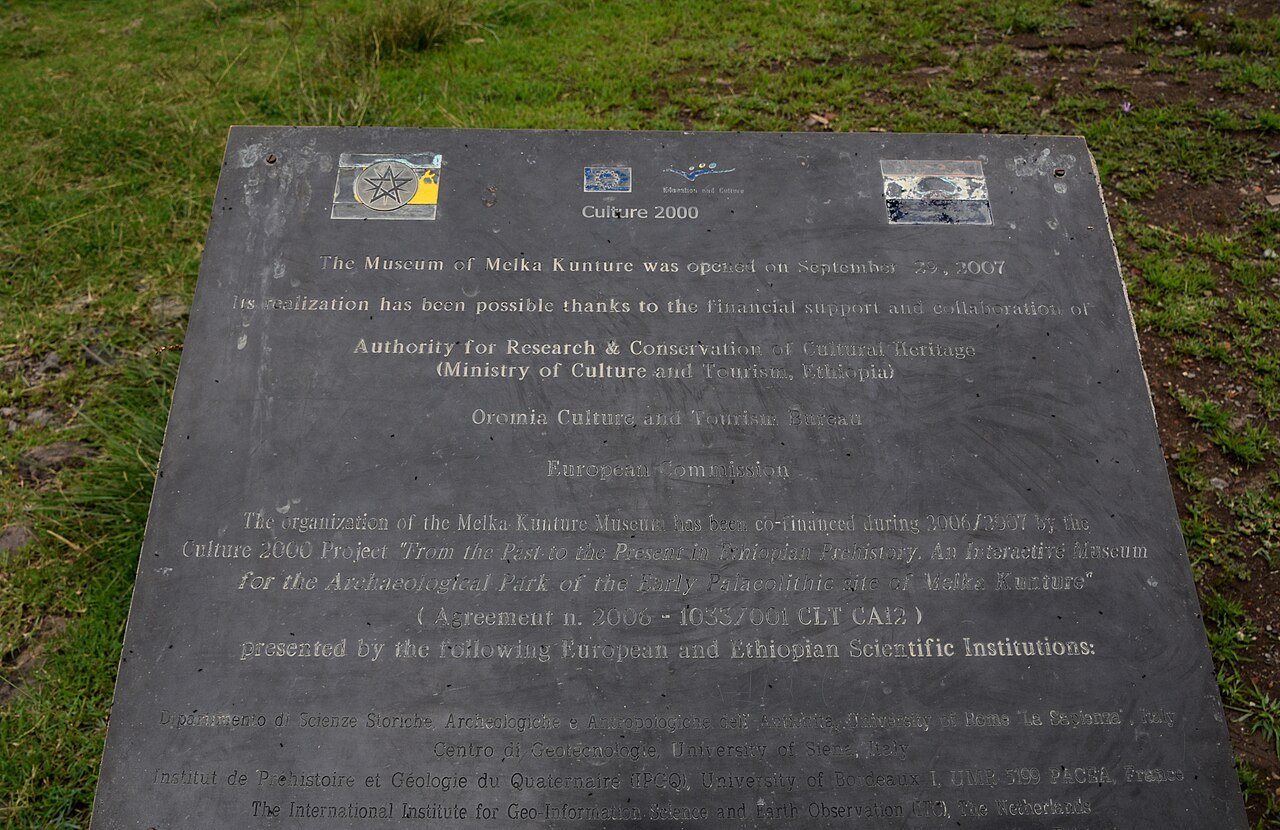
The site is located at the town of Melka Kunture, 50 km south of Addis Ababa on the Butajira road. A small site museum opened in 2015 displays stone tools and explanatory panels. Access is straightforward by private vehicle from Addis Ababa (1.5 hours); guided visits can be arranged through the Ethiopian Heritage Authority. The site is modest in visual terms — an excavation trench in a river bank — but enormously significant as the place where the record of two million years of human ingenuity is most completely preserved.
Find it on the map
See this place and what’s around it →📷 Become a Cultural Heritage Online photographer
Share your photos of places: they stay published under your name as the author. The more they're seen, the more you get noticed — and soon a contest will reward the most appreciated photos.
Log in or sign up free to add a photo