
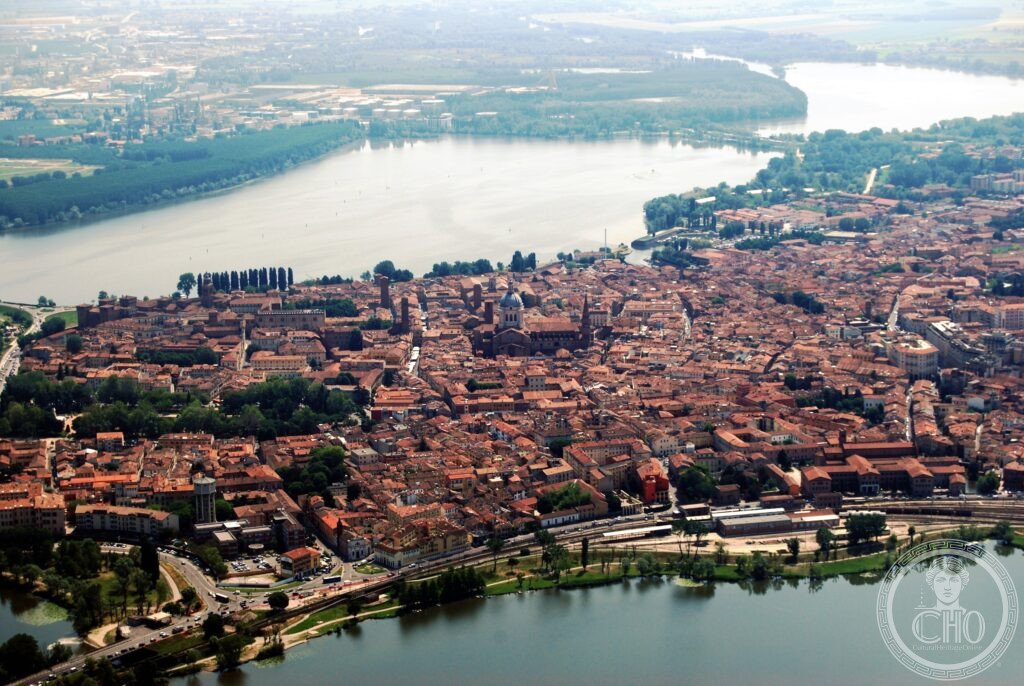
Mantova preserves the visual legacy of the Gonzaga dynasty, three centuries of rule that filled a small city on the Po plain with some of the Renaissance’s most inventive painting, above all Andrea Mantegna’s illusionistic ceiling in the Camera degli Sposi.
At a glance
Mantova sits within a loop of artificial lakes formed when the Mincio river was dammed in the eleventh century at the request of Matilda of Tuscany. The historic centre, ringed by the Lago Superiore, di Mezzo and Inferiore, grew around the Palazzo Ducale in Piazza Sordello, seat of the Gonzaga family from 1328 to 1707.
The UNESCO listing covers Mantua together with Sabbioneta, a small ideal city founded from scratch in 1560 by Vespasiano Gonzaga some thirty kilometres to the south. Together they form a single serial site recognised by UNESCO in 2008.
Key facts
- Camera degli Sposi: painted by Andrea Mantegna between 1465 and 1474 for Marquess Ludovico III Gonzaga, in the north tower of the Palazzo Ducale.
- Technique: fresco secco, paint applied to dried rather than wet plaster, allowing unusually fine detail.
- The oculus: a painted circular opening in the ceiling, considered the first illusionistic painted ceiling in Western art and an influence on Melozzo da Forlì, Correggio and Michelangelo’s Sistine Chapel.
- Palazzo Ducale: the Gonzaga residence, built up over four centuries and counted among the largest palace complexes in Europe, with numerous rooms and courtyards.
- Palazzo Te: the summer palace designed by Giulio Romano for Federico II Gonzaga between 1524 and 1534, notable for the Sala dei Giganti.
History
Mantua’s literary pedigree reaches back to the poet Virgil, born near the city in 70 BCE and later celebrated by Dante in the Purgatorio. The medieval city passed into Gonzaga hands in 1328, when Luigi I Gonzaga overthrew the previous Bonacolsi lord in the square that would become Piazza Sordello.
Over the following centuries successive Gonzaga rulers shaped the city’s art and architecture: Ludovico III brought Mantegna to paint the Camera degli Sposi in the 1460s and 1470s, Federico II commissioned Giulio Romano to build the Palazzo Te in the 1520s and 1530s, and Vincenzo I assembled a princely art collection and employed Peter Paul Rubens around 1600. Financial ruin forced the sale of that collection to King Charles I of England in 1627; after Charles’s execution in 1649 it was dispersed further, with works such as Mantegna’s Triumphs of Caesar passing to Hampton Court Palace, where they remain, and Raphael’s La Perla eventually reaching the Prado.
Vespasiano Gonzaga, a cousin of the Mantuan dukes, founded Sabbioneta as an ideal city in 1560, building among other things a theatre considered one of the earliest in Europe designed as a permanent, freestanding building. Gonzaga rule in Mantua ended in 1707, when Ferdinando Carlo IV fled before the Austrian invasion. Mantua and Sabbioneta were jointly inscribed on the UNESCO World Heritage list in 2008.
What you see
The Palazzo Ducale complex holds the Camera degli Sposi, where Mantegna’s frescoes cover the walls with court scenes and the ceiling opens into the painted oculus, its foreshortened figures looking down as if from a real balustrade. Nearby, the Salone degli Arcieri displays seventeenth-century copies of Mantegna’s Triumphs of Caesar, the originals having gone to England. The Appartamento Ducale includes the Sala dello Zodiaco, its ceiling frescoed with zodiac imagery by Lorenzo Costa the Younger, and the Sala dei Cavalli, once used for the Gonzaga’s horses.
At the Palazzo Te, the Sala dei Giganti is decorated across all four walls and the ceiling with the myth of the Giants’ rebellion against Jupiter, an immersive scheme designed by Giulio Romano to make the room appear to be collapsing around the viewer, with an acoustic effect that amplifies voices inside it.
In Sabbioneta, the surviving ensemble includes the Teatro Olimpico of 1590 and the Galleria degli Antichi of 1583, an early example of a purpose-built gallery museum, alongside the Villa del Giardino. In Mantua itself, the Rotonda di San Lorenzo, consecrated in 1083, stands just off Piazza delle Erbe.
Practical information
- Visiting the Camera degli Sposi: access is timed and numbers are limited; arriving soon after opening reduces waiting, particularly in summer. Check the Palazzo Ducale’s own channels for current arrangements and admission.
- Palazzo Te: open separately from the Palazzo Ducale; consult the site directly for hours and tickets.
- Sabbioneta: reached from Mantua by road; a combined ticket covers the Teatro Olimpico, the Galleria degli Antichi and other sites in the town.
- Rotonda di San Lorenzo: a small entrance fee applies; details are best confirmed locally.
Getting there
Mantua has direct rail connections from Verona, and services from Milan and Bologna that typically involve a change at Verona or Cremona. Sabbioneta is reachable from Mantua by bus. Current timetables and fares should be checked with Trenitalia or the relevant local operator.
Nearby
- Palazzo Te — within Mantua, the Gonzaga summer palace with the Sala dei Giganti.
- Rotonda di San Lorenzo — in the historic centre near Piazza delle Erbe, consecrated in 1083.
- Sabbioneta — about thirty kilometres south, the ideal city built by Vespasiano Gonzaga, part of the same UNESCO listing as Mantua.
Sources
- UNESCO
Gallery
Find it on the map
See this place and what’s around it →📷 Become a Cultural Heritage Online photographer
Share your photos of places: they stay published under your name as the author. The more they're seen, the more you get noticed — and soon a contest will reward the most appreciated photos.
Log in or sign up free to add a photoIs this page about you?
This page is read by travellers and heritage enthusiasts who find it on Google. Tell us how you are connected to this place and we will take it from there.