

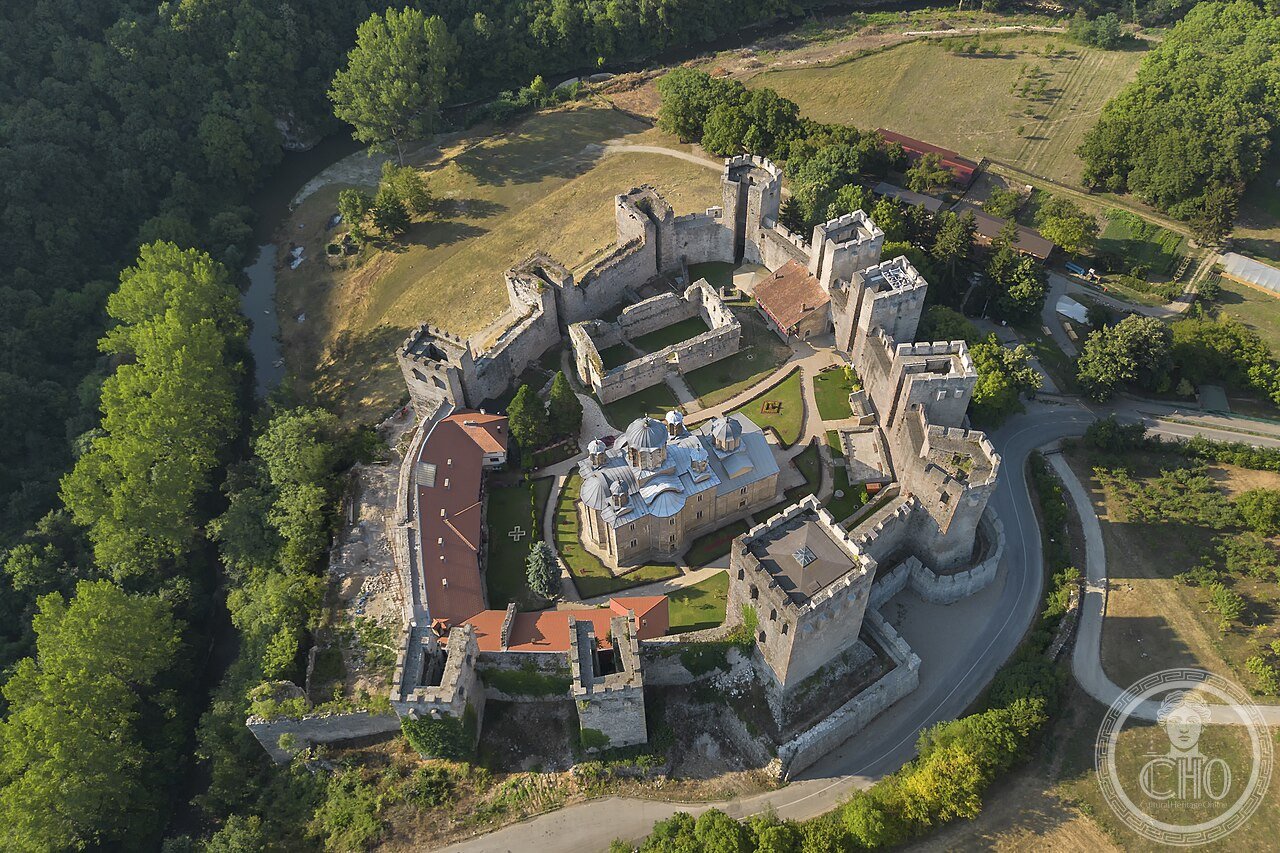
Manasija Monastery was founded by the despot Stefan Lazarević between 1406 and 1418, who intended it as his own mausoleum. The church, dedicated to the Holy Trinity and belonging to the Morava architectural school, was consecrated on Pentecost 1418, after some 2,000 square metres of frescoes had been completed. What makes Manasija truly unique is its fortification: the whole complex is ringed by walls 3.2 metres thick and 12 metres high, strengthened by eleven towers — the largest of which, the Despot’s Tower, housed the monks’ quarters — linked by battlemented wall-walks, protected by a second outer wall and by a moat 17 metres wide. The monastery quickly became the cultural centre of the Serbian Despotate, home to the Resava School, a scriptorium renowned throughout the fifteenth and sixteenth centuries for its manuscripts and religious translations.
About Manasija Monastery
Manasija Monastery, near the town of Despotovac in central Serbia, was founded by Despot Stefan Lazarević between 1406 and 1418, who built it specifically to serve as his own mausoleum. The monastery church, dedicated to the Holy Trinity, belongs to the Morava School of medieval Serbian architecture and was consecrated on the Feast of Pentecost in 1418, following the completion of roughly 2,000 square metres of interior frescoes. What most distinguishes Manasija among Serbian medieval monasteries is its extraordinary military fortification: the entire complex is enclosed by massive curtain walls standing approximately 12 metres high and 3.2 metres thick, reinforced by eleven towers — the largest of which, known as the Despot’s Tower, contained living quarters for the monastery’s monks — connected by defensive walkways lined with crenellated merlons and pierced by machicolations for vertical defence. A second, lower outer wall stood roughly two metres beyond the main fortifications, providing a further stage of defence, while a broad defensive ditch some 17 metres wide ran before the entire fortified perimeter. Following its foundation, Manasija rapidly established itself as the principal cultural centre of the Serbian Despotate, home to the Resava School, a scriptorium renowned throughout the 15th and 16th centuries for its production of religious manuscripts and translations, contributing significantly to the preservation and transmission of Serbian Orthodox literary and religious culture during a period of mounting Ottoman pressure on the region.
Key facts
- 1406-1418: monastery built by Despot Stefan Lazarević as his own mausoleum
- Pentecost 1418: church consecrated, following completion of roughly 2,000 m² of frescoes
- Fortification: curtain walls 12 m high, 3.2 m thick, reinforced by 11 towers
- Despot’s Tower: the largest tower, housing monks’ living quarters
- Defensive ditch: roughly 17 metres wide, surrounding the fortifications
- Resava School: renowned manuscript scriptorium active through the 15th-16th centuries
- Architectural style: Morava School of medieval Serbian architecture
History
Despot Stefan Lazarević’s decision to build his own monastery-mausoleum as one of the most heavily fortified religious complexes in medieval Serbia reflects the precarious military position of the Serbian Despotate during the early 15th century, caught between mounting Ottoman pressure from the south and the need to project both spiritual authority and genuine defensive capability. The monastery’s eleven-tower fortification system, among the most elaborate defensive works attached to any Serbian religious foundation, blurred the line between monastery and castle, anticipating the increasingly militarised character many Balkan religious institutions would adopt as Ottoman expansion continued through the 15th century.
The Resava School’s sustained output of manuscripts and translations across the 15th and 16th centuries situates Manasija among the most significant centres of Serbian literary and religious culture during the Despotate period, its scriptorium work helping preserve and transmit Orthodox textual tradition through a period of severe regional political instability and eventual Ottoman conquest.
What you see
The monastery’s imposing fortress walls, studded with eleven mostly rectangular towers (with two hexagonal and one square exception), remain remarkably well preserved, offering visitors a rare direct encounter with genuine medieval Serbian military-religious architecture. Inside the fortified perimeter, the Morava School church, its interior once covered by roughly 2,000 square metres of frescoes, stands as the spiritual and artistic heart of the complex, alongside the Despot’s Tower where the monastic community once lived under the protection of Stefan Lazarević’s formidable defensive design.
Practical information
- Opening hours: generally open daily with seasonal variation; check current hours before visiting
- Address: Cara Uroša, Despotovac, Pomoravlje District, Serbia
Getting there
Manasija Monastery stands just outside the town of Despotovac in central Serbia, reachable by road from Belgrade or the nearby town of Ćuprija. GPS: 44.1005° N, 21.4689° E.
Nearby
- Despotovac — the nearest town, immediately adjacent
- Ravanica Monastery — another significant Morava School monastery, nearby
- Resava Cave — notable karst cave system in the same region
Sources
- Wikipedia — “Manasija” (en.wikipedia.org)
- UNESCO World Heritage Centre — “Fortified Manasija Monastery” (whc.unesco.org)
- Serbia.com — “Manasija Monastery, a jewel of Serbian medieval culture” (serbia.com)
Find it on the map
See this place and what’s around it →📷 Become a Cultural Heritage Online photographer
Share your photos of places: they stay published under your name as the author. The more they're seen, the more you get noticed — and soon a contest will reward the most appreciated photos.
Log in or sign up free to add a photo