
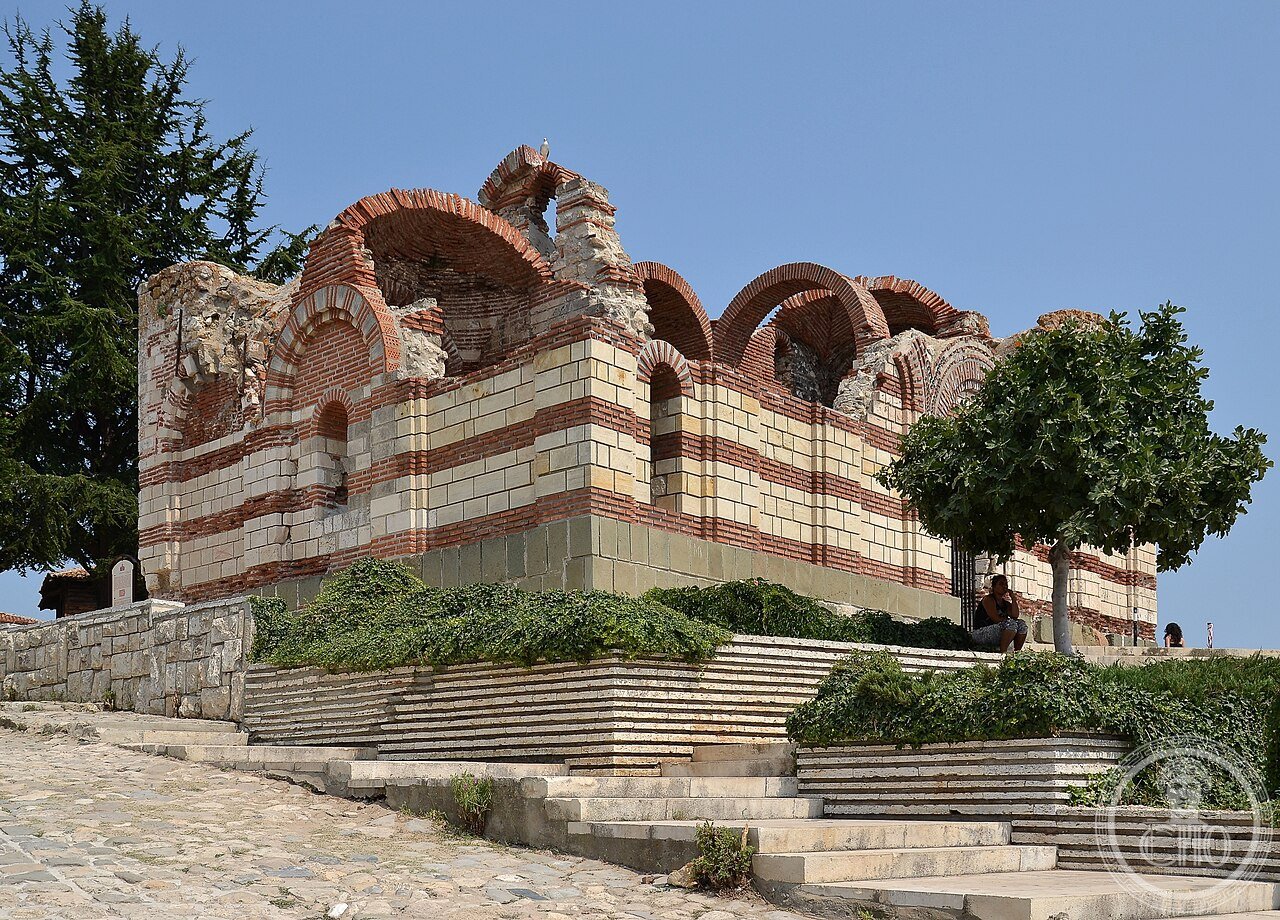
Built in the fourteenth century, the church of St John Aliturgetos was probably one of the finest buildings of ancient Nesebar, its walls alternating white stone and red brick together with ceramic tiles, composing geometric patterns like polychrome embroidery. Its Greek name, aliturgetos (αλειτούργητος), means literally “non-liturgical” or “never consecrated”: according to legend a workman fell and died during the building, and canon law did not allow a place where a man had been killed to be consecrated for worship — though some historical sources suggest that services were held there in spite of the name. The building was badly damaged by the Chirpan earthquake of 1913, and today its ruins, in the southern part of the Nesebar peninsula, remain among the most evocative witnesses to the town’s medieval religious architecture.
About the Church of St John Aliturgetos
The Church of St John Aliturgetos, built in the 14th century in the historic town of Nesebar on Bulgaria’s Black Sea coast, was with its intricate stone and brick archways and remarkable medieval architecture likely one of the most beautiful buildings anywhere in the ancient town. The church takes the form of a domed cruciform building with three altar apses and a narthex, measuring approximately 18.5 metres long and 10 metres wide. Its facade demonstrates the distinctive ceramic-plastic decorative style characteristic of medieval Nesebar’s churches: an adroit alternation of white stone blocks and red bricks, combined with decorative ceramic plates, creating patterns that resemble multicoloured embroidery across the walls, with the facades further segmented by blind two-step niches decorated in varied geometric patterns of brick and stone. The church’s unusual name derives from the Greek word “aliturgetos” (αλειτούργητος), meaning “unconsecrated” or “at which liturgy is not celebrated.” According to local legend, this name arose because one of the builders fell and was killed during the church’s construction; ecclesiastical canon law did not permit a site where a person had died to be consecrated for worship, and the church was consequently never formally consecrated in the usual manner — although some historical records suggest that religious services were nonetheless held within it at various points, creating an intriguing contradiction between the building’s name and its actual use. The church suffered severe additional damage during the powerful Chirpan earthquake of 1913, which struck the wider region. Its surviving ruins, standing today in the southern part of the Nesebar peninsula, continue to testify to what was likely one of the most architecturally accomplished medieval churches the town ever possessed.
Key facts
- 14th century: church built
- Dimensions: domed cruciform church, roughly 18.5 x 10 metres
- Name meaning: “Aliturgetos” (Greek) = unconsecrated / never celebrated
- Legend: a builder’s death during construction prevented formal consecration
- Decoration: ceramic-plastic style, alternating stone, brick, and ceramic plates
- 1913: severely damaged by the Chirpan earthquake
History
The church’s distinctive ceramic-plastic decorative style, blending stone, brick, and glazed ceramic elements into elaborate geometric facade patterns, represents one of the finest surviving examples of a decorative tradition closely associated with medieval Nesebar’s remarkable concentration of Byzantine and Bulgarian ecclesiastical architecture, a town whose churches collectively earned UNESCO World Heritage recognition. The persistent legend surrounding the builder’s death and the church’s consequent “unconsecrated” status reflects a broader medieval concern with ritual purity and the sanctity of consecrated space, even as documentary evidence complicating the strict legend suggests the reality of the church’s religious use was more nuanced than the folk tradition alone conveys.
The 1913 Chirpan earthquake’s damage to the church situates its ruined present state within the broader seismic history of the Bulgarian Black Sea coast, adding a modern layer of destruction to a building whose very name already carried associations of incompletion and interrupted sanctity from its medieval origins.
What you see
The church’s surviving ruins preserve substantial sections of its cruciform stone-and-brick walls, the alternating courses of white stone and red brick combined with decorative ceramic plates still clearly visible despite the structure’s earthquake damage and roofless state. The blind, two-step decorative niches patterning the facade remain among the best-preserved examples of Nesebar’s distinctive ceramic-plastic architectural ornamentation.
Practical information
- Opening hours: exterior viewable freely at any time, as an open-air ruin; check for any seasonal access restrictions before visiting
- Address: Ribarska Street, Old Nesebar, 8231 Nesebar, Bulgaria
Getting there
The Church of St John Aliturgetos stands in the southern part of the Old Nesebar peninsula, on Bulgaria’s Black Sea coast, easily reachable on foot within the historic old town. GPS: 42.6573° N, 27.7332° E.
Nearby
- Old Nesebar — the UNESCO-listed medieval peninsula town, surrounding the church
- Church of Christ Pantocrator — another notable medieval church in Nesebar, nearby
- Nesebar Harbour — the town’s historic harbour, a short walk away
Sources
- Wikipedia — “Church of St John Aliturgetos” (en.wikipedia.org)
- Visit Nessebar — “The Saint John Aliturgetos Church” (visitnessebar.bg)
- Cityseeker — “Church of St John Aliturgetos, Nesebar” (cityseeker.com)
Find it on the map
See this place and what’s around it →📷 Become a Cultural Heritage Online photographer
Share your photos of places: they stay published under your name as the author. The more they're seen, the more you get noticed — and soon a contest will reward the most appreciated photos.
Log in or sign up free to add a photo