
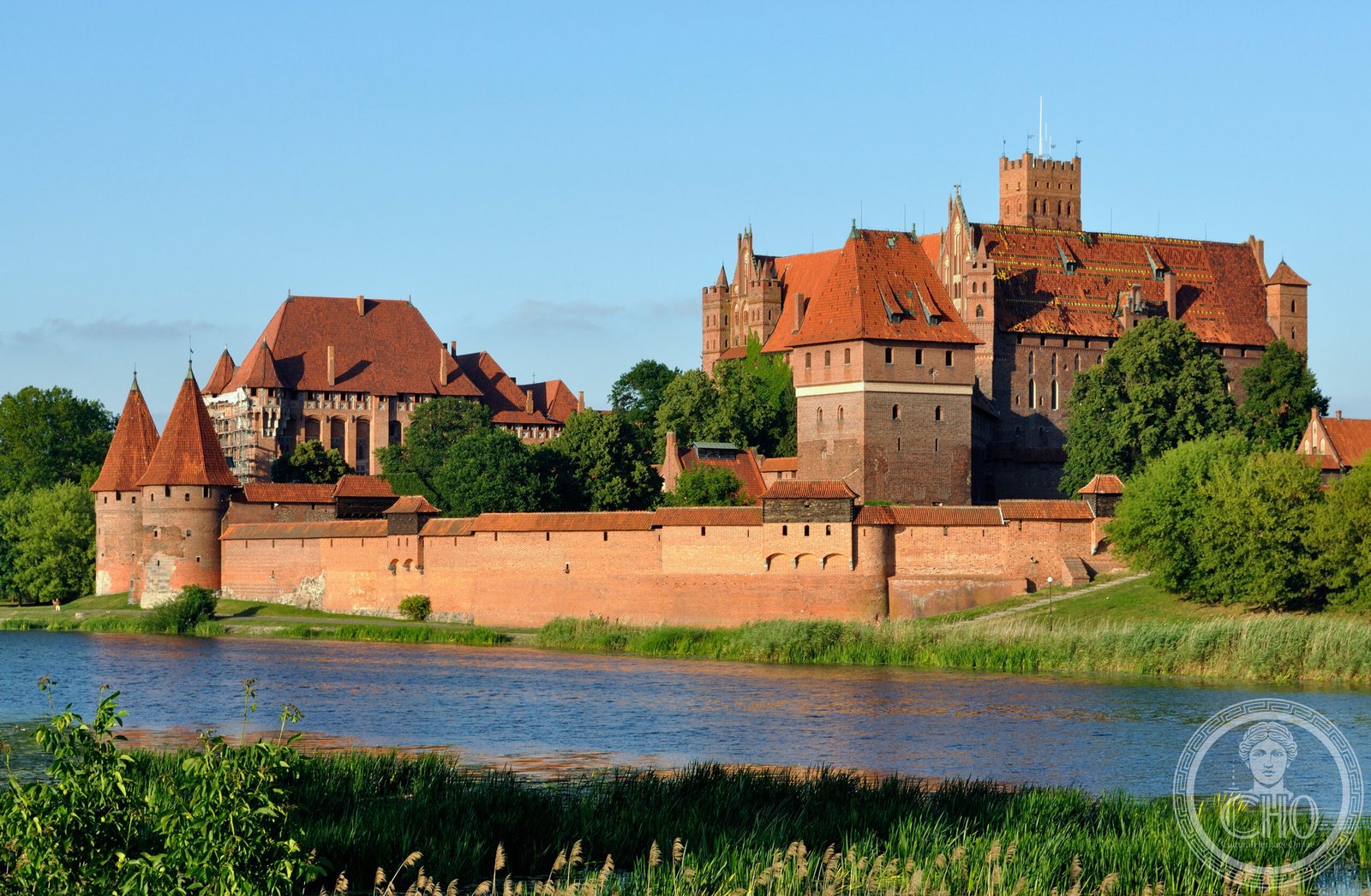
The world’s largest castle by land area, this monumental Brick Gothic fortress was built by the Teutonic Order and later became a Polish royal residence. Today it stands as Europe’s most imposing medieval stronghold.
At a glance
Malbork Castle is a Brick Gothic complex of extraordinary scale, originally constructed as an Ordensburg fortress by the Teutonic Order and named Marienburg in honour of Mary, mother of Jesus. The castle changed hands decisively in 1457, when Bohemian mercenaries sold it to King Casimir IV of Poland during the Thirteen Years’ War, transforming it into a royal residence and seat of power. It remains Poland’s most significant medieval fortress.
History
Construction began in 1274 and continued until 1406—a span of 132 years accepted by most historians as the building period. Upon completion, Malbork became the world’s largest brick castle. The Teutonic Order, a German Catholic crusading order, developed the site as the administrative heart of their Baltic territories.
In 1457, during the Thirteen Years’ War, Bohemian mercenaries sold the castle to King Casimir IV of Poland in exchange for indemnities. The fortress then served as one of several Polish royal residences and housed vital state offices until the First Partition of Poland in 1772. Swedish occupation interrupted this period, but the castle remained a centre of power.
After 1772, Malbork passed under German control for over 170 years until 1945. Architectural advances in military technology gradually rendered the fortress obsolete, and it deteriorated significantly during this period. The castle’s transformation from active stronghold to historical monument was complete.
What you see
Malbork exemplifies medieval fortress design at monumental scale. The Brick Gothic style—built entirely in brick rather than stone—dominates every elevation, creating massive walls and distinctive red-brick towers. The complex comprises multiple courtyards and defensive rings, each reflecting the different phases of construction and functional specialization.
The layout showcases the order’s sophisticated military engineering and administrative needs. High crenellated walls, narrow windows, and robust gateways reveal the fortress’s defensive purpose, while ceremonial spaces within document its role as a seat of power and prestige.
Cultural significance
Malbork Castle represents the pinnacle of medieval crusader architecture and Teutonic Order ambitions in the Baltic. Its long career as a Polish royal centre infused it with deep national meaning. Today it embodies the region’s complex medieval history, when German military-religious orders and Polish kingdoms competed for dominance.
The castle’s scale and preservation make it an essential text in understanding European fortress design and the political geography of the late medieval Baltic.
Key facts
- Location: Malbork, Poland (54.04°N, 19.03°E)
- Built: 1274–1406 by the Teutonic Order
- Style: Brick Gothic fortress complex
- Distinction: World’s largest castle by land area
- UNESCO World Heritage Site: December 1997
- Polish National Historic Monument (Pomnik historii): designated 8 September 1994
Practical information & getting there
The castle and its museum complex are open to visitors year-round. Malbork lies in north-central Poland, approximately 40 kilometres south-east of Gdańsk. Train and bus services connect the town to major cities. Consult the Malbork Castle Museum website for current hours, admission prices, and guided tour availability. The National Heritage Board of Poland maintains the site’s listing and conservation records.
Sources & resources
Find it on the map
See this place and what’s around it →
📷 Become a Cultural Heritage Online photographer
Share your photos of places: they stay published under your name as the author. The more they're seen, the more you get noticed — and soon a contest will reward the most appreciated photos.
Log in or sign up free to add a photoIs this page about you?
This page is read by travellers and heritage enthusiasts who find it on Google. Tell us how you are connected to this place and we will take it from there.