
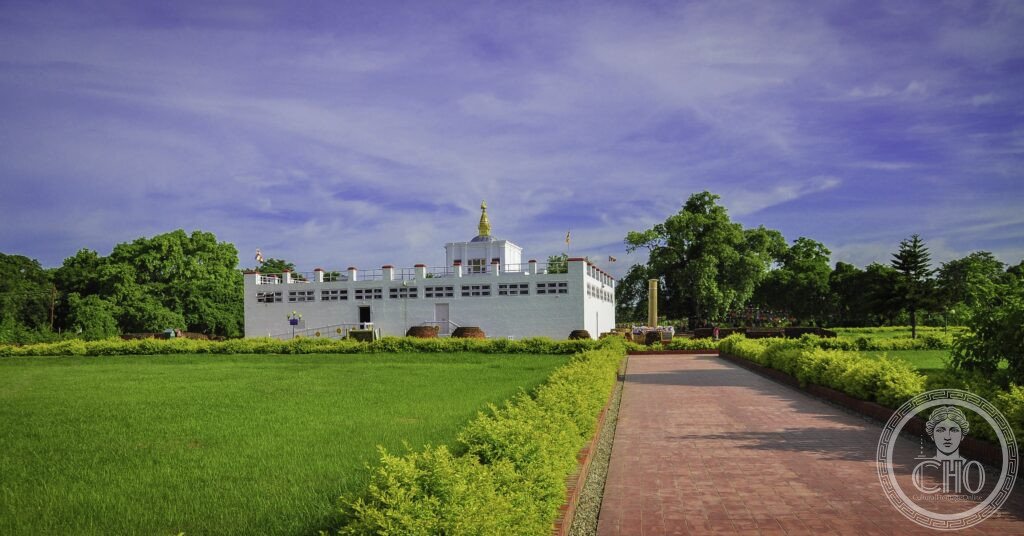
In a quiet garden near Nepal’s border with India stands the spot Buddhist tradition names as the birthplace of Siddhartha Gautama, the future Buddha. A pillar raised by the Emperor Ashoka identifies the place in his own words, making Lumbini the earliest physical link between the historical Buddha and a specific location on earth.
At a glance
Lumbini is a garden complex of roughly eight square kilometres, laid out under a master plan drawn up by the architect Kenzo Tange in 1978. The plan divides the site into a Sacred Garden holding the core birthplace remains, a monastic zone built up by Buddhist nations, and a new town. At the centre of the Sacred Garden stand the Maya Devi Temple, the Puskarni sacred pool, the Ashoka Pillar and a Bodhi tree.
The Ashoka Pillar carries the physical proof of the site’s identity. Its Prakrit inscription states that the Blessed One was born here, that King Devanampiya Piyadasi, known as Ashoka, came in the twentieth year of his reign to pay reverence, and that he reduced the tax on the village of Lumbini from one quarter to one eighth. Around the monastic zone, some twenty countries including Japan, China, Korea, Thailand, Germany, Sri Lanka and Myanmar have built national monasteries and temples.
Key facts
- Location: Lumbini, Rupandehi District, Lumbini Province, Nepal, close to the border with India.
- Significance: traditional birthplace of Siddhartha Gautama, the historical Buddha.
- Key monument: the Ashoka Pillar, erected by the Emperor Ashoka and inscribed with an identification of the birth site.
- Status: inscribed as a UNESCO World Heritage Site in 1997.
- Coordinates: 27.4833° N, 83.2769° E.
- Open question: the birth date of the Buddha is disputed, with Theravada tradition placing it around 623 BCE, scholarly consensus around 563-480 BCE, and a 1956 political anniversary implying roughly 544 BCE.
History
Around the seventh to sixth centuries BCE, Lumbini lay within the territory of the Shakya kingdom, a small republic in the Himalayan foothills whose capital, Kapilavastu, stood some thirty kilometres to the west. According to tradition, Queen Maya Devi was travelling from Kapilavastu to her maternal home when she went into labour in the sal-tree garden at Lumbini. Siddhartha Gautama is said to have left Kapilavastu at around the age of twenty-nine, spent roughly six years as an ascetic, attained enlightenment at Bodh Gaya, taught for around forty-five years, and died at Kushinagar at around the age of eighty.
The Maurya emperor Ashoka, who ruled from 268 to 232 BCE, converted to Buddhism after the Battle of Kalinga and visited Lumbini in the twentieth year of his reign, erecting the pillar that identifies the site. Centuries later the Chinese pilgrim monks Fa Xian, who travelled between 399 and 404 CE, and Xuanzang, who visited in 633 CE, both recorded the pillar and the site’s sanctity. Lumbini was then forgotten after the tenth century CE, until the German archaeologist Alois Anton Fuhrer, working for the Nepal government, rediscovered and identified the Ashoka Pillar in 1896.
What you see
The Sacred Garden, measuring roughly one kilometre by half a kilometre, holds the Maya Devi Temple, built on foundations excavated to the third century BCE and possibly earlier. Inside is a bas-relief known as the Nativity Sculpture, showing Maya Devi holding the branch of a sal tree as she gives birth, with the infant Siddhartha standing beside her; the original sculpture is kept in the National Museum of Nepal. Nearby lies the Puskarni sacred pool, where Maya Devi is said to have bathed before and after the birth, and where pilgrims still take water. The Ashoka Pillar itself survives to a height of about 6.5 metres; it was broken by an earthquake in the sixteenth century and later repaired, and its inscription remains visible near the base, alongside a marker stone said to indicate the exact spot of the birth.
Beyond the Sacred Garden, the monastic zone follows Kenzo Tange’s 1978 plan, split into an eastern zone of Theravada monasteries built by Thailand, Myanmar, Sri Lanka, Cambodia and Laos, and a western zone of Mahayana monasteries built by China, Japan, Korea, Vietnam and Germany. The most visually striking building is the Shanti Stupa, a white pagoda about thirty metres high donated by Japanese Buddhist organisations. An Eternal Flame, donated by the World Tourism Organization in 1986, burns continuously at the boundary between the monastic zone and the Sacred Garden.
Practical information
- Nearest airport: Gautam Buddha Airport at Bhairahawa, around 25 km from Lumbini, with domestic connections from Kathmandu; check current schedules with the airlines.
- Overland from Kathmandu: long-distance and tourist buses run to Bhairahawa, from where local transport covers the final stretch to Lumbini.
- From India: the border crossing at Sunauli/Belahiya lies about 20 km away, and Lumbini is often visited as part of a wider Buddhist circuit taking in Varanasi, Sarnath, Kushinagar, Kapilavastu, Shravasti and Bodh Gaya.
- Best season: the drier, cooler months from November to February offer clearer skies for visiting the site.
Getting there
Lumbini is reached most directly by flying into Gautam Buddha Airport at Bhairahawa from Kathmandu, followed by a short road transfer, or overland by bus from Kathmandu to Bhairahawa. Travellers coming from India typically cross the border at Sunauli, about 20 km from the site, often as one stop on a longer Buddhist pilgrimage route.
Nearby
- Kapilavastu — about 30 km away, the traditional capital of the Shakya kingdom where Siddhartha Gautama grew up.
- Sunauli/Belahiya border — about 20 km away, the crossing point into India used by many pilgrims.
- Kushinagar, India — the site of the Buddha’s death, part of the wider Buddhist pilgrimage circuit that includes Lumbini.
- Bodh Gaya, India — the place of the Buddha’s enlightenment, another stop on the same circuit.
Sources
- UNESCO
- National Museum of Nepal
Find it on the map
See this place and what’s around it →📷 Become a Cultural Heritage Online photographer
Share your photos of places: they stay published under your name as the author. The more they're seen, the more you get noticed — and soon a contest will reward the most appreciated photos.
Log in or sign up free to add a photoIs this page about you?
This page is read by travellers and heritage enthusiasts who find it on Google. Tell us how you are connected to this place and we will take it from there.