
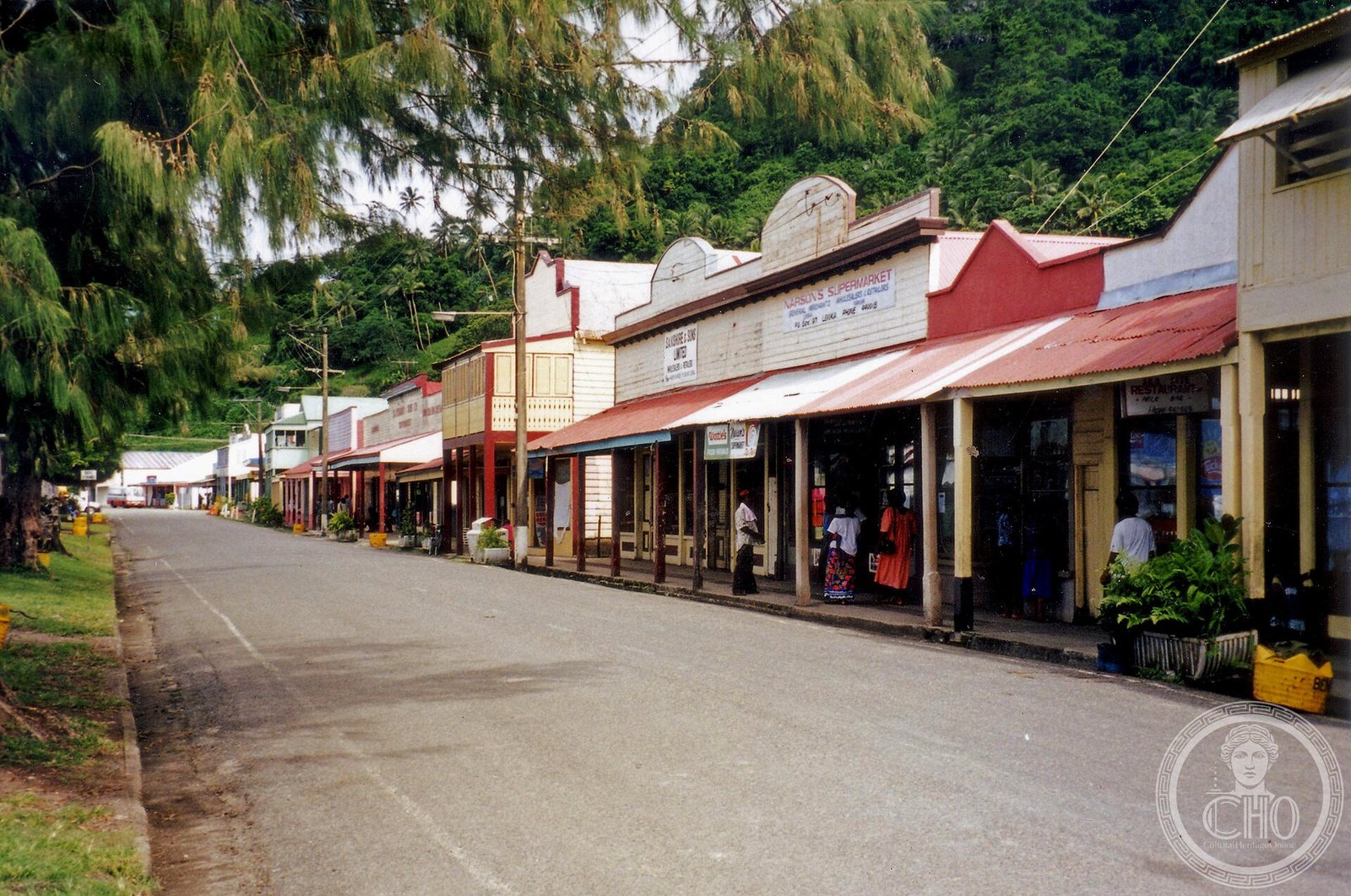
UNESCO World Heritage Site since 2013: the most intact 19th-century Pacific island colonial trading port in the world — preserved entire by the volcanic cliffs that prevented it from ever growing beyond its original Beach Street footprint.
At a glance
On the eastern coast of Ovalau island in the Lomaiviti archipelago of Fiji, Levuka is wedged between a near-vertical volcanic cliff face and the sea — a geographical constraint that made expansion of the town physically impossible after its founding in the 1830s and, paradoxically, preserved its 19th-century colonial fabric intact into the 21st century. When Fiji’s capital was transferred to Suva in 1882 because Levuka had literally run out of buildable land, the town entered a long period of suspended animation. It is today the most complete surviving example of a Pacific island colonial trading port: a single Beach Street of colonial-era timber and corrugated-iron buildings, churches, schools, and government offices that were Fiji’s commercial and administrative heart for half a century.
Key facts
- Location: Eastern coast of Ovalau island, Lomaiviti archipelago, Fiji
- Founded: c. 1830s by European beachcombers, whalers, and traders
- Status as capital: First colonial capital of Fiji, 1874–1882
- UNESCO designation: World Heritage Site inscribed 2013 (criterion ii: Outstanding Universal Value as Pacific colonial port town)
- Surviving heritage buildings: Approximately 50 colonial-era structures along Beach Street and surroundings
- Population today: Approximately 1,300 (2017 census), making it one of Fiji’s smaller urban centres
- Historic event: Cession of Fiji to the British Crown signed here 10 October 1874, at a table preserved in the Sacred Heart Parish
History
Levuka’s history as a European settlement begins in the 1820s and 1830s, when beachcombers — European sailors who had left their ships and settled among Pacific island communities — established a rough trading post on the sheltered eastern shore of Ovalau. The natural harbour made it ideal for the bêche-de-mer (sea cucumber), sandalwood, and copra trades that connected Fiji to the broader Pacific commercial network, and by the 1840s and 1850s the settlement had grown into a significant port with European merchants, Australian traders, and Fijian chiefs all drawn into its commercial orbit. The whaling trade brought additional shipping, and the town developed the characteristic mix of trading stores, grog shops, missionary churches, and consular offices that defined Pacific port towns of the era.
The decisive moment came on 10 October 1874, when paramount chief Ratu Seru Epenisa Cakobau and other leading Fijian chiefs signed the Deed of Cession at Levuka, transferring sovereignty over Fiji to Queen Victoria. The document was signed on a table that is still preserved in the Sacred Heart Parish building. Levuka became the capital of British Fiji, and the colonial government established the administrative buildings, schools, and infrastructure that remain the core of the town’s heritage fabric. But the same cliff that gave the harbour its protection also made expansion impossible: by the early 1880s the town had no buildable land remaining, and in 1882 the colonial government relocated the capital to the newly surveyed settlement of Suva on the main island of Viti Levu.
After the capital transfer Levuka declined commercially but never reinvented itself, and the colonial timber buildings that would have been demolished and replaced in a more dynamic economy simply remained. This benign neglect — combined with active heritage protection from the Levuka Historical and Cultural Society from the 1980s onwards — produced the intact town that UNESCO inscribed in 2013.
What you see
Beach Street, running parallel to the harbour, is the spine of Levuka’s heritage zone. The surviving colonial buildings are mostly two-storey timber-framed structures with wide verandas, corrugated iron roofs, and the decorative woodwork characteristic of Pacific colonial architecture of the 1860s–1900s. Key buildings include: the Town Hall (1876), one of the oldest civic buildings in Fiji; the Royal Hotel (established 1860, claimed as the oldest hotel in the Pacific), still operating; the Church of the Sacred Heart (1858), where the cession table is preserved; the Marist Convent School (1882), now the Levuka Public School; and the Ovalau Club (1904), a colonial social institution that survives as a functioning club. The Morris Hedstrom store (established 1868) preserves its original trading store shopfront.
Behind Beach Street, the cliff face rises so steeply that it was historically inaccessible. The 199 Steps — a staircase cut directly into the cliff — lead to a small settlement and viewpoint above the town, and the cliff vegetation and waterfalls visible from the town are part of the characteristic Levuka townscape documented since the 1850s. The harbour itself, with traditional Fijian boats alongside fishing vessels, completes a scene that has changed relatively little in outline since the height of the bêche-de-mer trade.
Practical information
- Getting there: Regular ferry from Natovi Landing (Viti Levu) or Patterson Brothers Shipping from Suva; approximately 5–6 hours by ferry; small aircraft available from Nausori Airport to Bureta airstrip on Ovalau
- Accommodation: Small guesthouses and the historic Royal Hotel in the town; limited options, advance booking essential
- Visitor centre: The Levuka Historical and Cultural Society operates a museum and walking tour programme from the town centre
- Opening hours: Town is open at all times; specific heritage buildings have variable hours — check locally
- Best visited: May–October (Fiji’s dry season) for most reliable weather and ferry conditions
Getting there
Levuka is accessible from Suva (Fiji’s capital) by overnight ferry (Patterson Brothers Shipping, approximately 5–6 hours) or from Natovi Landing on Viti Levu by shorter ferry crossing. A small airstrip at Bureta on Ovalau island is served by charter aircraft from Nausori Airport near Suva. From Bureta it is a 30-minute road transfer to Levuka. Most visitors combine Levuka with a broader Fiji itinerary based in Suva or the Coral Coast resorts on Viti Levu.
Nearby
- Lovoni village — inland Ovalau, a traditional Fijian village in an ancient volcanic crater; accessible by 4WD or guided walk
- Rukuruku village — 5 km north of Levuka, known for traditional Fijian culture and weaving
- Suva — Fiji’s capital, 3 hours by ferry, with the Fiji Museum (national collection of Pacific cultural heritage) and Thurston Gardens
- Caqalai Island — small resort island near Ovalau with snorkelling and diving access to the Lomaiviti reef system
Sources
- UNESCO World Heritage Committee (2013). Levuka Historical Port Town — Inscription Decision. WHC-13/37.COM/8B. Paris.
- Routledge, D. (1985). Matanitu: The Struggle for Power in Early Fiji. University of the South Pacific, Suva.
- Derrick, R. A. (1950). A History of Fiji. Government Press, Suva. Revised edition.
- Levuka Historical and Cultural Society. Heritage Walking Trail — Levuka. Society publication, Levuka.
- Wikipedia contributors. “Levuka.” Wikipedia, The Free Encyclopedia. Accessed 2026.
Find it on the map
See this place and what’s around it →📷 Become a Cultural Heritage Online photographer
Share your photos of places: they stay published under your name as the author. The more they're seen, the more you get noticed — and soon a contest will reward the most appreciated photos.
Log in or sign up free to add a photo