
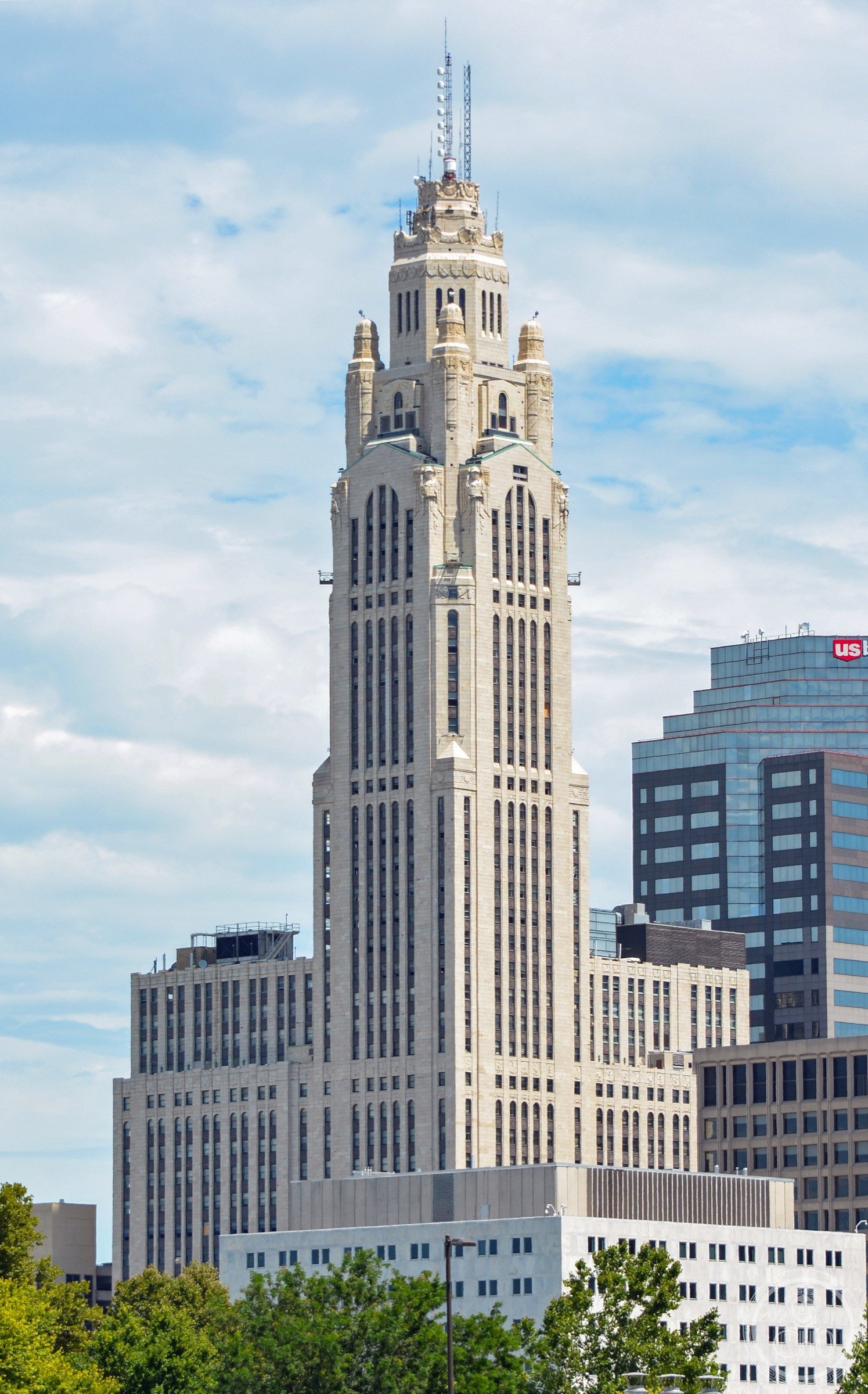

Columbus’s defining skyline presence since 1927, the LeVeque Tower blends Art Deco verticality with a European crown of Baroque-influenced ornament — an eclectic flourish that made Ohio’s capital unmistakable on the horizon.
At a glance
The LeVeque Tower rises at 50 West Broad Street in the heart of Columbus in a composition that starts strictly Art Deco and finishes in an elaborate crown of Flemish Baroque and Renaissance ornament — turrets, lanterns, and gilded metalwork that mark the building from miles away. Completed in 1927 to a design by C. Howard Crane and Kenneth Franzheim, the tower was one of the tallest buildings in Ohio at its completion and became the symbolic centre of the state capital’s commercial life. Listed on the National Register of Historic Places and a designated Columbus landmark, it has been sensitively adapted in recent decades for mixed hotel and office use.
Key facts
- Address: 50 West Broad Street, Columbus, OH 43215
- Architects: C. Howard Crane & Kenneth Franzheim
- Completed: 1927
- Original client: American Insurance Union (fraternal benefit society)
- Style: Art Deco with Baroque-influenced crown
- Status: National Register of Historic Places; Columbus Landmark
- Current use: Mixed hotel and office building
History
The tower was commissioned by the American Insurance Union, a fraternal benefit society headquartered in Columbus, as its national headquarters building. The AIU was a substantial institution in the 1920s, and its ambition was to give Columbus a building that would rival the great commercial towers going up in New York and Chicago. Architects C. Howard Crane — better known for his theatre designs across the Midwest and South — and his partner Kenneth Franzheim produced a design that satisfied the commission’s aspiration for permanence and distinctiveness.
The completed building was originally called the American Insurance Union Citadel. It passed through various owners over the following decades, and the LeVeque family, prominent Columbus businesspeople, became associated with the building through their ownership in the mid-twentieth century, giving it the name by which it is now known. The tower was Columbus’s defining high-rise for decades, and its crown remained the most recognisable element of the capital city’s skyline long after taller buildings appeared.
In the early twenty-first century, the tower underwent a comprehensive renovation that converted upper floors into a hotel while maintaining the building’s historic character. The lobby and ornamental elements were carefully restored, and the crown continues to be illuminated at night, making it one of central Ohio’s most visible landmarks after dark.
What you see
The tower’s lower floors are straightforward Art Deco: limestone-clad piers, geometric ornament in the spandrel panels, setbacks at regular intervals as the building narrows toward its upper stories. The shaft is restrained and corporate. But above the final setback, the building abandons Art Deco discipline for something far more exuberant — a multi-stage crown of Baroque ornament, false turrets, gilded metalwork, and lanterns that references the great guild halls and town halls of Flanders and the Dutch Republic.
This crown is the building’s signature. At street level it reads as a remote fantasy above the city; at rooftop level on nearby buildings, the ornament resolves into extraordinarily detailed stone and metalwork, including eagles, decorative shields, and elaborate finials. The lobby has been restored to approximate its original splendour: marble and bronze at human scale, elevator doors with relief panels, and light fixtures in period styles.
Practical information
- Access: Hotel lobby open to the public; café and public spaces at street level
- Admission: Free to view exterior and hotel lobby
- Photography: Crown best photographed from the Scioto Mile riverfront to the west; street level offers the best perspective on the lobby entrance
- Time needed: 20–30 minutes for exterior and lobby
Getting there
The LeVeque Tower stands on West Broad Street at the heart of Columbus’s downtown, one block west of the Ohio Statehouse. The COTA bus network serves the Broad/High intersection directly. Street parking is available on weekends; parking garages are within a block. John Glenn Columbus International Airport (CMH) is approximately 15 minutes east by highway.
Nearby
- Ohio Statehouse (1861) — The Greek Revival state capitol building in the centre of the Statehouse Square, one block east on Broad Street, whose uncluttered dome silhouette provided the historic skyline backdrop against which the LeVeque Tower asserted itself in 1927.
- Columbus Museum of Art — A significant collection of 19th- and 20th-century American and European art five blocks north on Broad Street, including an outstanding collection of early Modernist works.
- Scioto Mile — The riverfront park and urban trail system along the west bank of the Scioto River, three blocks west, which offers some of the best distant views of the tower’s crown.
Sources
- National Register of Historic Places nomination, LeVeque Tower (American Insurance Union Citadel), Columbus, Ohio.
- Columbus Landmarks Foundation — designation documentation.
- Ohio History Connection — architectural survey records.
- Wikimedia Commons — LeVeque Tower photograph (Jud McCranie, CC BY-SA 4.0).
Find it on the map
See this place and what’s around it →📷 Become a Cultural Heritage Online photographer
Share your photos of places: they stay published under your name as the author. The more they're seen, the more you get noticed — and soon a contest will reward the most appreciated photos.
Log in or sign up free to add a photoDo you manage this place?
This page is read by travellers and heritage enthusiasts who find it on Google. Keep it accurate — and make it work for you. Free for non-profit heritage institutions.