
The best-preserved large Roman city in the world — a colonnaded forum, a market building with two octagonal kiosks, an amphitheatre on the sea cliff, a lighthouse harbour still standing — raised to imperial splendour by the Emperor Septimius Severus (193–211 AD), who was born here and stripped the rest of the empire to build the finest city Africa had ever seen, then died in York and left his city to be buried by the desert.
At a glance
Leptis Magna (Latin: Lepcis Magna; also Leptis or Lepcis) is an ancient city on the Mediterranean coast of Libya, 130 km east of Tripoli near the modern town of Al Khums. Founded as a Phoenician trading post by settlers from Tyre (c. 1000 BC), it became a major commercial centre of the western Mediterranean under Carthaginian and later Roman rule. The city reached its zenith when Septimius Severus (193–211 AD) became emperor — the first African-born emperor of Rome — and invested massively in his home city: a new forum (the Severan Forum), a new basilica, a new colonnaded street, a triumphal arch, and an expanded harbour all date from his reign. After Severus’s death, the city declined; the harbour silted; desert sands gradually buried most of the structures. The remarkable state of preservation (the sand acted as protection) and the quality of the surviving architecture make Leptis Magna arguably the finest Roman site outside Rome and Pompeii. UNESCO inscribed it as a World Heritage Site in 1982.
Key facts
- Severan Forum: built c. 203–216 AD; 100 × 60 metres; the Medusa-head decorations in the arcade (the Medusa heads are carved in a style combining Roman imperial and North African local traditions) are the finest decorative sculpture at the site; the adjoining Severan Basilica is 97 × 40 metres, with elaborate marble colonnades; the two buildings together are the most monumental Severan civic complex in the empire.
- The Old Forum (Chalcidicum): the civic centre of the city before Severus; the Temple of Rome and Augustus, the Curia (senate house), and the Chalcidicum (exchange) surround a 50 × 35 metre open space; the marble pavement is partially intact; the overall scale gives a clear impression of a prosperous Roman provincial city before the Severan explosion.
- The Market (Macellum): built c. 8 BC; two octagonal kiosks (one largely intact) in a colonnaded courtyard; the stone measuring tables (with standard measures for commodities) are still in place; the most intact Roman market building outside Rome; it illuminates the commercial life of the city.
- Hunting Baths: a smaller bath complex of the 2nd–3rd century AD; the interior painted vaulted ceilings show hunting scenes; the chambers are in good structural condition with original painted plaster surviving.
- The Amphitheatre: carved into the coastal hillside east of the city; 40,000 spectator capacity; the curved seating follows the natural contour of the hill; the arena floor (at sea level, below the original ground surface) and the access corridors are largely intact; gladiatorial and animal hunt reliefs visible in the surviving decoration.
- Heritage: UNESCO World Heritage Site, Archaeological Site of Leptis Magna, inscribed 1982.
- GPS: 32.6387° N, 14.2912° E.
History
Leptis Magna was founded by Phoenician traders from Tyre or Sidon around 1000 BC as a strategic waypoint for the trans-Saharan trade in gold, salt, and slaves. Under Carthaginian hegemony (6th–2nd century BC), it was a significant port; after the Third Punic War (146 BC), it aligned with Rome voluntarily rather than waiting to be conquered. Roman citizenship was granted in 74 BC; the city became a Roman colony under Trajan (c. 109 AD). Its wealth derived from the export of African grain, olive oil (the Leptis hinterland was a major olive oil production zone), and wild animals for the Roman games.
The transformation of Leptis Magna from a prosperous provincial city to an imperial showpiece occurred entirely because of the accident of Septimius Severus’s birth: born in Leptis in 146 AD, he became emperor in 193 AD after a civil war, and between 203 and his death in 211 AD invested what ancient sources describe as enormous sums in his home city. The Severan Forum and Basilica, the new colonnaded street from the forum to the harbour, the triumphal arch, and the expanded harbour with its lighthouse were all built within a decade. The quality of the workmanship — columns of Aswan granite, floors of imported marble, Medusa-head friezes carved by artists brought from Rome or Athens — reflects imperial resources applied to provincial ambition.
After Severus’s death, the city never found another patron of equivalent power. The third-century crisis reduced trade; the harbour silted; in 365 AD, an earthquake damaged the buildings and the resulting tsunami (the same earthquake destroyed Alexandria and Crete) flooded the lower city. The Vandal conquest in the 5th century and Arab conquest in the 7th century ended urban life; the desert sands drifted over the abandoned buildings and preserved them. Italian colonial-period excavations (1920s–1930s) uncovered the main sites; British archaeologists worked at the site after World War II; ongoing international missions continue excavation and conservation.
What you see
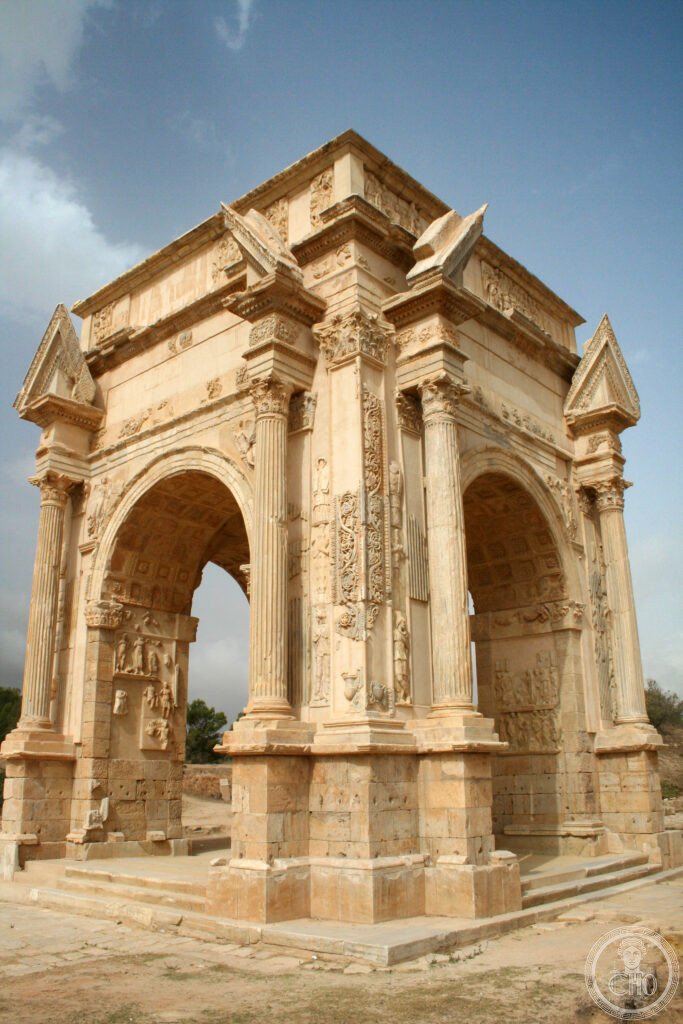
Leptis Magna is a large open site; a full visit requires 3–4 hours on foot. The entry is near the Arch of Septimius Severus, the four-faced triumphal arch erected in 203 AD at the intersection of the main north-south and east-west streets; the relief carvings show Severus with his two sons Caracalla and Geta (Geta’s face was later erased after Caracalla murdered him) and scenes of imperial sacrifice. From the arch, the Severan colonnaded street leads north-east toward the harbour; the Old Forum is 200 metres south-west.
The best-preserved individual structures are the Macellum (the market building with its octagonal kiosks, measuring tables, and intact colonnade), the Hunting Baths (intact painted vaulted ceilings), and the amphitheatre east of the main site. The Severan Forum and Basilica, while partially standing, have lost their upper stories; the surviving arcade with its Medusa-head keystones gives an impression of the original scale. The harbour, now partially silted and a short walk east of the main site, still has its moles and lighthouse base.
Practical information
- Access (2026): travel to Libya remains restricted due to ongoing political instability; visitors should consult their government’s travel advisory before planning; the site itself has been protected by the Libyan authorities; specialist heritage tour operators (primarily UK and Italian) organise escorted visits.
- Location: 130 km east of Tripoli; 2 km north of the town of Al Khums (formerly Homs); the site is directly on the coast.
- Museum: the site museum at the entrance (closed for restoration at the time of writing) has the finest collection of African Roman sculpture outside Rome, including the Hunt Frieze from the Hunting Baths and portrait sculpture from the Severan period.
Getting there
Mitiga International Airport (MJI), Tripoli, is the nearest major airport; 130 km west of Leptis Magna. The site is 2 km north of Al Khums town on the coastal highway. Access requires an organised tour with local security; independent travel to Libya is not recommended in 2026. GPS: 32.6387, 14.2912.
Nearby
- Sabratha — another major Phoenician-Roman city on the Libyan coast, 65 km west of Tripoli; the best-preserved Roman theatre in North Africa (3rd century AD), with a three-storey scaenae frons (stage backdrop) still standing 25 metres; UNESCO WHS (as part of the same inscription series).
- Tripoli Old City (Medina) — the Ottomman-period old city with its souk and the Marcus Aurelius Arch (163 AD, the only surviving Roman monument in the modern city of Tripoli); the Jamahiriya Museum (now National Museum of Libya) has important collections from Leptis Magna and Sabratha; 130 km west of Leptis Magna.
Sources
- Wikipedia, Leptis Magna, accessed June 2026.
- UNESCO, Archaeological Site of Leptis Magna, WHS reference 183, inscribed 1982.
- David Mattingly, Tripolitania, University of Michigan Press, 1995 — the standard scholarly study of the Roman province and its cities.
- Anthony Birley, Septimius Severus: The African Emperor, Yale University Press, 1988.
Find it on the map
See this place and what’s around it →📷 Become a Cultural Heritage Online photographer
Share your photos of places: they stay published under your name as the author. The more they're seen, the more you get noticed — and soon a contest will reward the most appreciated photos.
Log in or sign up free to add a photo