
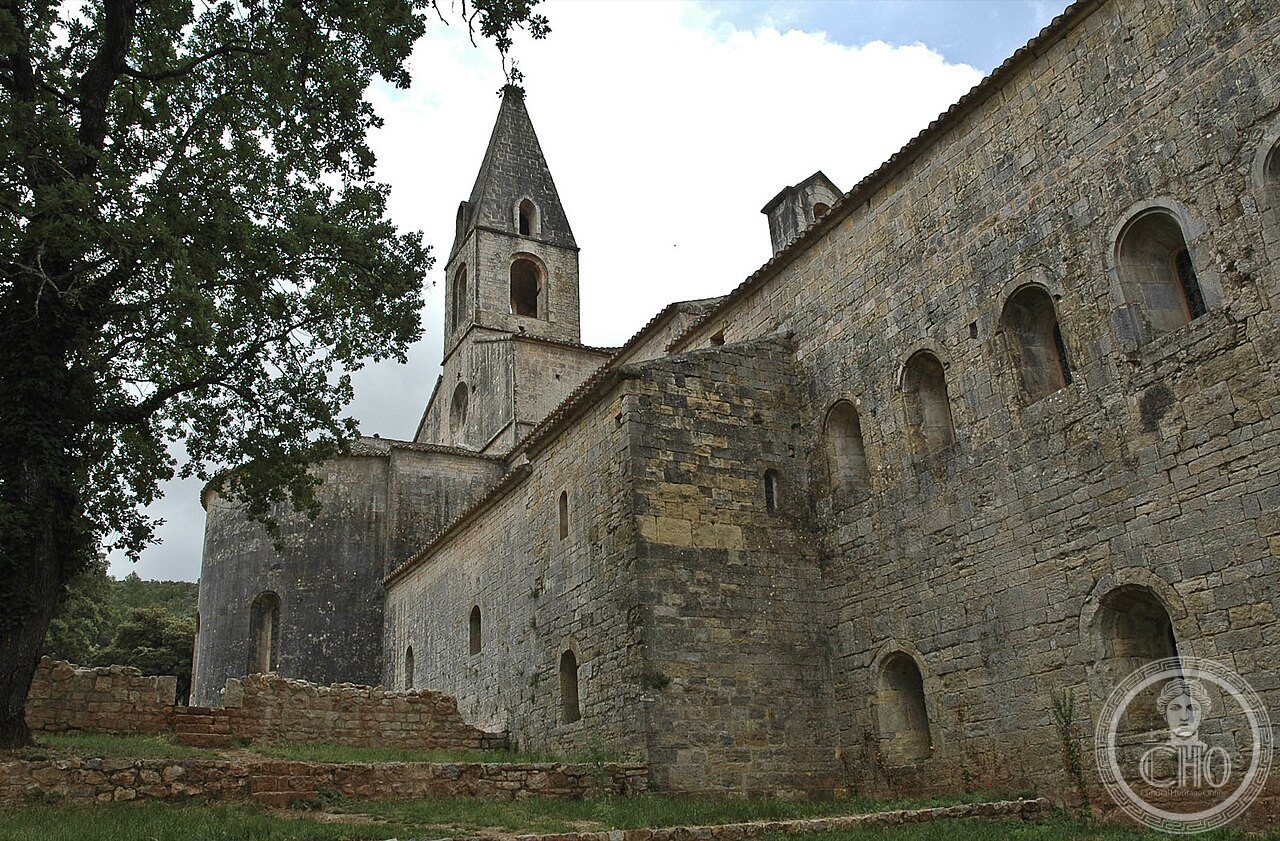
The stone walls of the church of Le Thoronet create an echo that can last up to thirteen seconds at any point in the building: acoustics so extreme that they imposed on the monks a precise discipline in singing, slow and perfectly synchronised. That same space, one of the Cistercian “Three Sisters” of Provence together with Sénanque and Silvacane, has left its mark on generations of modern architects, from Le Corbusier to Tadao Ando.
About Le Thoronet Abbey
Le Thoronet Abbey, a former Cistercian abbey now restored as a museum, stands between the towns of Draguignan and Brignoles in the Var department of Provence. Founded by monks of the Cîteaux order, the abbey was built mainly between 1160 and 1190, with the complex completed by 1250. Le Thoronet is one of three Cistercian abbeys in Provence — together with Sénanque and Silvacane — collectively known as “the Three Sisters of Provence,” each celebrated as among the finest surviving examples of the Cistercian architectural spirit: pure, simple, and harmoniously proportioned Romanesque design. The abbey’s single most celebrated feature is its extraordinary acoustics — the stone walls of the church create an echo lasting up to 13 seconds anywhere within the building, a resonance so extreme it imposed genuine discipline on the monks, who were forced to sing slowly and in perfect unison to avoid the sound collapsing into incoherence. By the 13th century, the abbey housed around twenty monks and several dozen lay brothers, the latter managing the rural agricultural estates (barns) and wine and olive-growing operations (cellars) that sustained the community. The abbey went into decline over the following centuries, with the Black Death of 1348 devastating the population of Provence and directly impacting the community. In 1840, Le Thoronet became one of the very first buildings in France to be officially classified as a historical monument. Its remarkable acoustics and pure architectural form have since left a documented mark on generations of modern architects, including Le Corbusier, Fernand Pouillon, John Pawson, and Tadao Ando.
Key facts
- Construction: mainly 1160-1190, complex completed by 1250, by monks of the Cîteaux order
- “Three Sisters of Provence”: Le Thoronet, alongside Sénanque and Silvacane, celebrated as premier examples of Cistercian architecture
- Acoustics: up to 13 seconds of echo anywhere in the church, requiring slow, perfectly synchronised monastic chant
- 13th-century community: c. 20 monks and several dozen lay brothers managing agricultural and viticultural estates
- 1348 Black Death: devastated Provence’s population, contributing to the abbey’s decline
- 1840: among the first buildings in France classified as a historical monument
- Architectural influence: Le Corbusier, Fernand Pouillon, John Pawson, Tadao Ando all documented as influenced by the site
History
The extreme acoustic properties of Le Thoronet’s church — a genuinely unusual architectural phenomenon among medieval churches — reflect the Cistercian order’s characteristic pursuit of a specific, disciplined form of communal worship, in which the building’s very physical properties reinforced the monastic community’s required precision and unity in liturgical chant; the monks’ forced slow, synchronised singing wasn’t merely an aesthetic preference but a practical necessity imposed directly by the stone architecture’s sound behaviour. This tight integration of architectural form and monastic liturgical practice exemplifies the broader Cistercian design philosophy, in which purely functional and spiritual considerations shaped building decisions rather than external decorative ambition.
Le Thoronet’s documented influence on major 20th-century modernist architects — most notably Le Corbusier, whose own later work shows clear engagement with the abbey’s spatial and light qualities — situates this 12th-century Cistercian building within a genuinely significant and well-documented lineage connecting medieval monastic design principles to modern architectural minimalism. This connection reflects how Cistercian architecture’s foundational commitment to purity, simplicity, and harmonious proportion anticipated, by roughly eight centuries, core principles that architectural modernism would later articulate as deliberate, self-conscious design philosophy — making Le Thoronet a genuine touchstone for architects seeking historical precedent for minimalist spatial design.
What you see
The church’s extraordinary acoustics, best experienced by speaking or singing within the space itself, are Le Thoronet’s essential and most immediately memorable feature, offering visitors a rare direct sensory encounter with medieval architectural design intention. The cloister and surrounding monastic buildings, product of the 1160-1250 construction, give visitors a complete sense of the pure Cistercian architectural ensemble that has drawn generations of modern architects to study the site. The abbey’s continuing recognition since 1840 as one of France’s earliest classified historical monuments underscores its long-established status as an architectural touchstone.
Practical information
- Opening hours: generally open daily, check current hours before visiting; admission fee
- Address: D79, 83340 Le Thoronet, France
Getting there
Le Thoronet Abbey is reachable by car from Draguignan (approximately 20 minutes) or Brignoles (approximately 20 minutes) in the Var department, Provence. GPS: 43.4605° N, 6.2637° E.
Nearby
- Draguignan — approximately 20 minutes away; a historic Provençal town
- Lac de Carcès — a nearby reservoir lake, popular for outdoor recreation
- French Riviera coast — within driving distance of the Var’s Mediterranean coastline
Sources
- Wikipedia — “Thoronet Abbey” (en.wikipedia.org)
- Aleteia — “Le Thoronet: This 12th century-monastery is one of the ‘Three Sisters of Provence'” (aleteia.org)
- Le Thoronet official site — “History of Le Thoronet Abbey” (le-thoronet.fr)
Find it on the map
See this place and what’s around it →📷 Become a Cultural Heritage Online photographer
Share your photos of places: they stay published under your name as the author. The more they're seen, the more you get noticed — and soon a contest will reward the most appreciated photos.
Log in or sign up free to add a photo