
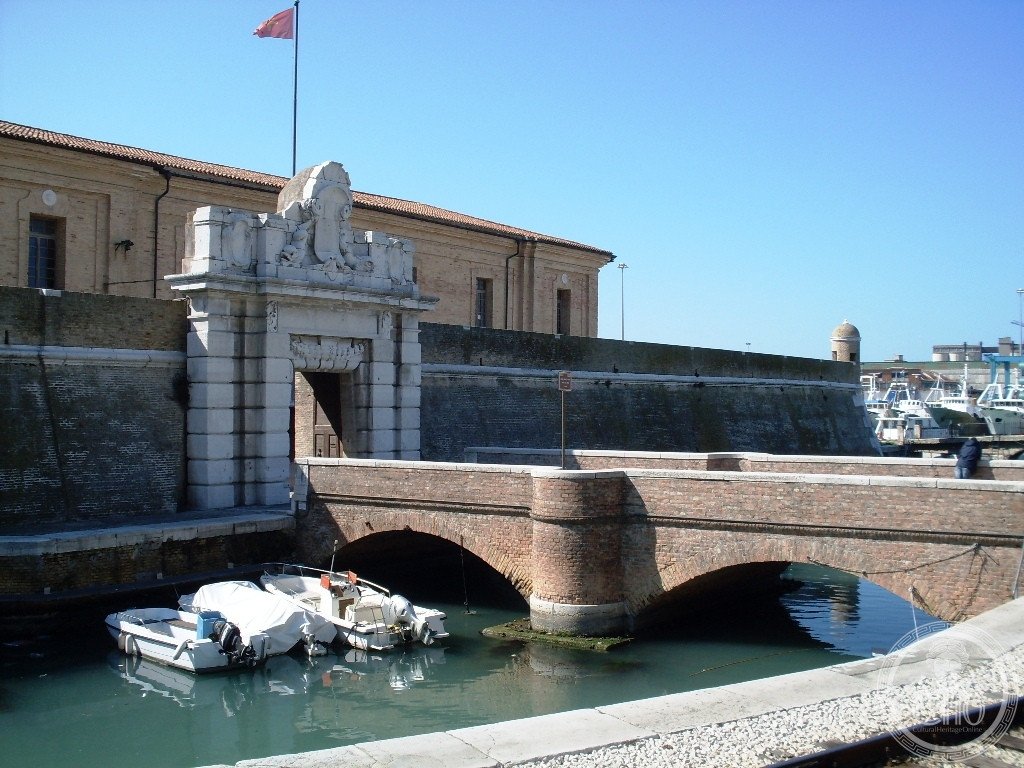
A pentagonal island fortress designed by Luigi Vanvitelli, this 18th-century quarantine hospital and port defense structure now serves as a cultural and exhibition venue.
At a glance
The Mole Vanvitelliana occupies an artificial pentagonal island in Ancona’s harbor, connected to the mainland by three bridges. Spanning 20,000 square meters, it originally functioned as a multifunctional complex: quarantine facility, goods warehouse, and military fortification. Today it operates as La Mole, a cultural system hosting exhibitions, performances, and creative events.
History
Designed by architect Luigi Vanvitelli, the Lazzaretto was built to isolate arriving ships and cargo from areas deemed unsafe, protecting Ancona’s public health. Originally accessible only by boat, the complex accommodated up to 2,000 people and substantial merchandise. Its geometric pentagonal form—echoing the five-pointed star fortification of the Citadel above—carried symbolic weight as an expression of human power to reshape reality.
The structure proved strategically vital during the Austrian siege of 1799 and again in World War I. On the night of April 5–6, 1918, approximately 60 Habsburg navy saboteurs attempted to infiltrate the harbor to destroy Italian vessels moored nearby. Finance guards Carlo Grassi and Giuseppe Maganuco, with support from patrol chief Brigadiere Guadagnini, repelled the attack—an event commemorated by a plaque placed in 1927.
What you see
The island’s centerpiece is a small neoclassical temple dedicated to San Rocco, open on all four sides. This design permitted quarantined individuals in adjoining rooms to attend mass while maintaining isolation from the priest and one another. At the temple’s core lies the lid of the main drinking water tank, which collected filtered rainwater from surrounding roofs—part of an ingenious underground cistern network fed by three wells.
The building’s layout divides internal quarantine quarters from external warehouses, while a ravelin on the seaward side provided military defense. Every architectural element served dual purposes: protection, containment, and preservation of goods and people.
Cultural significance
The Lazzaretto embodies Renaissance and Enlightenment thinking about public health infrastructure and rational urban planning. Its multifunctional design—simultaneously hospital, fortress, and storage facility—reflects the complexity of early modern port management and disease prevention. The geometric pentagonal form, chosen for both aesthetic and symbolic reasons, links it conceptually to the broader defensive architecture of Ancona.
As La Mole today, it continues to serve the community through cultural programming that emphasizes the creative relationship between human intention and material form, welcoming diverse audiences without exclusion.
Key facts
- Address: Banchina Giovanni da Chio, 28, 60121 Ancona
- Coordinates: 43.6144713, 13.5038147
- Area: 20,000 m²
- Original capacity: Up to 2,000 people
- Architect: Luigi Vanvitelli
- Phone: 071 9257388
- Website: https://www.lamoleancona.it/
Practical information
La Mole operates as a cultural venue with exhibitions, performances, and educational programs. Current opening hours and admission details are available on the official website. The site is accessible by car or public transport; parking and accessibility accommodations should be confirmed in advance.
Getting there
The Mole is located on a pentagonal island in Ancona’s harbor, connected to the mainland by three bridges. From central Ancona, follow signs toward the port (Porto). The venue is directly accessible via Banchina Giovanni da Chio. For public transport, contact local transit authorities or check the website for visitor information.
Sources & resources
Find it on the map
See this place and what’s around it →Historical events at this place (1)
📷 Become a Cultural Heritage Online photographer
Share your photos of places: they stay published under your name as the author. The more they're seen, the more you get noticed — and soon a contest will reward the most appreciated photos.
Log in or sign up free to add a photoIs this page about you?
This page is read by travellers and heritage enthusiasts who find it on Google. Tell us how you are connected to this place and we will take it from there.