
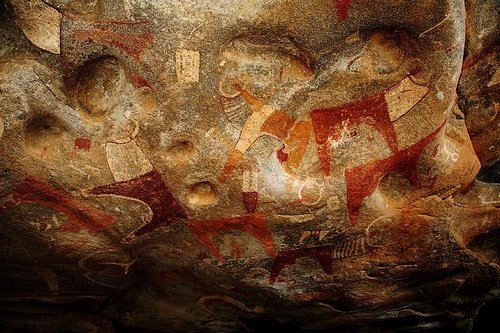
In the granite hills 60 km northeast of Hargeisa, a series of rock shelters contains what specialists consider the best-preserved prehistoric cave paintings in Africa: vivid polychrome images of cattle, herders, and dogs from the Neolithic Green Sahara period.
At a glance
Laas Geel means “water source for camels” in Somali. Discovered by a French archaeological mission in 2002 and documented in 2003-2004, the site comprises approximately 20 rock shelters distributed across a limestone and granite hillside. The principal chamber alone contains over 350 individual painted figures. The paintings remain extraordinarily vivid thanks to the dry microclimate under the granite overhangs, spanning roughly 6,000 years of continuous use from c. 9000 BC to 3000 BC.
Key facts
- Location: 60 km northeast of Hargeisa, Somaliland (northwestern Somalia)
- Period: c. 9000-3000 BC (Neolithic, Green Sahara phase)
- Discovery: French archaeological mission, 2002; documented 2003-2004 by Xavier Gutherz
- Principal subjects: Polychrome cattle with dewlaps, herders in ceremonial garb, domesticated dogs
- Shelters: Approximately 20 rock shelters; main chamber contains 350+ figures
- Status: Proposed for UNESCO World Heritage List; not yet inscribed (Somaliland is unrecognised)
History
The paintings were produced during the African Humid Period, also called the “Green Sahara” (c. 11000-5000 BP), when cattle-herding communities occupied landscapes now desert or near-desert. The Neolithic pastoralists used the site continuously for approximately six millennia. Artists applied mineral pigments — iron oxides for reds, kaolin for whites, manganese for blacks — directly to sheltered rock surfaces. The overhanging granite and the exceptionally dry climate preserved the images without significant fading.
The site was unknown to international archaeology until a French team from the Centre Francais d’Etudes Ethiopiennes visited in November 2002. The 2003-2004 documentation campaign, led by archaeologist Xavier Gutherz, produced the first systematic record and established the site’s world-class significance. Despite immediate international recognition, archaeological excavation has remained minimal because of the political and logistical difficulties of working in Somaliland, which has functioned as a de facto autonomous region since 1991 but is not recognised by any sovereign state. The Somaliland government has proposed Laas Geel for UNESCO World Heritage listing, but the application faces a political deadlock: the nomination would formally require submission through Somalia, which claims nominal sovereignty over Somaliland. The site has a small guard post staffed by Somaliland authorities, and visits require advance permission from the Ministry of Tourism in Hargeisa.
What you see
The paintings are concentrated in approximately 20 rock shelters formed where granite boulders create overhung recesses. The most important shelter contains more than 350 individual figures arranged in horizontal registers, suggesting deliberate narrative or ritual organisation. The cattle are painted with striking anatomical precision: dewlaps, curved horns, and musculature rendered with a confidence that implies intimate knowledge of the animals. Human figures appear alongside cattle in pastoral or ceremonial scenes: some wear robes or kilt-like garments, others have elaborate headdresses. Several figures appear to interact with cattle in gestures that may represent milking, leading, or sacrifice. Dogs appear in herding or hunting poses, their domesticated relationship with humans clearly depicted.
The colour palette — predominantly warm reds, oranges, and ochres with white highlights and occasional blacks — gives the paintings immediate visual impact. Superimposed figures from different periods are visible in several shelters, allowing archaeologists to construct a relative chronology of the site’s use over six millennia. The site is accessible by 4WD vehicle from Hargeisa on a track passing through semi-arid Somali highlands.
Practical information
- Access permit: Required from the Somaliland Ministry of Tourism and National Heritage, Hargeisa
- Transport: 4WD vehicle essential; approximately 1.5-2 hours from Hargeisa on unpaved tracks
- Best time: October-March (dry season); avoid June-August rains
- On site: Government guards present; no visitor centre, no toilets, no shade structures
- Photography: Permitted; avoid flash and use natural light only
Getting there
Laas Geel is approximately 60 km northeast of Hargeisa, the capital of Somaliland. Most visitors hire a 4WD with driver in Hargeisa, where local tour operators familiar with the route and permit procedures can be found. The Egal International Airport in Hargeisa is served by regional carriers including Jubba Airways and Daallo Airlines from Addis Ababa, Djibouti, and Nairobi. Somaliland issues its own visas at the border or at Hargeisa airport, independently of the Somali federal government.
Nearby
- Hargeisa: Capital of Somaliland, 60 km southwest — war memorial, national museum, camel market
- Dhambalin: Another significant prehistoric rock art site further east in the Togdheer region
- Berbera: Historic coastal town on the Gulf of Aden, c. 180 km north — Ottoman and British colonial-era architecture
Sources
- Gutherz, X. et al. Discovery of rock art in the Horn of Africa. Journal of African Archaeology 1.2 (2003): 227-236.
- Gutherz, X., Cros, J.-P., and Lesur, J. The rock art of Laas Geel, Republic of Somaliland. Journal of African Archaeology (2003).
- Wikipedia contributors. Laas Geel. Wikipedia, The Free Encyclopedia. Accessed 2026.
- Smith, A. B. African Herders: Emergence of Pastoral Traditions. AltaMira Press, 2005.
Find it on the map
See this place and what’s around it →📷 Become a Cultural Heritage Online photographer
Share your photos of places: they stay published under your name as the author. The more they're seen, the more you get noticed — and soon a contest will reward the most appreciated photos.
Log in or sign up free to add a photo