
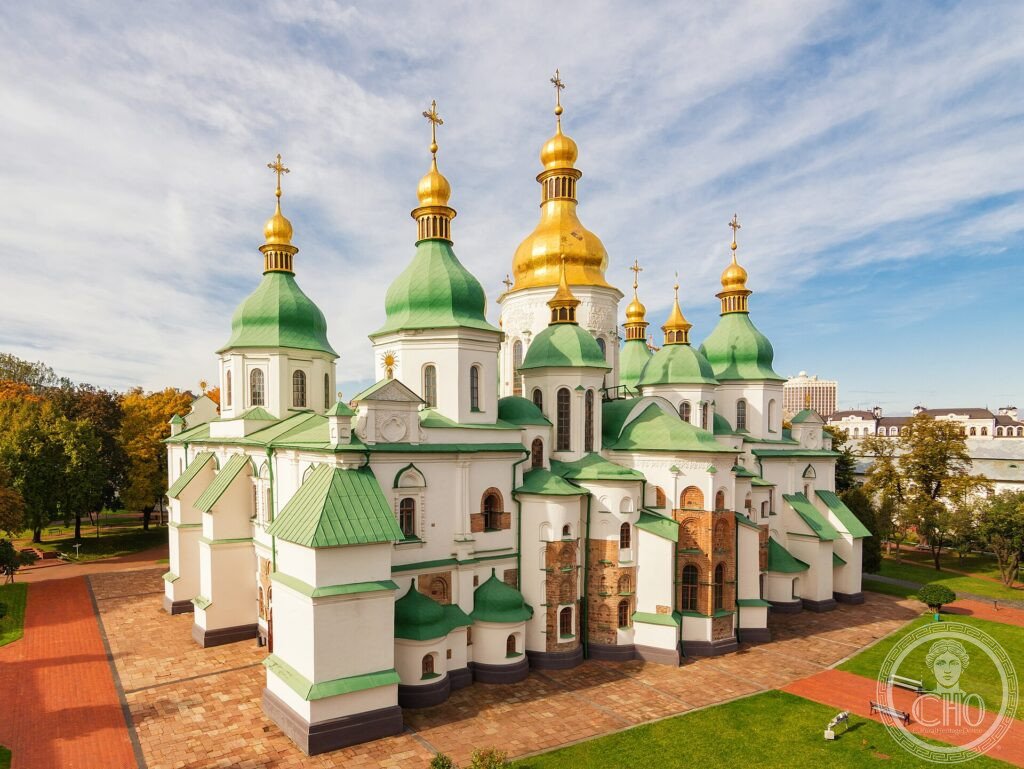
When Kyiv was the capital of the Rus’, Prince Yaroslav the Wise raised the cathedral of Saint Sophia here in imitation of Constantinople, with mosaics and frescoes that have lasted a thousand years. Not far away, the caves of the Pechersk Lavra hold the relics of the monk saints: two beacons of Slavic Orthodoxy.
At a glance
The UNESCO site of Kyiv brings together two monuments at the origin of East Slavic Christianity. Saint Sophia Cathedral, built in the 11th century by Prince Yaroslav the Wise, was conceived to rival Hagia Sophia in Constantinople and preserves an outstanding ensemble of mosaics and frescoes. The Kyiv-Pechersk Lavra, the Monastery of the Caves, is a hill of churches above the Dnieper honeycombed with catacombs holding the relics of revered monks. Together they were inscribed by UNESCO in 1990.
Key facts
- UNESCO: World Heritage since 1990 (Saint-Sophia Cathedral and Kyiv-Pechersk Lavra)
- Saint Sophia: built in the 11th century by Yaroslav the Wise
- Mosaics and frescoes: a rare surviving 11th-century Byzantine ensemble
- Kyiv-Pechersk Lavra: the Monastery of the Caves, founded 1051
- Catacombs: underground galleries holding the relics of monks
- Origin of the Rus: Kyiv was the capital of medieval Kievan Rus
History
In the 11th century Kyiv was the capital of Kievan Rus, the first East Slavic state, recently converted to Christianity. Prince Yaroslav the Wise built Saint Sophia as its cathedral, importing Byzantine craftsmen to line it with gold-ground mosaics and frescoes, a statement that Kyiv was a new centre of the Orthodox world.
Around the same time monks founded the Monastery of the Caves on the slopes above the Dnieper, digging the catacombs that became a great pilgrimage site and a centre of learning and chronicle-writing. Both complexes were rebuilt and given Baroque additions over the centuries, but their medieval cores survive at the heart of Ukrainian and Orthodox identity.
What you see
Saint Sophia keeps its many domes and, within, the shimmering 11th-century mosaics of the Virgin Orans and Christ, and frescoes including the family of Yaroslav. The bell-tower and surrounding buildings wear an elegant Ukrainian Baroque dress added later.
At the Lavra, golden-domed churches crown the hill, and stairways lead down into the candle-lit caves where the mummified relics of monks lie in niches, still venerated by pilgrims.
Practical information
- Saint Sophia: a museum-reserve; the cathedral and bell-tower charge entry
- Lavra: an active monastery and museum; modest dress required for the caves
- Time needed: a full day for both sites
- Note: the two monuments lie a few kilometres apart in central Kyiv
Getting there
Both monuments are in central Kyiv, the capital of Ukraine. Saint Sophia is on Sofiivska Square; the Lavra is on the Dnieper slopes to the south-east, reached by metro and a short walk. GPS (Saint Sophia): 50.4529° N, 30.5145° E.
Nearby
- Kyiv-Pechersk Lavra — the Monastery of the Caves, part of the site
- St Andrew’s Church — a Baroque masterpiece by Rastrelli
- Golden Gate — the reconstructed medieval gate of Kyiv
Sources
- UNESCO World Heritage Centre — “Kyiv: Saint-Sophia Cathedral and Related Monastic Buildings, Kyiv-Pechersk Lavra” (ref. 527)
- National Conservation Area “St Sophia of Kyiv” — official body
- Encyclopaedia Britannica — Saint Sophia Cathedral; Kyiv
Find it on the map
See this place and what’s around it →📷 Become a Cultural Heritage Online photographer
Share your photos of places: they stay published under your name as the author. The more they're seen, the more you get noticed — and soon a contest will reward the most appreciated photos.
Log in or sign up free to add a photoIs this page about you?
This page is read by travellers and heritage enthusiasts who find it on Google. Tell us how you are connected to this place and we will take it from there.