

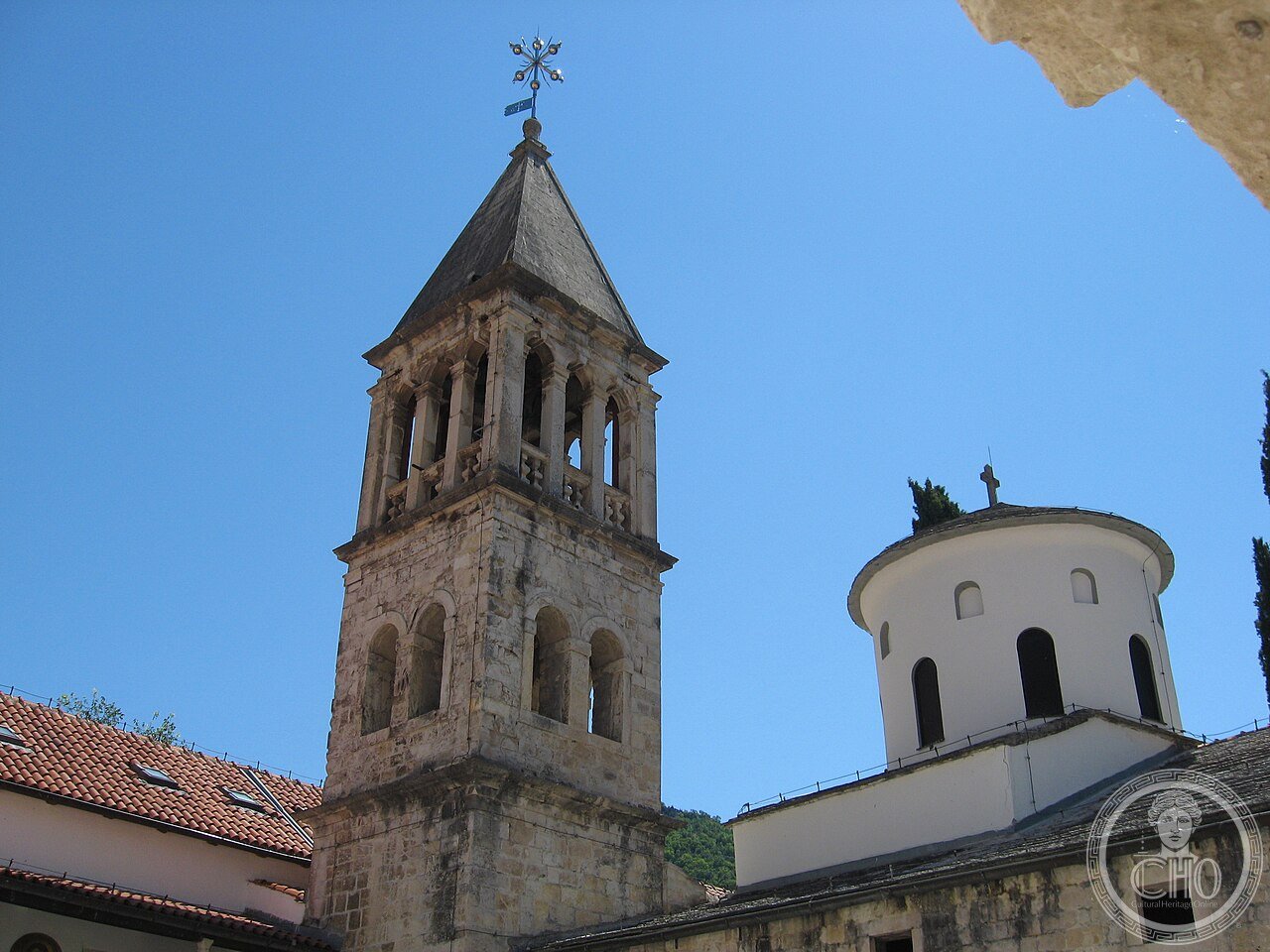
Krka Monastery, dedicated to the Archangel Michael, stands above a system of natural caves that hold Roman catacombs with early Christian graffiti, perhaps of the 1st century. The oldest surviving mention of the site dates to 1345, as an endowment of Princess Jelena Nemanjić Šubić. The present building, however, belongs to the sixteenth century. It was raised over the remains of an earlier Gothic-Romanesque Catholic church of the 14th century, of which a Romanesque belfry and a Gothic window survive.
About Krka Monastery
Krka Monastery, a Serbian Orthodox monastery dedicated to the Archangel Michael, stands near the river Krka in central Dalmatia, Croatia, roughly three kilometres east of Kistanje. The oldest surviving mention of the site dates to 1345, when it is recorded as an endowment of Princess Jelena Nemanjić Šubić, half-sister of the Serbian emperor Dušan and wife of Mladen III Šubić Bribirski. Architectural evidence, however, points to an even more layered history: Roman burial catacombs, a Romanesque belfry, and a Gothic window preserved within the complex suggest that the site was previously home to a late medieval Catholic church or monastery dating to around the 14th century, before its later establishment as an Orthodox monastery around 1577 or afterward. A fragment of a profiled Gothic frame with the remains of a rosette, found built into a wall at Krka, is almost identical to a frame and rosette surviving at the Catholic church of St. Mary and Franciscan monastery in Bribir, suggesting both were produced by the same medieval workshop. Beneath the monastery complex, within a natural cave system, lie catacombs bearing early Christian graffiti that may date as far back as the 1st century, indicating that the site’s sacred use likely predates its medieval Catholic and later Orthodox phases by well over a thousand years. This layered sequence — Roman-era catacombs, a 14th-century Catholic Gothic-Romanesque church, and a 16th-century Serbian Orthodox monastery — makes Krka one of the most historically stratified religious sites along the Dalmatian coast.
Key facts
- Possibly 1st century: earliest Christian graffiti in the underlying catacombs.
- 1345: earliest documented mention, as an endowment of Princess Jelena Nemanjić Šubić.
- c. 14th century: evidence of an earlier Catholic Gothic-Romanesque church on the site.
- c. 1577 or later: present Serbian Orthodox monastery established.
- Surviving earlier elements: a Romanesque belfry and a Gothic window.
- Dedication: the Archangel Michael.
- Location: within Krka National Park, on the Krka river.
History
The possible 1st-century date of the catacomb graffiti beneath Krka Monastery, if confirmed, would place the site’s sacred use among the earliest documented instances of Christian activity anywhere along the eastern Adriatic coast, layered beneath centuries of subsequent Catholic and then Orthodox religious use of the same ground. The architectural fragments shared between Krka and the Franciscan monastery at Bribir — evidently produced by the same medieval workshop — offer physical evidence connecting Krka’s earlier Catholic phase to the wider network of Gothic ecclesiastical building projects active across medieval Dalmatia.
The transition from a 14th-century Catholic foundation to a Serbian Orthodox monastery by the late 16th century reflects the broader demographic and political shifts reshaping the Dalmatian hinterland during the period of Ottoman expansion and subsequent Venetian and Habsburg contestation of the region, a transition visible today in the mixed Romanesque, Gothic, and later Orthodox architectural elements preserved within a single complex.
What you see
The monastery’s Church of the Archangel Michael presents a mixture of architectural periods, incorporating a surviving Romanesque belfry and Gothic window from the earlier medieval Catholic structure alongside later Orthodox-era additions. Beneath the complex, the natural cave system holding the Roman-era catacombs remains a significant, if less visited, layer of the site’s history, its early Christian graffiti representing some of the oldest surviving Christian markings in the region.
Practical information
- Opening hours: generally open daily with seasonal variation; check current hours before visiting; reachable by boat within Krka National Park.
- Address: Krka, near Kistanje, Šibenik-Knin County, Croatia.
Getting there
Krka Monastery is located within Krka National Park, near Kistanje, reachable by the park’s boat services or by road. GPS: 43.9622° N, 15.9898° E.
Nearby
- Krka National Park waterfalls — the park’s celebrated natural attractions, nearby.
- Visovac Monastery — a Franciscan monastery on an island within the same river system.
- Kistanje — the nearest town.
Sources
- Wikipedia — “Krka monastery” (en.wikipedia.org).
- SpottingHistory — “Krka monastery, Kistanje, Croatia” (spottinghistory.com).
- Religiana — “Krka Monastery” (religiana.com).
Find it on the map
See this place and what’s around it →📷 Become a Cultural Heritage Online photographer
Share your photos of places: they stay published under your name as the author. The more they're seen, the more you get noticed — and soon a contest will reward the most appreciated photos.
Log in or sign up free to add a photo