
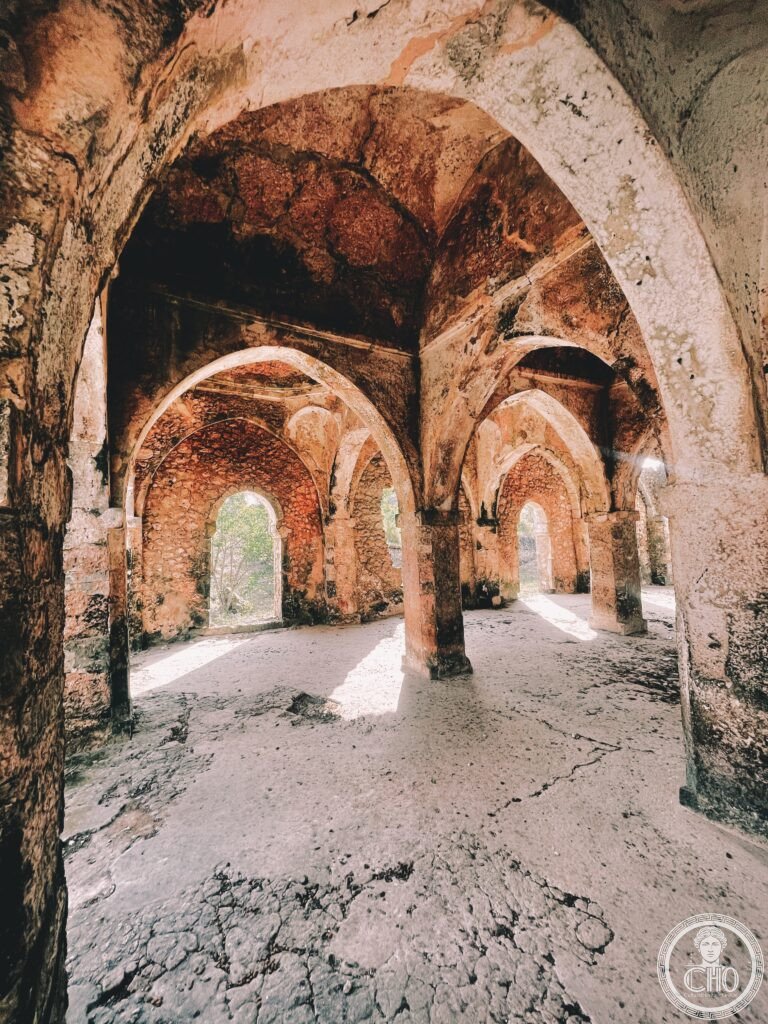
Kilwa Kisiwani was the greatest port of the medieval Swahili coast, the gateway through which the gold of Great Zimbabwe reached Arabia, India and China. Its coral-stone Great Mosque and the ruined palace of Husuni Kubwa remain the most complete surviving testimony to a trading sultanate that once astonished visiting Arab travellers.
At a glance
Kilwa Kisiwani, meaning ‘Kilwa on the Island’, lies a short distance off the coast of Lindi Region in southern Tanzania. From roughly the late 10th century until the Portuguese conquest of 1505, it was the capital of the Kilwa Sultanate, the dynasty that controlled the flow of Zimbabwean gold through the port of Sofala on the Mozambique coast and out into the Indian Ocean trading world. Gold was exchanged for Indian cloth, Chinese ceramics and Persian metalwork, and at its height in the fourteenth and fifteenth centuries Kilwa minted its own copper coinage, one of the few autonomous currencies in medieval sub-Saharan Africa. The Moroccan traveller Ibn Battuta, who visited in 1330, described it as one of the most beautiful and well-built cities he had seen, a remark that later surprised European scholars unfamiliar with African urban history of this period.
The two principal monuments are the Great Mosque, the largest medieval mosque in East Africa, and Husuni Kubwa, the palace complex built for Sultan al-Hasan ibn Sulaiman, said to be the largest pre-European building in sub-Saharan Africa.
Key facts
- Dynasty: Kilwa Sultanate, ruling from the late 10th century CE until the Portuguese conquest of 1505.
- Great Mosque: originally built in the 10th–11th century, enlarged in the 15th century under Sultan Suleyman ibn Muhammed with a thirty-column prayer hall in coral stone.
- Husuni Kubwa: palace of Sultan al-Hasan ibn Sulaiman, with a swimming pool, an octagonal pavilion and coral-stone walls.
- Decoration: Chinese porcelain bowls from the Song, Yuan and Ming dynasties set into the plaster of the mosque and palace, a practice unique to Kilwa on the East African coast.
- UNESCO status: inscribed as a World Heritage Site in 1981 jointly with the nearby ruins of Songo Mnara.
- Coordinates: approximately 8.96° S, 39.51° E.
History
The Kilwa Chronicle, the earliest known Arabic historical text from East Africa, records a founding legend in which a Persian prince from Shiraz, Ali ibn al-Hasan, sailed south with his six sons, each said to have founded a different Swahili coastal city. At Kilwa he is said to have bought the island from its Bantu ruler, paying in cloth for as much grain as would cover the land. Whether the ruling dynasty was truly Persian in origin, or a local African lineage that adopted Persian and Arab cultural forms, remains one of the most debated questions in East African medieval history.
Kilwa’s power peaked in the fourteenth and fifteenth centuries, when its sultans controlled trade along the coast as far north as Zanzibar and Mombasa. That dominance ended abruptly in 1505, when the Portuguese viceroy Francisco de Almeida arrived with a fleet, demanded tribute beyond what the sultan had agreed, and when Kilwa hesitated, sacked the city, killed many of its inhabitants, looted its treasury and demolished the Husuni Kubwa palace. A Portuguese fort, the Fort of Santiago de Kilwa Kisiwani, was built within the ruins, and the city never recovered its former commercial standing.
What you see
Kilwa Kisiwani is reached only by boat from Kilwa Masoko on the mainland, and a permit from the District Cultural Office there is required before visiting, along with a guide from the Archaeological Section of the Ministry of Natural Resources and Tourism, who can be found near the island’s landing point. The island itself is still inhabited, and the ruins stand within a working village rather than a fenced archaeological park.
The usual route on foot takes in the Great Mosque first, with its domed southern hall and fragments of Chinese porcelain still set into the plaster niches, then continues through bush paths to Husuni Kubwa, where the palace rooms, the pool and the octagonal pavilion can still be traced, and finishes at the Portuguese Fort Santiago, with its cannon mount overlooking the channel.
Practical information
- Permits and guides: a permit from the District Cultural Office in Kilwa Masoko and an accompanying official guide are required; arrange both on arrival or check current requirements with the relevant Tanzanian tourism authority in advance.
- Boat crossing: the island is reached by boat from Kilwa Masoko harbour; boats are arranged locally.
- Accommodation: Kilwa Masoko has a small number of basic guesthouses; book locally or check current listings, as options change.
- Best season: the dry period from June to October offers calmer seas and clearer water for the crossing.
Getting there
Kilwa Masoko lies well south of Dar es Salaam and is usually reached by road, either by long-distance bus or by driving via Kibiti and Mloka. There is no regular scheduled air service to the small local airstrip; travellers relying on flights should check current charter options directly with operators. From Kilwa Masoko, the island itself is reached only by boat.
Nearby
- Songo Mnara — around 8 km south, the second site of the joint UNESCO inscription, with the ruins of another medieval Swahili city including an elaborate multi-room palace and a private mosque; reached by boat from Kilwa Masoko and often visited on the same day as Kilwa Kisiwani.
- Selous / Nyerere National Park — roughly 100 km north, Tanzania’s largest wildlife reserve, renamed Nyerere National Park after the country’s first president, centred on the Rufiji River with boat safaris and notable wild dog packs, and considerably quieter than the parks of northern Tanzania.
Sources
- Wikipedia, Kilwa Kisiwani
- Wikipedia, Kilwa Sultanate
- Wikipedia, Husuni Kubwa
- UNESCO, Ruins of Kilwa Kisiwani and Ruins of Songo Mnara, World Heritage Site reference 144
Find it on the map
See this place and what’s around it →📷 Become a Cultural Heritage Online photographer
Share your photos of places: they stay published under your name as the author. The more they're seen, the more you get noticed — and soon a contest will reward the most appreciated photos.
Log in or sign up free to add a photo