
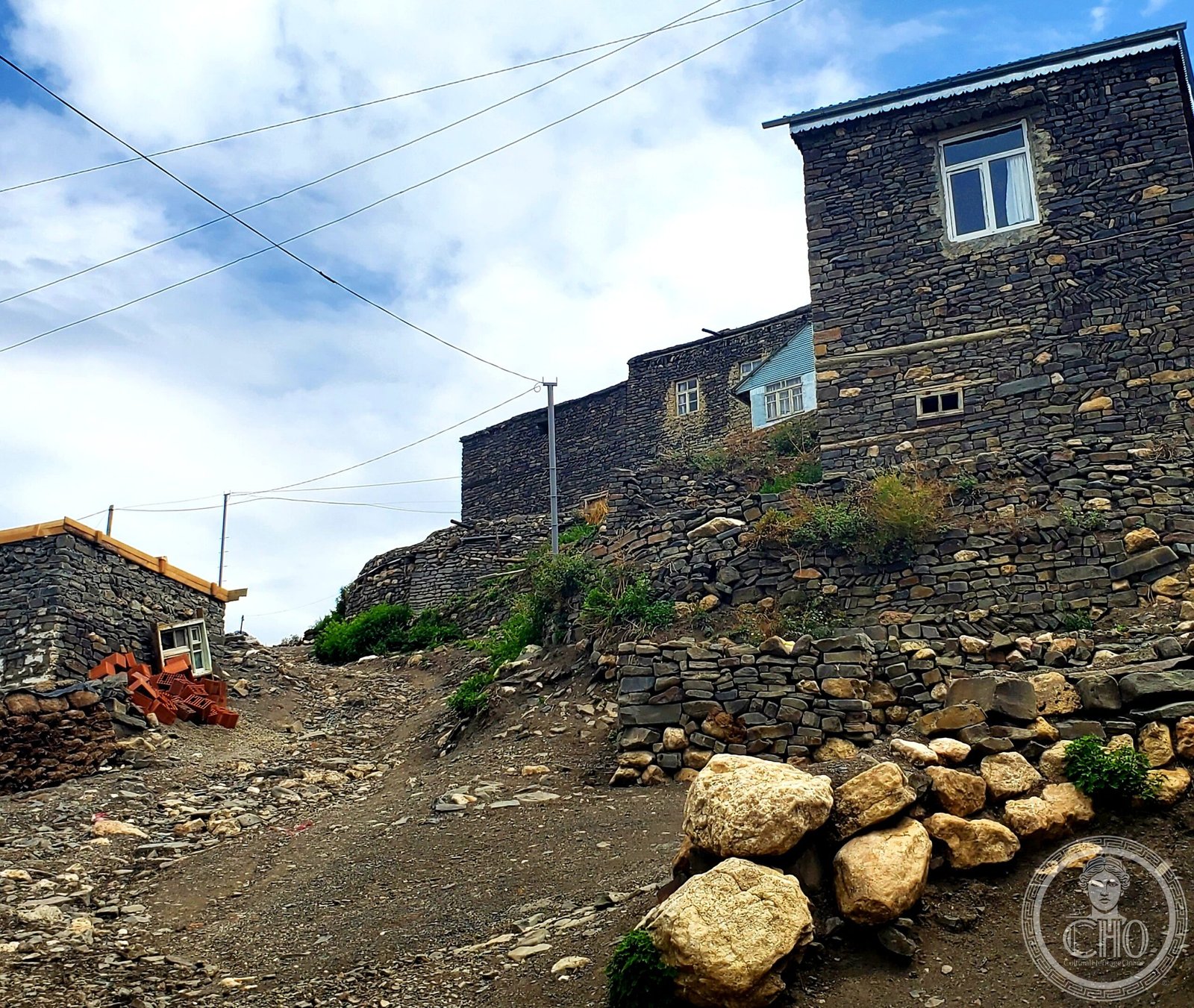
The Village at the Edge of the Sky
At 2,350 metres above sea level in the Greater Caucasus, Khinalig (Xınalıq in Azerbaijani) is one of the highest and most remote permanently inhabited settlements in the world. Accessible for centuries only by a mountain path that was snowbound half the year, this compact stone village of 2,000 inhabitants has maintained an unbroken cultural continuity for at least three thousand years.
The Kety People and Their Language
The inhabitants of Khinalig speak Kety — an isolated language of the Northeast Caucasian family with no close relatives, unintelligible even to speakers of other Azerbaijani mountain languages. Linguists believe Kety is a direct descendant of the language spoken by the Caucasian Albanians, a pre-Islamic Caucasian civilisation that flourished in what is now northern Azerbaijan and southern Dagestan. The language is spoken by no more than 2,000 people, making it one of the smallest living languages in the world.
Architecture and Urban Form
Khinalig’s architecture is a masterpiece of vernacular adaptation: houses of stone and clay are stepped up the mountainside, each rooftop serving as the courtyard for the dwelling above. The village has no streets in the conventional sense — movement flows across rooftops and through narrow passages. The mosque, the mosque school, and the fire-keeper’s shrine are embedded in this organic structure without hierarchical separation.
Living Traditions
The Kety people have practised transhumance — seasonal movement of livestock between highland summer pastures and lowland winter grazing — for millennia. The pastoral calendar, the carpet-weaving tradition (Khinalig carpets use distinctive geometric patterns encoding clan identity), and the oral poetry sung at weddings and funerals remain vigorous. The fire-keeper tradition — maintaining a sacred flame — is a surviving echo of Caucasian Albanian Zoroastrian practice.
UNESCO Recognition
Inscribed in 2024 under criteria iii and v, the Cultural Landscape of the Khinalig People was recognised for its outstanding testimony to a living cultural tradition of great antiquity, and for the exceptional integrity of its physical landscape — settlement, pastoral routes, and mountain ecology — as an evolved cultural landscape.
Visiting Khinalig
Khinalig is accessible by road (improved in recent years) from Quba, the nearest town in northern Azerbaijan. The drive from Quba takes approximately 1.5–2 hours on mountain roads. Guesthouses in the village offer homestay accommodation. Spring and early summer are ideal, when flowers carpet the alpine meadows. Winter road conditions can close the village entirely.
Getting There
Quba is 3.5 hours north of Baku by road, passing through the Azerbaijani lowlands and foothills. Baku’s Heydar Aliyev International Airport is well connected to Europe, the Middle East, and Central Asia. A taxi or marshrutka from Quba to Khinalig can be arranged at the bazaar.
Wider Caucasus Context
The Greater Caucasus is one of the world’s great concentrations of linguistic diversity, with over 30 distinct languages spoken across an area smaller than France. Khinalig’s inscription highlights the mountain communities of the Azerbaijani Caucasus that have remained culturally distinct from both the Azerbaijani lowlands and the Russian North Caucasus.
Find it on the map
See this place and what’s around it →📷 Become a Cultural Heritage Online photographer
Share your photos of places: they stay published under your name as the author. The more they're seen, the more you get noticed — and soon a contest will reward the most appreciated photos.
Log in or sign up free to add a photo