
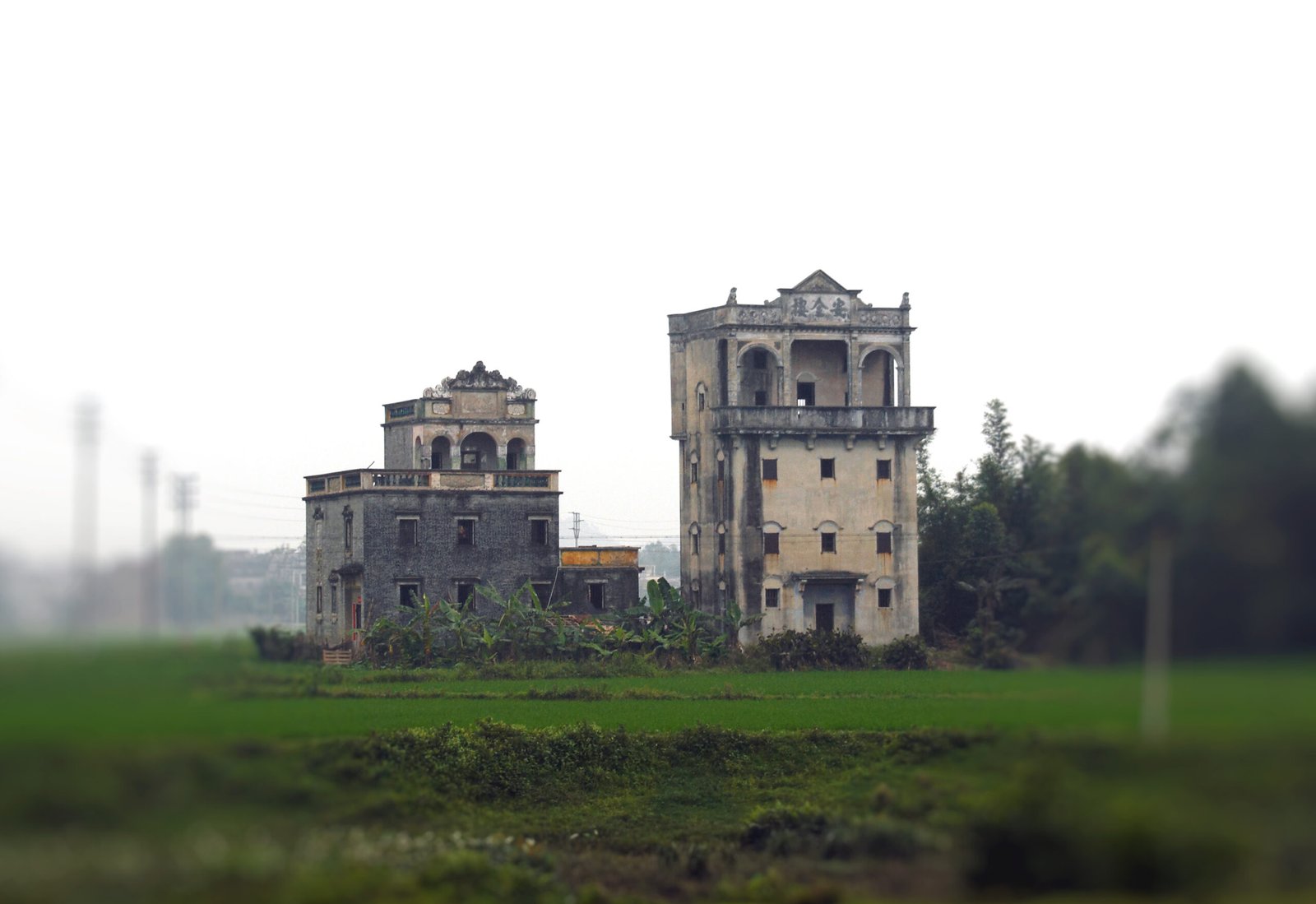
Towers of the Diaspora
The Diaolou of Kaiping, in Guangdong Province, southern China, are multi-storey fortified towers built by overseas Chinese communities returning from North America and Southeast Asia in the late 19th and early 20th centuries. Blending Southern Chinese vernacular construction with architectural motifs drawn from Greece, Rome, baroque Europe, and North American Art Deco, they stand as one of the most extraordinary examples of cultural fusion in the built world. UNESCO inscribed Kaiping Diaolou and Villages in 2007, encompassing four clusters of towers and traditional village settings.
Origins: Emigration and Return
The Pearl River Delta region around Kaiping was one of the primary sources of Chinese emigration to California during the Gold Rush of the 1850s and to Canada during the construction of the transcontinental railway in the 1880s. Decades of labour abroad earned remittances that flowed back to Kaiping villages, funding ambitious building projects. The towers — diaolou means literally “watchtowers” — served as fortified refuges against the banditry and warlord violence that plagued the Pearl River Delta in the Republican era (1912–1949), but their architecture also expressed the hybrid cultural identity of men who had lived between China and the West.
Architectural Eclecticism at Its Most Extreme
No two Diaolou are alike in their decorative programme. A single tower may combine a Roman-arched ground floor, Italian Renaissance balustrades on the second level, Islamic minarets at the corners, a Byzantine dome at the summit, and crenellations inspired by medieval European castles — all executed in reinforced concrete by Cantonese builders following postcards and magazine clippings sent home by emigrant relatives. The result is an architecture of nostalgic imagination, each tower a three-dimensional collage of the places its builder had visited or dreamed of, planted incongruously in rice paddies and banana groves.
The Four Inscribed Clusters
The UNESCO inscription encompasses four clusters of towers and villages: Zili, Majianglong, Jinjiangli, and Sanmenli. Each cluster has a distinct character. Zili preserves fifteen towers of exceptional variety in a compact setting surrounded by rice fields, with the Art Deco Mingshi Tower as its centrepiece. Majianglong contains nine towers rising dramatically above a grove of bamboo. Jinjiangli has three towers in a more intimate village setting. Sanmenli includes the Li Garden, a private garden estate built by an emigrant returning from North America, whose Western-style pavilions and Chinese rock gardens form a microcosm of the Kaiping aesthetic.
Construction Technology: Reinforced Concrete Pioneers
The Diaolou were among the earliest large-scale uses of reinforced concrete construction in rural China. Emigrant builders returning from California and Canada brought knowledge of concrete technology and sometimes hired Western engineers for the structural work. The choice of concrete was practical — it resisted fire, flood, and bullet better than traditional brick or wood — but it was then clad in plaster and carved decoration that mimicked stone and terracotta. The towers’ reinforced floors could support the weight of an entire village community sheltering during a bandit raid.
Defensive Function and Village Life
At the tower’s summit, a projecting watchtower (douxiong) allowed defenders to observe attackers at the base and drop stones or pour boiling water through openings in the overhanging concrete floor. Iron doors, steel window shutters, and thick walls made the towers effectively impregnable to the armed bands that extorted villages throughout the 1920s and 1930s. Communities would retreat to the tower at the first sign of threat, remaining inside for days until the danger passed. The towers thus functioned simultaneously as symbols of overseas wealth and as practical instruments of local security.
Decline and Heritage Rediscovery
With the Communist revolution of 1949 and the closure of China to the outside world, emigration ceased and the flow of remittances that had built the towers dried up. Many tower owners fled to Hong Kong, the United States, or Canada, and the towers stood empty for decades. Their rediscovery as heritage objects came in the 1990s as China opened to tourism and overseas Chinese communities began returning to trace their family histories. The towers became pilgrimage sites for the diaspora: descendants of the builders travel from California and Vancouver to photograph the towers their great-grandfathers built with Gold Rush money.
UNESCO Recognition
Kaiping Diaolou and Villages were inscribed on the UNESCO World Heritage List in 2007 under criteria (ii) and (iv), recognised as an outstanding example of a building type that illustrates the fusion of Chinese and Western architectural styles resulting from the significant interaction of Chinese emigrant communities with the wider world in the late 19th and early 20th centuries. The site is accessible by bus from Guangzhou (approximately three hours) or from Jiangmen, and the four tower clusters can be visited in a single full day.
Find it on the map
See this place and what’s around it →📷 Become a Cultural Heritage Online photographer
Share your photos of places: they stay published under your name as the author. The more they're seen, the more you get noticed — and soon a contest will reward the most appreciated photos.
Log in or sign up free to add a photo