

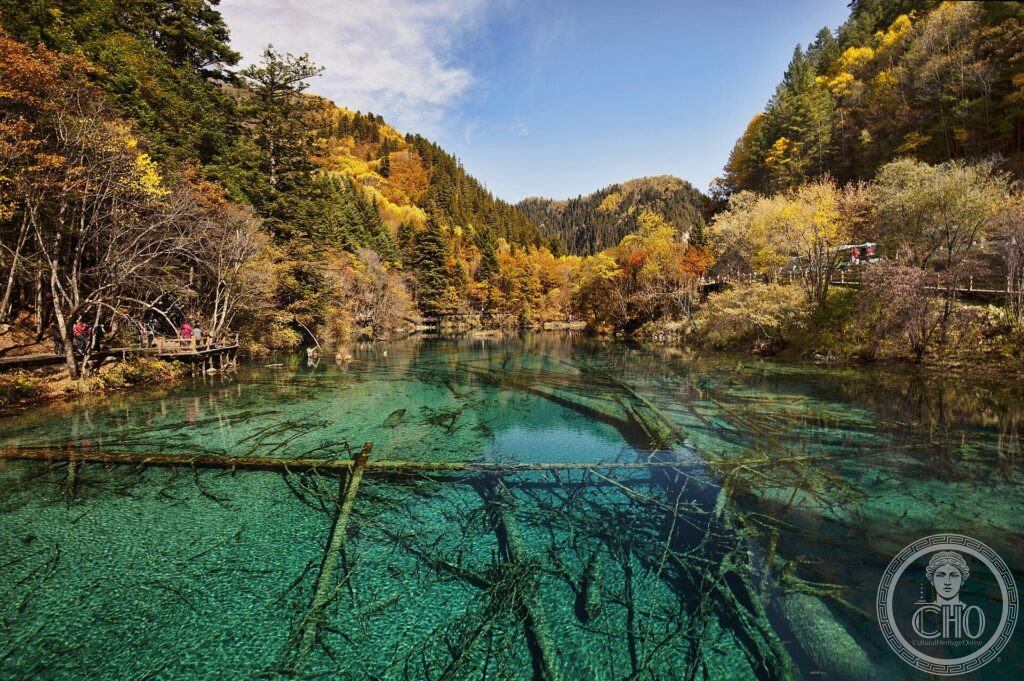
In a deep valley of the Tibetan plateau of Sichuan, dozens of lakes of transparent water and impossible colours — turquoise, emerald, pale blue — follow one another among waterfalls and forests, overlooked by snow-covered peaks. Jiuzhaigou is one of the most spectacular natural landscapes in China, inhabited by Tibetan communities.
At a glance
Jiuzhaigou (“Valley of Nine Villages”), high on the edge of the Tibetan plateau in northern Sichuan, is one of China’s most spectacular natural landscapes. Along its valleys lie dozens of lakes of extraordinary clarity and colour — turquoise, emerald and blue — fed by snowmelt and linked by waterfalls and travertine shoals, beneath forested slopes and snow peaks. Home to Tibetan and Qiang communities and to rare wildlife including the giant panda, it was inscribed by UNESCO in 1992.
Key facts
- UNESCO: World Heritage since 1992 (Jiuzhaigou Valley)
- Coloured lakes: dozens of clear lakes in vivid blues and greens
- Waterfalls and shoals: travertine terraces and cascades link the lakes
- Tibetan villages: the “Nine Villages” that give the valley its name
- Wildlife: giant panda and golden snub-nosed monkey habitat
- High altitude: on the eastern edge of the Tibetan plateau
History
The valley was little known to the outside world until the late 20th century, long the home of Tibetan and Qiang peoples who held its lakes and mountains sacred. Its extraordinary geology — lakes coloured by mineral deposits and underwater calcite, dammed by travertine and fallen trees — results from karst processes in a glaciated mountain landscape.
Recognised for its beauty and its rare ecosystems, Jiuzhaigou was protected as a reserve and inscribed by UNESCO in 1992, becoming one of China’s most visited natural sites. A strong earthquake in 2017 damaged some features, after which the park was restored and reopened.
What you see
Boardwalks and shuttle roads follow the valleys past a sequence of lakes — the Five Flower Lake, with its tangle of submerged trunks visible through turquoise water, the Long Lake, the Mirror Lake — and waterfalls such as Nuorilang and Pearl Shoal. Forests blaze with colour in autumn, and Tibetan prayer flags and villages dot the slopes.
Snow peaks rise above the valley, completing one of the most photographed landscapes in China.
Practical information
- Park: entry ticket and internal shuttle buses; boardwalks link the lakes
- Best time: autumn for colour; the lakes are striking year-round
- Time needed: a full day or two
- Note: high altitude (2,000–3,000 m); pace yourself
Getting there
Jiuzhaigou is in northern Sichuan, China, about 450 km north of Chengdu. It has its own airport (Jiuzhai Huanglong) and is reached by road from Chengdu. GPS: 33.10° N, 103.92° E.
Nearby
- Huanglong — the travertine pools, also UNESCO-listed, nearby
- Tibetan highlands — the grasslands and monasteries of north Sichuan
- Chengdu — the provincial capital and panda base, to the south
Sources
- UNESCO World Heritage Centre — “Jiuzhaigou Valley Scenic and Historic Interest Area” (ref. 637)
- Jiuzhaigou National Park — official administration
- Encyclopaedia Britannica — Jiuzhaigou
Find it on the map
See this place and what’s around it →📷 Become a Cultural Heritage Online photographer
Share your photos of places: they stay published under your name as the author. The more they're seen, the more you get noticed — and soon a contest will reward the most appreciated photos.
Log in or sign up free to add a photo