
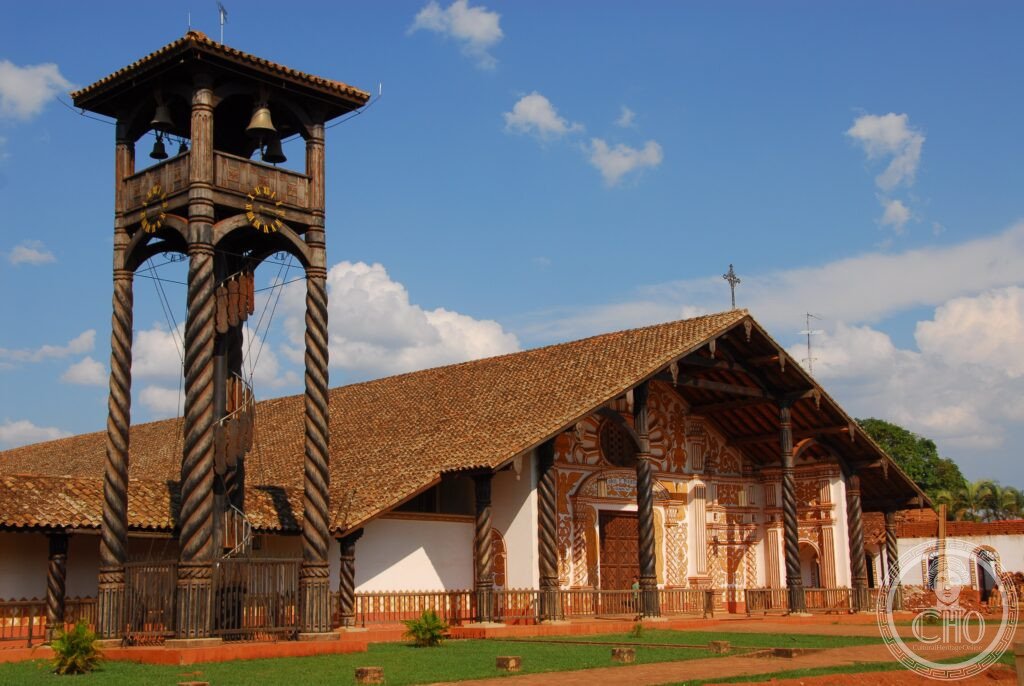
The most complete surviving system of Jesuit missionary communities in South America and the birthplace of a living polyphonic music tradition that has endured for four centuries. The six Jesuit mission churches of the Chiquitos region in eastern Bolivia, built between 1691 and 1760 in a remarkable hybrid of Spanish Baroque architecture and indigenous Amerindian craft traditions, preserve both the architecture and the extraordinary 17th-century choral music tradition that the Swiss missionary Martin Schmid taught the Chiquitos peoples and which their communities still sing today.
At a glance
The six surviving Jesuit mission churches of the Chiquitos region are distributed across the eastern lowlands of Santa Cruz Department in Bolivia, in the savanna and dry forest landscape of the Chiquitanía (the traditional territory of the Chiquitos peoples). The six missions are: San Javier (92 km north-east of Santa Cruz de la Sierra; the oldest surviving mission; founded 1692 by Father Felipe Suárez). Concepción (226 km north-east; the largest mission; the most visited). Santa Ana (245 km east of Santa Cruz). San Miguel (229 km east). San Rafael (226 km east). And San José de Chiquitos (255 km east; the only mission with a stone facade — the others are wood construction). All six missions are still active Catholic parish churches. The communities that descend from the original Chiquitos converts still inhabit the towns built around the missions. The churches are open to visitors at all times (though some have restricted access to the altarpieces and sacristy; confirm locally).
Key facts
- The Jesuit Reductions: the most ambitious experiment in cultural and religious synthesis in colonial South America. The Jesuit Reductions (“Reducciones”; the word means “gathering into order”) were communities of indigenous Amerindian peoples organized by Jesuit missionaries from the 1610s onward into a system of towns that combined Christian religious practice, indigenous communal social organization (the ayllu), and European craft and musical training. The Reductions were controversial from the start because they operated in a legal grey zone. They were formally within the Spanish colonial jurisdiction but were in practice autonomous communities under Jesuit direction, with no Spanish colonists, no encomienda (forced labour), and no alcohol. The most famous Reductions were the Guaraní Reductions in modern Paraguay, Argentina, and Brazil (the subject of the film The Mission, 1986). The Chiquitos Reductions were established later (1691–1760) and survived the Jesuit expulsion of 1767 better than the Guaraní Reductions, because the Chiquitos communities had stronger local leadership and were less dependent on Jesuit authority for their day-to-day organisation.
- Martin Schmid SJ (1694–1772), architect and musician: the defining figure of the Chiquitos mission heritage. Martin Schmid was a Swiss Jesuit lay brother from Baar (in the canton of Zug, Switzerland) who arrived in the Chiquitos region in 1730 and spent the next 37 years (until the Jesuit expulsion in 1767) designing the mission churches and developing the choral music programme. As an architect, Schmid designed 5 of the 6 surviving Chiquitos mission churches in a distinctive indigenous-Baroque style that adapted Spanish Baroque forms (triple-nave basilica plan, carved polychrome wooden altarpieces, twisted painted columns, figural polychrome wood sculpture) to local materials (tropical hardwood for the structural system and carved decorations; clay brick and lime plaster for the walls; thatched roofing replaced by ceramic tile in later restorations) and indigenous craft skills. The churches are unique in world architecture. Neither purely Spanish Baroque nor purely indigenous, but a synthetic tradition that emerged from the specific encounter between the Jesuit mission system and the Chiquitos craftspeople. As a musician, Schmid composed sacred polyphonic music (masses, motets, vespers) in the Baroque style he had learned in Europe and taught the Chiquitos community a choral tradition that they maintained continuously after the Jesuit expulsion.
- The music tradition and the “Misiones de Chiquitos” festival: the most extraordinary living musical heritage in South America. When the Bolivian musicologist Samuel Claro Valdés visited the Chiquitos missions in 1969, he discovered that the community choirs were still singing from 17th and 18th-century handwritten musical manuscripts (the “Jesuit Choir Books” of the Chiquitanía) that had been maintained in the mission churches since the Jesuit period. The manuscripts contained compositions by Domenico Zipoli (1688–1726; an Italian Jesuit composer who came to Argentina in 1716 and whose sacred works were transmitted throughout the Jesuit network) and by local Chiquitos composers. The discovery of this living tradition (a polyphonic choral tradition of European baroque music, maintained unbroken in a remote indigenous community in the Amazon basin for 250 years) was one of the most remarkable musicological discoveries of the 20th century. The biennial “Misiones de Chiquitos” early music festival (held in even-numbered years, typically April) now brings baroque music performers from across the world to perform the Chiquitos repertoire in the original mission churches. The acoustics of the colonial mission churches (designed by a musician) are superbly suited to choral music.
- The Jesuit expulsion (1767) and the survival of the missions: the political crisis that paradoxically preserved the Chiquitos heritage. In 1767, King Charles III of Spain ordered the expulsion of all Jesuit missionaries from the Spanish Americas. The Guaraní Reductions of Paraguay and Argentina largely collapsed within a generation, as the communities lost their organizing structure and were exposed to the depredations of slave raiders and colonial administrators. The Chiquitos Reductions survived better because the Chiquitos communities had a more robust indigenous leadership structure and the missions were in a more remote and less economically attractive region. The mission churches were maintained by the communities through the subsequent centuries, though with varying degrees of care. A major international restoration effort (1972–2001; led by the Swiss architect Hans Roth, of the same canton as Martin Schmid) stabilised and restored all six surviving mission churches to approximately their original appearance. The restoration used traditional materials and techniques.
- Heritage: UNESCO World Heritage Site, Jesuit Missions of the Chiquitos, inscribed 1990.
- GPS: -16.2800° S, -62.5000° W (San Javier, the northernmost mission).
History
Father Felipe Suárez SJ founded the first Chiquitos Reduction at San Javier in 1691. The mission system expanded through 1760 (the last founded mission was Santa Ana, 1755). The Swiss Jesuit Martin Schmid arrived 1730 and designed 5 of the 6 churches. The Jesuits were expelled from Spanish Americas 1767 (Pragmatic Sanction of Charles III). The missions survived under Franciscan and diocesan administration. The music manuscripts were maintained by the community. Samuel Claro Valdés discovered the manuscripts 1969. Hans Roth led the major restoration 1972–2001. UNESCO WHS 1990. The biennial Misiones de Chiquitos festival established 1996.
What you see
The most complete and best-restored mission is Concepción (2h north-east of Santa Cruz; the widest nave, the most elaborate restoration; the Concepción church and the mission museum are the primary visitor destination). San Javier (the oldest, 1h 30 min from Santa Cruz; the most accessible from the city) is the usual first stop. The six missions can be visited in a loop circuit from Santa Cruz (approximately 3 days; rough road conditions on some sections; 4WD recommended in the wet season). The interiors of all six churches have their polychrome wooden altarpieces and carved column decoration (some original, some restored or replicated to original patterns). The choral music tradition is best experienced at the biennial festival (April of even-numbered years; check the festival programme and book accommodation well in advance as the region’s accommodation is limited).
Practical information
- Admission and access: the six mission churches are active Catholic parish churches. Admission is typically free (donations welcomed). Visiting hours are generally daytime (7am–7pm) but may be interrupted during services. Some missions have a small museum or sacristy display with additional admission of approximately 20–50 BOB (Bolivian Bolivianos; approximately €3–8). Guided tours of the church interiors (with local guides, usually in Spanish) are available at Concepción and San Javier. English interpretation is rarely available without advance arrangement. The dirt roads connecting the missions are generally passable by ordinary car in the Dry Season (May–October). A 4WD is strongly recommended in the Wet Season (November–April) and for the more remote missions (Santa Ana, San Miguel, San Rafael).
- Getting there: from Santa Cruz de la Sierra (the largest city in eastern Bolivia; international flights from Lima, Buenos Aires, São Paulo, and other South American hubs; domestic flights from La Paz and Sucre): take the main highway east toward San Javier (92 km; 1h 30 min by car; the road is mostly sealed and accessible to all vehicles). A rental car from Santa Cruz is the most practical option for a self-guided circuit. Organized 4-6 day tour circuits from Santa Cruz are available from several tour operators and include the six missions plus optional extensions to the Pantanal or the Bolivian Amazon basin.
- The Misiones de Chiquitos music festival: the most significant cultural event in the Bolivian lowlands. The biennial festival (held in even-numbered years; April; lasting 10–12 days) features performances by international early music ensembles and local Chiquitos choirs in the original mission churches. The acoustic experience of polyphonic Baroque choral music performed in a candlelit 17th-century indigenous-Baroque church is extraordinary. The festival has attracted ensembles from Germany, Switzerland, Argentina, Brazil, Spain, and the UK. Accommodation in the mission towns is limited and books out months in advance for the festival.
Getting there
From Santa Cruz de la Sierra by car (San Javier 92 km, 1h 30 min; circuit of 6 missions requires 2–3 days). Rental car recommended. 4WD for wet season. GPS (San Javier): -16.2800, -62.5000.
Nearby
- Bolivian Pantanal (Puerto Quijarro/Puerto Suárez). 250 km east of the Chiquitos missions (3h by car from San José de Chiquitos). The Bolivian part of the world’s largest tropical wetland. The Pantanal (shared between Brazil, Bolivia, and Paraguay) is the world’s largest tropical freshwater wetland (approximately 150,000 km²). The Bolivian sector (accessed from Puerto Suárez/Puerto Quijarro on the Brazilian border) is less visited than the Brazilian Pantanal (accessed from Corumbá, Brazil) but offers exceptional wildlife: the highest density of jaguars anywhere in the world (an estimated 80 jaguars per 100 km², 3× the Amazon density), giant river otters, giant anteaters, capybara, tapir, caimans, and over 650 bird species. The Bolivian railway to Puerto Quijarro (the so-called “Death Train” — an old Bolivian Railway line from Santa Cruz to the Brazilian border, dramatically named for the difficult construction through the lowland savanna in the 1950s — is one of the most interesting train journeys in Bolivia).
- Tiwanaku. 600 km south-west of the Chiquitos missions (7h by road via Santa Cruz and Cochabamba). The most important pre-Inca archaeological site in South America and the only UNESCO WHS in Bolivia with a pre-Columbian urban complex. Tiwanaku (Tiahuanaco in Spanish; altitude 3,850 metres above sea level on the Bolivian altiplano south of Lake Titicaca; founded c. 200 AD; at its peak 500–1000 AD; population estimated at 10,000–20,000 at the city and up to 1 million in the broader sphere of influence; the Akapana pyramid, the Kalasasaya court with the famous Gateway of the Sun — the most important single monument of the Tiwanaku culture — and the Semi-subterranean Temple with its carved stone heads are the essential monuments; UNESCO WHS 2000; see separate CHO place card.
- Samaipata and El Fuerte. 120 km west of Santa Cruz (2h by car). The most important Inca and pre-Inca ceremonial site in the Bolivian lowlands. El Fuerte de Samaipata (UNESCO WHS 1998) is a sandstone outcrop carved with an extraordinary complex of ceremonial reliefs, channels, pools, seats, and geometric motifs. It is the most important pre-Inca sacred site in the Bolivian lowlands and the most eastern extension of Inca stonework in South America. The carved rock surface (approximately 220 × 60 metres) includes a large rectangular enclosure interpreted as an Inca ushnu (ceremonial platform), water channels, carved animal figures (felines, serpents), and earlier pre-Inca carvings. The village of Samaipata itself (1,630 metres; a cool climate ideal for a rest stop on the way to or from the Chiquitos missions) has a growing community of international artists and organic farmers. See separate CHO place card.
Sources
- Wikipedia, Jesuit Missions of the Chiquitos. Martin Schmid (Jesuit). Domenico Zipoli. Misiones de Chiquitos (festival), accessed June 2026.
- UNESCO, Jesuit Missions of the Chiquitos, WHS reference 529, inscribed 1990.
- Piotr Nawrot, Indígenas y cultura musical de las Reducciones Jesuíticas, Verbo Divino, 2000.
- Hans Roth, Arquitectura de las Misiones de Moxos y Chiquitos, APCOB, 1994.
Find it on the map
See this place and what’s around it →📷 Become a Cultural Heritage Online photographer
Share your photos of places: they stay published under your name as the author. The more they're seen, the more you get noticed — and soon a contest will reward the most appreciated photos.
Log in or sign up free to add a photo