
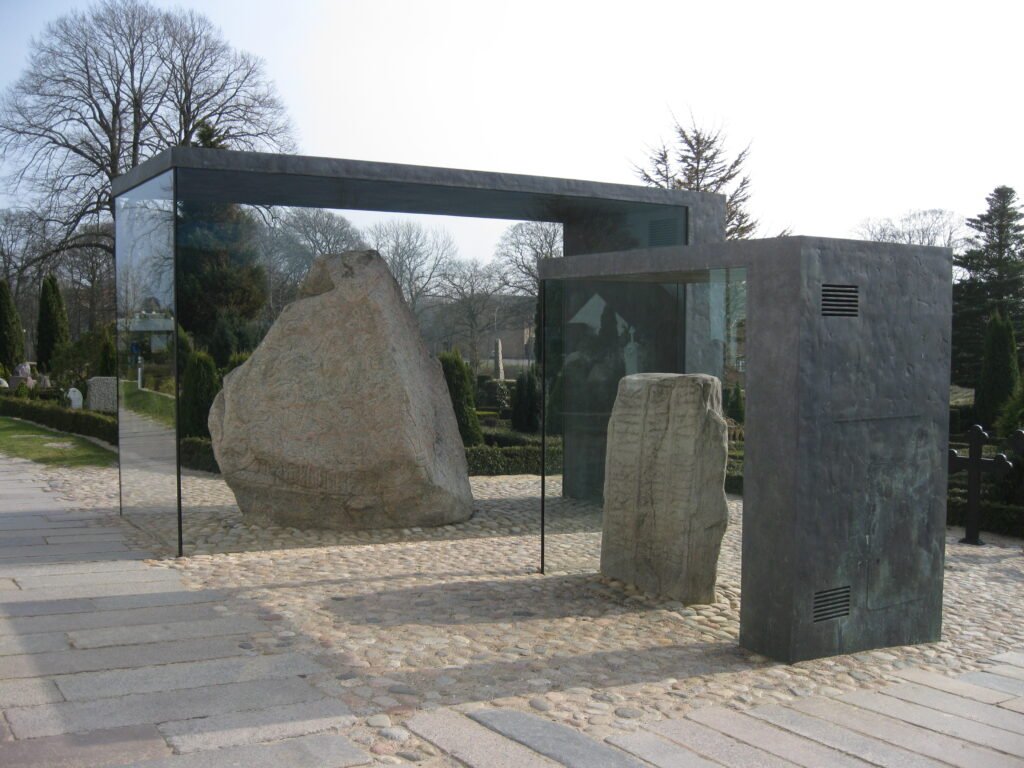
The birthplace of the Danish kingdom: two great burial mounds, two runic stones — including the “Certificate of Baptism of Denmark” — and a church where Viking-age paganism gave way to Christianity in a single dynastic gesture that founded a nation.
At a glance
In the town of Jelling in central Jutland, a complex of monuments created by three generations of Danish royalty in the 10th century CE constitutes the most important Viking Age royal heritage site in Scandinavia. Two enormous burial mounds flank a parish church; between them stand two runic stones — one erected by King Gorm the Old c. 958–964 CE in memory of his wife Thyra, the other raised by his son Harald Bluetooth c. 965 CE bearing the oldest known image of Christ in Scandinavia and an inscription proclaiming that Harald “won all of Denmark and Norway and made the Danes Christian.” UNESCO World Heritage Site since 1994.
Key facts
- UNESCO designation: 1994 (criteria ii, iii, iv)
- Period: c. 958–986 CE — Viking Age, reigns of Gorm the Old and Harald Bluetooth
- Location: Jelling, Vejle Municipality, central Jutland, Denmark. GPS: 55.7573° N, 9.4197° E
- Key monuments: North and south burial mounds; Gorm Stone (c. 958–964 CE); Harald Stone / Jelling Stone (c. 965 CE); Romanesque church over earlier wooden church foundations
- Harald Stone height: approximately 2.4 metres — the largest runestone in Denmark
- Bluetooth symbol origin: The wireless standard’s logo combines Harald Bluetooth’s runic initials (Hagall ᚼ + Berkanan ᛒ), chosen in 1994 by Ericsson to honour the king who united the Norse peoples
- Admission: Free — outdoor monuments freely accessible; Kongernes Jelling museum requires a ticket (adults approx. DKK 120 / €16)
History and significance
The Jelling complex was created across three generations of Danish royal authority. Gorm the Old — the first historically documented king of a unified Denmark, died c. 958–964 CE — erected the north mound as his own burial monument and raised the smaller Gorm Stone to honour his queen Thyra, describing himself as “King of the Danes” in the earliest unambiguous inscription associating the name “Denmark” with a unified realm.
His son Harald Bluetooth (died c. 986 CE) transformed the site in a politically calculated act: he dismantled his father’s burial in the north mound and had the remains reinterred in Christian fashion beneath the church he built on the same spot — simultaneously an act of Christian piety and an assertion of royal authority over Denmark’s transition from Norse paganism to Christianity. Harald then raised the great Jelling Stone, bearing on its three faces interlace ornament in the Urnes-Viking style, a serpent composition, and the figure of Christ — the oldest depiction of Christ known from Scandinavia — with the inscription declaring his conquest of Denmark and Norway and his Christianisation of the Danes.
The runic monogram Harald used to sign his name — combining the runes Hagall and Berkanan as his initials — was adopted in 1994 as the Bluetooth wireless standard logo by the Swedish firm Ericsson, in homage to the king who united disparate Norse peoples, just as the protocol was designed to unite disparate electronic devices. The symmetry is more than marketing: both the 10th-century king and the 20th-century engineers were solving the same fundamental problem of interoperability.
What you see
The two burial mounds are the most visually arresting features of the site. The north mound — originally Gorm’s burial monument — stands approximately 8.5 metres high and 65 metres in diameter; its summit provides orientation across the flat Jutland landscape and a view of the entire complex. The south mound, built by Harald, is similar in scale but was apparently never used for burial.
Between the mounds, in front of the church, stand the two runic stones under protective glass enclosures that preserve surviving traces of the original painted decoration (red, blue, and black pigments). The smaller Gorm Stone (DR 41) is a single boulder with one rune-carved face. The larger Harald Stone (DR 42) is a three-sided stepped granite boulder, its three faces carrying the runic inscription, a lion-like beast in Urnes-style interlace, and the bound figure of Christ — the earliest known Scandinavian representation of the crucifixion, depicted not on a cross but woven into an interlace composition that merges Christian iconography with the Viking animal-ornament tradition.
The Romanesque parish church behind the stones was rebuilt in its current stone form in the 12th century, but stands on the foundation of Harald’s 10th-century wooden church. Excavations under the floor in the 1970s revealed the reburied grave of Gorm the Old, including the Jelling Cup — a gilt-silver vessel now in the National Museum of Denmark in Copenhagen — one of the supreme objects of Viking Age craftsmanship.
Practical information
- Outdoor monuments: Freely accessible year-round at all hours
- Church: Open during regular parish hours (typically 09:00–17:00 daily)
- Kongernes Jelling museum: Daily 10:00–17:00 (closed Mondays outside summer season); adults DKK 120 (approx. €16); under 18 free; kongernes-jelling.dk
- Photography: Freely permitted outdoors; glass enclosures require care with reflections; interior photography with discretion
- Best time to visit: Spring and early summer for clear light on the stones; midsummer evenings for extended golden hour
- Duration: 1.5–3 hours including the museum
Getting there
Jelling lies in central Jutland, approximately 10 km northwest of Vejle and 30 km from Billund Airport (BLL). By rail: direct trains from Vejle (15–20 minutes); Vejle is served by IC trains from Copenhagen (2.5 hours) and Aarhus (1 hour). Jelling station is a 10-minute walk from the monuments. By car: exit 58 (Jelling/Givskud) from the E45 motorway; free parking at the site. From Copenhagen: approx. 260 km (2.5–3 hours). Nearest international airports: Billund (BLL, 30 km) and Copenhagen (CPH, 260 km).
Nearby
- Vejle (10 km south) — city centre, Vejle Museum, Vejle fjord views
- Billund / Legoland (30 km west) — world-famous attraction for combined family itineraries
- Ribe (80 km southwest) — oldest town in Denmark, Viking-age excavations, Ribe Viking Centre living-history museum
- Aggersborg ring fortress (150 km north) — one of Harald Bluetooth’s network of geometric ring fortresses, companion monument for understanding his reign
- National Museum of Denmark (Copenhagen) — holds the Jelling Cup and the largest Viking Age artefact collection in the world
Sources
- UNESCO World Heritage List — “Jelling Mounds, Runic Stones and Church,” whc.unesco.org/en/list/697
- Krogh, Knud J. Viking Jelling: Source and Context. National Museum of Denmark, Copenhagen, 1993
- Wikipedia contributors, “Jelling stones,” Wikipedia, The Free Encyclopedia, en.wikipedia.org/wiki/Jelling_stones
- Kongernes Jelling (Royal Jelling museum), kongernes-jelling.dk
Find it on the map
See this place and what’s around it →📷 Become a Cultural Heritage Online photographer
Share your photos of places: they stay published under your name as the author. The more they're seen, the more you get noticed — and soon a contest will reward the most appreciated photos.
Log in or sign up free to add a photo