
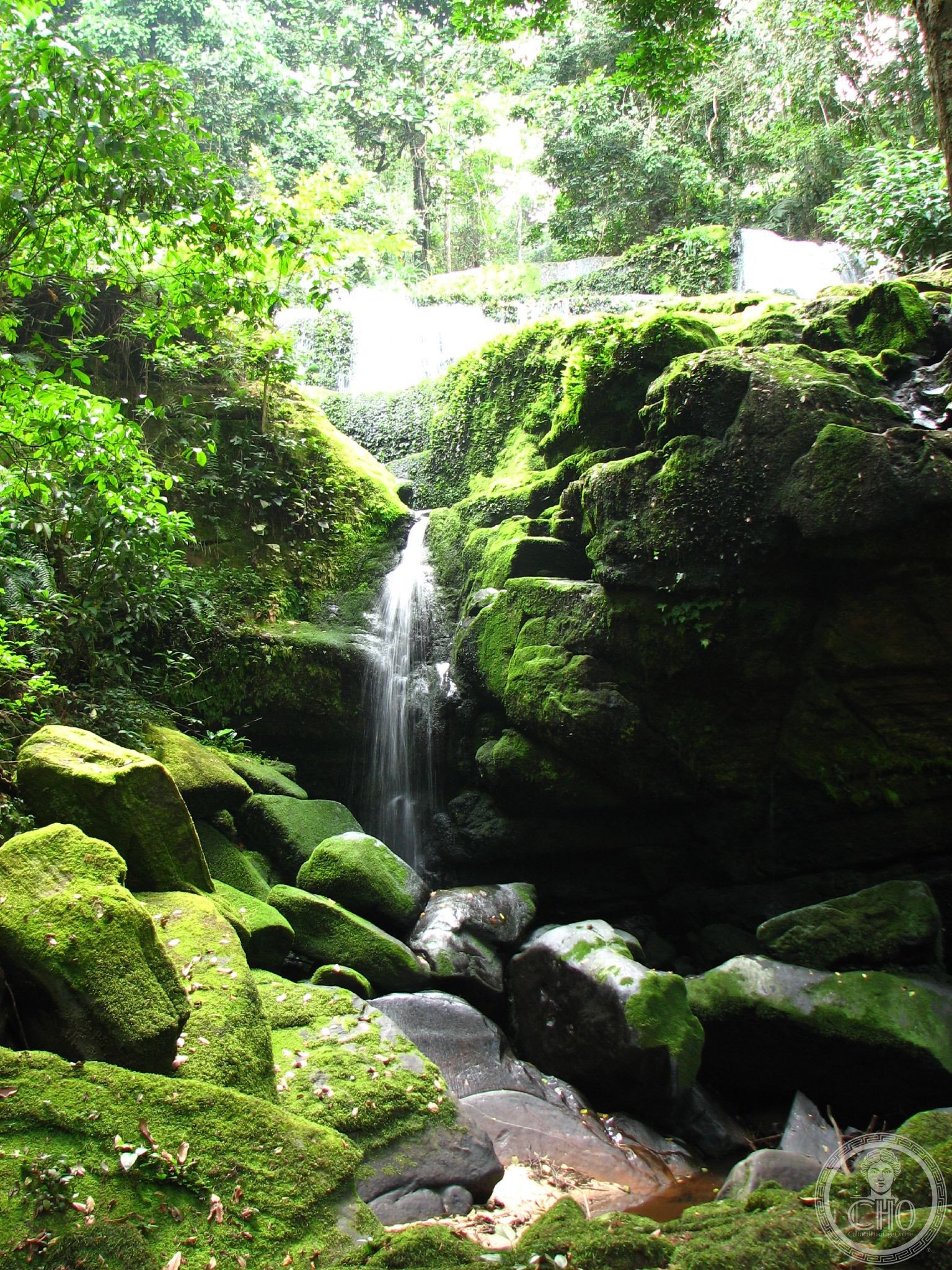
In north-eastern Gabon, where the river Ivindo comes down from the heights of the Central African Republic towards the Congo basin, Ivindo National Park holds one of the most intact stretches of rainforest in central Africa. Its jewel is the complex of the Kongou Falls: a series of rapids and waterfalls that make one of the most spectacular views of the Congo Basin, surrounded by a forest inhabited by western lowland gorillas, forest elephants, Congo manatees and the enigmatic mandrill. A UNESCO World Heritage site since 2021.
At a glance
Ivindo National Park covers approximately 3,000 km² in north-eastern Gabon, centred on the Ivindo River and its tributaries. UNESCO inscribed it in 2021 (ref. 1653) as an outstanding example of an intact Congo Basin rainforest ecosystem, with exceptional biodiversity and landscape beauty. The park’s centrepiece is the Kongou Falls — a magnificent series of rapids and falls on the Ivindo River, surrounded by dense primary forest. The park is part of the Ivindo-Minkébé-Odzala transboundary conservation complex, which includes the contiguous Minkébé National Park to the north and extends into Congo-Brazzaville.
Key facts
- UNESCO: World Heritage since 2021 (Ivindo National Park, ref. 1653)
- Kongou Falls: a spectacular series of rapids and falls on the Ivindo River; sacred to local Baka and Bakwélé peoples
- Mammals: western lowland gorillas, chimpanzees, forest elephants, African forest buffalo, mandrill, African manatee
- Fish: exceptionally diverse fish fauna in the Ivindo River; several species endemic to the river system
- Forest: 90%+ primary forest cover; minimal human disturbance due to the park’s remoteness
- Indigenous peoples: the Baka and Bakwélé (BaKa pygmy and related groups) maintain ancestral ties to the forest
History
The Ivindo River basin has been inhabited for millennia by the Baka (Pygmy) and Fang peoples. European exploration was late: the Ivindo was not mapped until the late 19th century, and the waterfall complex at Kongou was first described by European explorers in the early 20th century. Gabon’s decision in 2002 to create 13 national parks (the “Big Bang” of Gabonese conservation under President Omar Bongo) included Ivindo; the park was formally created in 2002 out of previously unprotected forest.
Gabon is one of the few countries that has maintained its forest cover despite development pressure: over 85% of the country remains forested. This exceptional decision — backed by petroleum revenues that reduced the need to exploit the forest for export revenue — has preserved Ivindo and its sister parks in near-pristine condition. UNESCO inscription in 2021 recognised Ivindo as part of Gabon’s 13-park system, confirming the global significance of this extraordinary conservation legacy.
What you see
The Kongou Falls are the park’s signature landscape: a wide river suddenly plunging into a gorge with multiple falls and rapids, surrounded by primary rainforest. The roar of the falls can be heard from kilometres away; mist and spray create a perpetual rainbow over the river. Gorillas, elephants and buffalos visit the river banks regularly.
Access to the interior of the park is by dugout canoe or on foot with guides. Gorilla habituation programmes at the research station at Langoué (within the broader Lopé-Ivindo corridor) allow close encounters with wild gorilla groups.
Practical information
- Access: fly from Libreville to Makokou (1 hr), then drive/boat to the park; pirogue trips on the Ivindo organised from Makokou
- Base: Makokou (the provincial capital of Ogooué-Ivindo); accommodation available
- Best time: June–September (dry season; rivers lower; better visibility in forest)
- Permits: required from ANPN (Agence Nationale des Parcs Nationaux du Gabon)
Getting there
Fly Afrijet from Libreville to Makokou (1 hr; several flights weekly). From Makokou, 4WD and pirogue to the park entrance at Langoué or Kongou. GPS (Kongou Falls area): 0.09° N, 12.63° E.
Nearby
- Lopé National Park (UNESCO) — the accessible Gabon park in the centre of the country, with excellent savanna and forest wildlife, 300 km south-west
- Minkébé National Park — the contiguous mega-park to the north, even more remote; one of the largest intact forest blocks in Africa
- Makokou — the gateway city for Ogooué-Ivindo province; small but lively
Sources
- UNESCO World Heritage Centre — “Ivindo National Park” (ref. 1653)
- ANPN Gabon — Ivindo National Park
- Encyclopaedia Britannica — Gabon
Find it on the map
See this place and what’s around it →📷 Become a Cultural Heritage Online photographer
Share your photos of places: they stay published under your name as the author. The more they're seen, the more you get noticed — and soon a contest will reward the most appreciated photos.
Log in or sign up free to add a photo